


It’s said that everything is bigger and better in Texas, and when it comes to the magnitude of negative natural gas prices, the Lone Star State recently captured the crown by a wide margin. By now, you’ve probably heard that Permian spot gas prices plumbed new depths in the past couple of weeks, falling as low as $9/MMBtu below zero in intraday trading and easily setting the record for the “biggest” negative absolute price ever recorded in U.S. gas markets. Certainly, that was bad news for many of the Permian producers selling gas into the day-ahead market. But every market has its losers and winners, and negative prices were likely “better” — dare we say much better — for those buying gas in the Permian. Today, we look at some of the players that are benefitting from negative Permian natural gas prices.

The Natural Gas Master Class is a one-day online event focusing on understanding flow analysis, interpreting pipeline data and forecasting future flows. This course is designed to equip you with the knowledge and skills to effectively analyze the complexities of natural gas markets, flow analysis, and pipeline modeling. Join us online
October 21 | Online
The Permian gas market has been keeping us busy lately, with wild prices swings that can’t go by without some explanation. As we’ve detailed in previous blogs on the topic, those swings have been driven by limited takeaway pipeline capacity that will continue to impact the Permian gas market until Kinder Morgan’s Gulf Coast Express Pipeline starts up later this year. Two weeks ago, in Don’t Dream It’s Over, we discussed the most recent price plunge at the region’s Waha Hub. In that blog, we detailed how pipeline maintenance and steady gas production growth further congested an already constrained market and pushed prices into negative territory for the third time in the past five months. We first saw Waha prices fall below zero during intraday trading in November 2018 (dashed purple circle in Figure 1; see Keep Breathin’ for more on that event), and subzero pricing returned in February (dashed orange circle; see King of Pain). But as we had expected, those first two negative-price events were just the beginning and, as it turns out, only blips by current standards.
The most recent negative-price event in late-March/early-April (dashed red circle) marked the first time that daily trades set not only an intraday low in negative territory (going as low as minus-$9/MMBtu on April 3) but also averaged below zero — and not just for one day but for multiple trading days, including for 10 days straight from March 25 to April 5. Even the intraday high on some of those days was in negative territory. While day-ahead spot prices last week improved dramatically — the daily average returning to positive on many days — they’re still on track to average below zero this month, and the forward price for May is also negative, indicating the oversupply situation continues to weigh heavily on the Permian gas market.
About the song
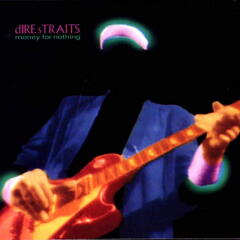
“Money for Nothing” was written by Mark Knopfler and Sting and appears as the second song on side one of Dire Straits’ fifth studio album, Brothers in Arms. Knopfler was inspired to write the song by comments from an employee at a New York City appliance store about an MTV video playing on one of the store’s television sets: “Money for nothing and chicks for free.” Sting makes an appearance on the song, singing “I want my MTV” to the melody of The Police’s “Don’t Stand So Close to Me.” Released as the second single from the LP in June 1985, it went to #1 on the Billboard Hot 100 Singles chart. It won the band a Grammy Award in 1986 and the Video of the Year Award at the third annual MTV Video Music Awards. Personnel on the record were: Mark Knopfler (lead vocals, guitar), John Illsley (bass, backing vocals), Guy Fletcher (synthesizer, Synclavier, keyboards), Alan Clark (Hammond organ), Terry Williams (drum intro), Omar Hakim (drums), and Sting (vocals).
Brothers in Arms was recorded at AIR Studios in Montserrat between October 1984 and February 1985, and produced by Mark Knopfler and Neil Dorfsman. The album was released in May 1985 and went to #1 on the Billboard 200 Albums chart, where it stayed for nine weeks. It has been certified 9X Platinum by the Recording Industry Association of America. Five singles were released from the LP.
Dire Straits was a British rock band formed in London in 1977 by Mark Knopfler, David Knopfler, John Illsley, and Pick Withers. They were active from 1977 to 1988 and again from 1991 to 1995. Twelve members passed through the band since their formation, with Mark Knopfler always at the helm. They released six studio albums, five live albums, three compilation albums, three EPs and 31 singles and have sold more than 100 million records worldwide. Dire Straits has won four Grammy Awards, three Brit Awards and two MTV Video Music Awards and are members of the Rock and Roll Hall of Fame. Mark Knopfler continues as a solo artist and retired from touring after a final concert at Madison Square Garden in September 2019. His latest album, One Deep River, was released in April 2024.
"About the Song" -- written by Mickey McMahan , RBN Director of Musicology




Comments
If the price for natural gas is negative, shouldn't the utiliy compaies be running their LEAST efficient plants?
In reply to Money For Nothing, Gas For Free - Negative Permian Prices a Posi by Mark Whitney
Yes, assuming some other physical limit doesn't prevent that from taking place.
Seems like article is missing a discussion of how added power burn would be used. Fuel switching, transport out of region, or added power sales in region or the like.
Jason,
With all the nat gas pipelines being built from the Permian to Mexico, Corpus and the Ship Channel areas, do you think we will be overbuilt at some time? What does pipeline capacity currently look like in the permian production and what will it look like in like 3 years time?
overbuilt?