Natural gas storage — especially well-sited storage with lightning-fast deliverability rates — is taking on a new significance (and value) as LNG export facilities and power generators seek to manage their often-volatile gas demand. But developing new gas storage capacity is costly and, with only a few exceptions, it’s hard to make an economic case for greenfield projects. That reality has spurred a lot of interest among midstream companies in acquiring existing storage assets and, where feasible, expanding that storage. In today’s RBN blog, we discuss one of the biggest storage-acquisition deals to date: Williams Companies’ recent purchase of six facilities with a combined working gas capacity of 115 Bcf in Louisiana and Mississippi. (It’s not all that Williams has been up to on the gas-storage front.)
As we said in our Squeeze Box series last year, storage has long been a critically important balancing mechanism in the Lower 48 natural gas market. In the Pre-Shale Era and the early days of the Shale Revolution, the storage market was driven primarily by the intrinsic value of capacity — i.e., the need to sock away gas in the lower-demand summer months for use in the peak winter months. More recently, the value of storage is being driven almost exclusively by extrinsic economics — i.e., how flexible and responsive capacity allows market participants to manage supply and demand during short-term market swings. This flexibility and responsiveness have become more important criteria for ensuring reliability as LNG export terminals and an increasingly renewables-heavy power sector navigate frequent gas-demand fluctuations day to day — or even intraday — as well as high-stakes, extreme weather events like 2021’s Winter Storm Uri and the cold snap that gripped Texas in mid-January.

Take LNG export facilities. A number of factors can cause frequent and often-sizable swings in LNG feedgas deliveries: things like planned and unplanned pipeline or liquefaction-plant maintenance, intraday temperature fluctuations that can affect facility operations — even foggy weather that slows or stops marine traffic. As a result, operators often need to be able to call on incremental gas or inject volumes on short notice. Gas suppliers and pipelines can help manage the ups and downs, but they can’t always accommodate big swings in volumes equivalent to a large-scale liquefaction train. That’s where storage comes in.
In a similar vein, the increasing amount of variable-output renewable generating capacity that helps power the electric grid keeps the operators of gas-fired power plants on the edge of their seats — their facilities always need to be at the ready to either ramp up or ramp down their electric output to compensate for the ever-changing (and often unpredictable) output of wind farms and solar facilities. That means that generators often need reliable access to significant volumes of gas on very short notice. Again, nearby gas storage can provide a much-needed, much-welcomed assist.
With the heightened demand for flexible, responsive gas storage top of mind, Williams earlier this month closed on the $1.95 billion acquisition of a portfolio of six underground gas storage assets in Louisiana and Mississippi from an affiliate of Hartree Partners LP. The half-dozen storage facilities (green stars in Figure 1 below) have a total capacity of 115 Bcf and — just as important, and maybe more so — a combined injection rate of 5 Bcf/d and a combined withdrawal rate of 7.9 Bcf/d. Those “deliverability” numbers are extraordinarily high and therefore are of particular value to storage customers like LNG facilities and gas-fired power plants that need to either receive or send into storage large volumes of gas at the drop of a hat.
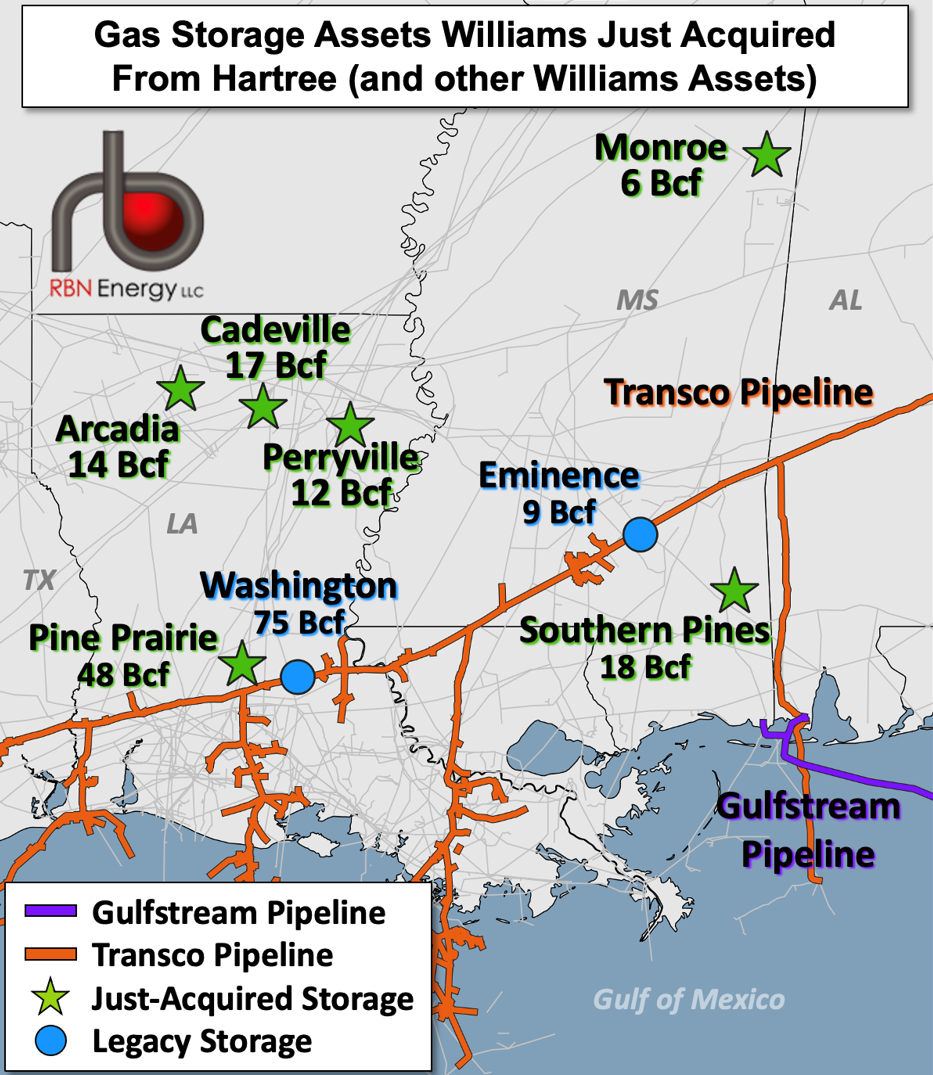
Figure 1. Gas Storage Assets Williams Just Acquired From Hartree (and Other Williams Assets). Source: RBN
About the song
“Smack Dab in the Middle” was written by Jesse Stone and appears as the first song on side one of Ry Cooder’s fifth studio album, Chicken Skin Music. The song is a jump blues tune celebrating being smack dab in the middle of the good life and partying down accordingly. It was originally recorded by its writer Jesse Stone and put out under his alias, Charlie Calhoun, in April 1955. It has also been covered by Ray Charles and The Mills Brothers. Stone’s best-known number is “Shake, Rattle and Roll,” which was a big hit for Big Joe Turner in April 1954. Stone was inducted into the Rock and Roll Hall of Fame in 2010. “Jesse Stone did more to develop the basic rock and roll sound than anybody else,” Atlantic Records President Ahmet Ertegun said. Cooder’s inclusion of the song on Chicken Skin Music is a reflection of his good taste in recording an array of often overlooked or forgotten songs that were crucial in the development of popular American music. Personnel on the record were: Ry Cooder (lead vocals, electric, slide guitars), Chris Ethridge (bass), Jim Keltner (drums), and Jimmy Adams, Terry Evans, Cliff Givens, Laurence Fishburne (backing vocals).
Chicken Skin Music was recorded during the summer of 1976 at Warner Bros. Recording Studios in North Hollywood and produced by Ry Cooder. In addition to Cooder’s unique tone and sound on stringed instruments, the album featured a mixed cast of super-talented musicians, including Milt Holland, Jim Keltner, Flaco Jimenez, Gabby Pahinui, and Pat Rizzo. Released in October 1976, the album went to #177 on the Billboard 200 Albums chart, Two singles were released from the LP.
Ry Cooder is an American musician, songwriter, film score composer, record producer, and author. He is known for his slide guitar work and collaborations with musicians from many different countries. Cooder started his professional career in 1965 when he was 17 as guitarist in the L.A. blues-rock band Rising Sons, which also included Taj Mahal. He has released 17 studio albums, four compilation albums, and 10 singles. He was the producer on the award-winning Buena Vista Social Club album, featuring traditional Cuban musicians, and recorded at Havana's EGREM studios in 1996. The album sold over 8 million records worldwide and has been certified Platinum by the Recording Industry Association of America. He has done collaborative albums with a wide range of musicians throughout his career. Cooder continues to record and tour.