In recent weeks, more than 750 Mb/d of new crude oil pipeline capacity out of the Permian Basin has been announced, and more project plans are likely. For Permian producers and shippers, open seasons for takeaway projects now rival Christmas and New Year’s Eve as big winter events, and companies are evaluating these projects and their implications for the basin. This is a big deal. With Permian crude production rising quickly, the pace at which new takeaway capacity is added — and the markets that the new capacity accesses — are all-important factors. Today, we discuss the dynamics of how and when this next wave of pipeline projects will affect producers, midstreamers and ultimately crude prices.
As we reviewed in our Permian Drill Down Reports and in Part 1 of this series, a number of new takeaway options and pipeline expansions have been announced as midstreamers look to capture West Texas market share. In 2017, over 3 MMb/d of new pipeline takeaway capacity has either held an open season or been announced for future development. These projects, along with a multitude of new gathering and shuttle systems, are being developed to address a growing demand for crude oil takeaway capacity. It is now less a question of if, but when these new outlets will come online. That timing issue is going to become increasingly important as Permian producers risk being caught with constrained barrels and pipeline companies angle to keep their systems full. If too little takeaway comes online, increased production would fill area pipelines to capacity and producers would take a pricing hit as they struggle to get their barrels to market. If too much capacity is added too soon, legacy pipeline companies would be forced to fight for barrels by heavily discounting their tariff rates as they battle to retain shippers amid new competition — pricing their transportation at razor-thin margins to keep their lines as full as possible.
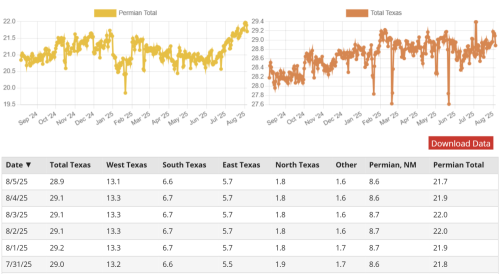
The NATGAS Production Tracker - Texas provides a DAILY update of natural gas production in Texas the New Mexico side of the Permian Basin. Quickly and easily view today’s supplies in the Lone Star state and download the full historical table when you need it.
To better understand what’s been happening, let’s first look at the Permian takeaway projects we expect to have an impact in the next few months:
- Enterprise Products Partners’ Midland-to-Sealy Pipeline began deliveries this month (December 2017) and is expected to flow at its full capacity of 450 Mb/d by the end of the second quarter of 2018. As the name reveals, this line runs from Midland, TX (in the heart of the Permian’s Midland Basin) to Sealy, TX, where it connects with Enterprise’s existing Rancho II pipeline for deliveries to Houston.
- Energy Transfer Partners’ Permian Express III Phase 1 expansion is expected to come online by early 2018, according to the company’s most recent investor presentation. The Phase 1 project completed a successful open season and will expand the existing Permian Express infrastructure by 100 Mb/d for Midland deliveries to Nederland, TX.
- EPIC Pipeline announced December 21 that it has completed a successful open season for its 550 Mb/d crude oil pipeline, which will carry volume from origination points in the Permian and Eagle Ford to Corpus Christi. The line will be completed in conjunction with EPIC’s planned Y-Grade NGL pipeline along the same general route and is slated for an in-service date of first-quarter 2019.
About the song
"Help On The Way” first appeared on the Grateful Dead's Blues For Allah album, which was released in September 1975. The song was written by band members Jerry Garcia, Keith Godchaux, Bill Kreutzman and Phil Lesh and band lyricist Robert Hunter. The songs on Blues for Allah evolved from jams the band did in the studio. "Help On The Way” was part of those jams, and it soon became a regular part of the Dead’s live set, opening the trilogy/suite of songs that also included "Slipknot" and "Franklin's Tower." The Grateful Dead was formed in Palo Alto, CA, in 1965, and broke up after Garcia's death in 1995. Various forms of offshoot bands with former members continue to record and perform to this day.