Last week Transport Canada (the federal department responsible for transportation policy) directed that DOT-111 rail tank cars built prior to new safety standards proposed in January 2014 be phased out or refitted within three years. Fifty five thousand railcars built to the new standards are currently on back-order. The directive could constrain rapidly developing Canadian crude by rail shipments to the US - currently running at about 250 Mb/d according to an April report by Peters and Company. Increased use of crude-by-rail is driven by pipeline congestion out of Alberta - a situation the latest Keystone pipeline delay appears to make worse. Today we review unit train options out of Western Canada.
The last episode in this series distinguished between oil sands producers that are able to deliver their bitumen crude to market direct from the production plant as pipeline quality dilbit via feeder pipelines and smaller producers that mostly do not have that luxury (see Keystone Kops Chase Oil Onto Trains – Challenges for Smaller Oil Sands Producers). We pointed out that it is often more convenient for small producers to deliver their crude by truck to rail terminals because of the overhead costs associated with blending up their crude to pipeline specifications and securing scarce capacity on pipelines out of Alberta. However, we also noted that such small producers are unable to justify shipping their crude on unit trains of 100 cars or more even though doing so would achieve economies of scale. Until these smaller producers are able to ramp up production and invest in improved infrastructure, they are essentially price takers. This time we look at increased unit train options available to larger producers.
At the start of this year prospects for larger Canadian oil sands producers to ship their crude by rail looked brighter because of the spate of new unit train terminals being developed at Edmonton, Hardisty and Kerrobert that we summarize below. However, building these terminals has not been without challenges and there have been delays and cost overruns caused by winter weather and a drastic shortage of labor in Alberta. So although operators expect over 1 MMb/d of rail loading capacity online at the end of 2014 that goal could be overly optimistic. In the meantime the economies of scale promised for unit train shipments will be reduced by the latest rail tank car regulations that at very least will increase lease rates for newer models and at worst will delay shipments due to a shortage of qualified railcars. And as we discuss here, unit trains continue to incur a diluent penalty (the cost of diluting heavy crude to flow in pipelines) because new terminals are mostly loading from pipeline gathering systems. However, given the continued pipeline take-away congestion, producers have little option but to keep moving forward with increased rail shipments.
Unlike the smaller oil sands producers who have not had access to pipeline infrastructure – because their output volumes are low or the overhead costs too high - larger producers have invested in pipeline infrastructure or secured capacity on existing feeder pipelines to ship their crude from the oil sands regions to terminals at the origin of the main pipeline systems out of Western Canada (see Storing Crude Oil in Harmony). Once crude arrives at these terminals it typically flows to main pipelines out of Alberta but there are a growing number of large unit train rail terminals that offer an alternative route to market. Last year we surveyed rail terminals in Edmonton, Hardisty and Kerrobert (see Go Your Own Way – Alberta Rail Terminals Part 1 and Part 2 as well as our Edmonton and Hardisty series covering Edmonton, Hardisty and Kerrobert terminal expansions). Despite many delays, these terminals are finally starting to come online. The following is a catch-up summary of the larger terminals that have or will have unit train capacity:
- Canexus Bruderheim: Part of the Canexus North American Terminal Operation (NATO), the Bruderheim unit train rail terminal, located north of Edmonton, connected to a MEG energy feeder pipeline from that company’s 900 MBbl Stonefell storage terminal, came online in December 2013. The terminal can load up to 50 Mb/d today – expanding to 100 Mb/d by the end of 2014 with the addition of volumes from Cenovus Cold Lake bitumen production. Bruderheim is connected to both Canadian National (CN) and Canadian Pacific (CP) railroads. Initial shipments are pipeline quality dilbit but Canexus is building a diluent recovery unit (DRU – more on these in a minute) that will come online in late 2015. The terminal’s start up date has been delayed and there have been cost overruns. Canexus will shut Bruderheim down for 90 days from June 2014 to finish loading expansion work.
- Kinder Morgan/Keyera Edmonton: The rail load facility known as the Alberta Crude Terminal is a 50/50 joint venture between Keyera and Kinder Morgan connected by pipeline to Keyera’s existing diluent terminal and Kinder Morgan’s North Edmonton storage terminal. The unit train facility is expected online in the second quarter of 2014 with an initial throughput of 40 Mb/d of dilbit crude underpinned by anchor shipper Irving Oil. The rail load terminal is connected to CN and CP railroads and is expandable to 165 Mb/d.
- Kinder Morgan/Imperial Edmonton: This unit train load facility will be connected by pipeline to the Kinder Morgan Edmonton storage terminal and Imperial’s refinery in Edmonton. The rail terminal will be able to load 100 Mb/d of pipeline quality dilbit and is expected online in December 2014. Imperial is the anchor shipper.
- Gibson/Statoil Edmonton: Gibson Energy is developing this unit train rail load facility for Statoil at its existing Edmonton terminal to be connected to a new 300 Mb/d Statoil storage tank and feeder pipelines. Expected online in 2015 with 60 Mb/d capacity to load dilbit crude.
- Gibson/US Development Hardisty: The terminal is being built by US Development Group about 3 miles from Gibson’s Hardisty East terminal with pipeline connections. The unit train facility will have capacity to load up to 120 Mb/d of dilbit or other pipeline quality crude and is expected in service by mid-2014 several months later than originally expected.
Torq Transloading Kerrobert: This is a unit train loading terminal at Kerrobert in Southwest Saskatchewan able to load up to 168 Mb/d of heavy oil and conventional crude. Torq will connect the terminal to area feeder pipelines and it will have a truck loading facility with heated tanks for railbit crude. The terminal is expected online in the third quarter of 2014 – again later than originally anticipated.
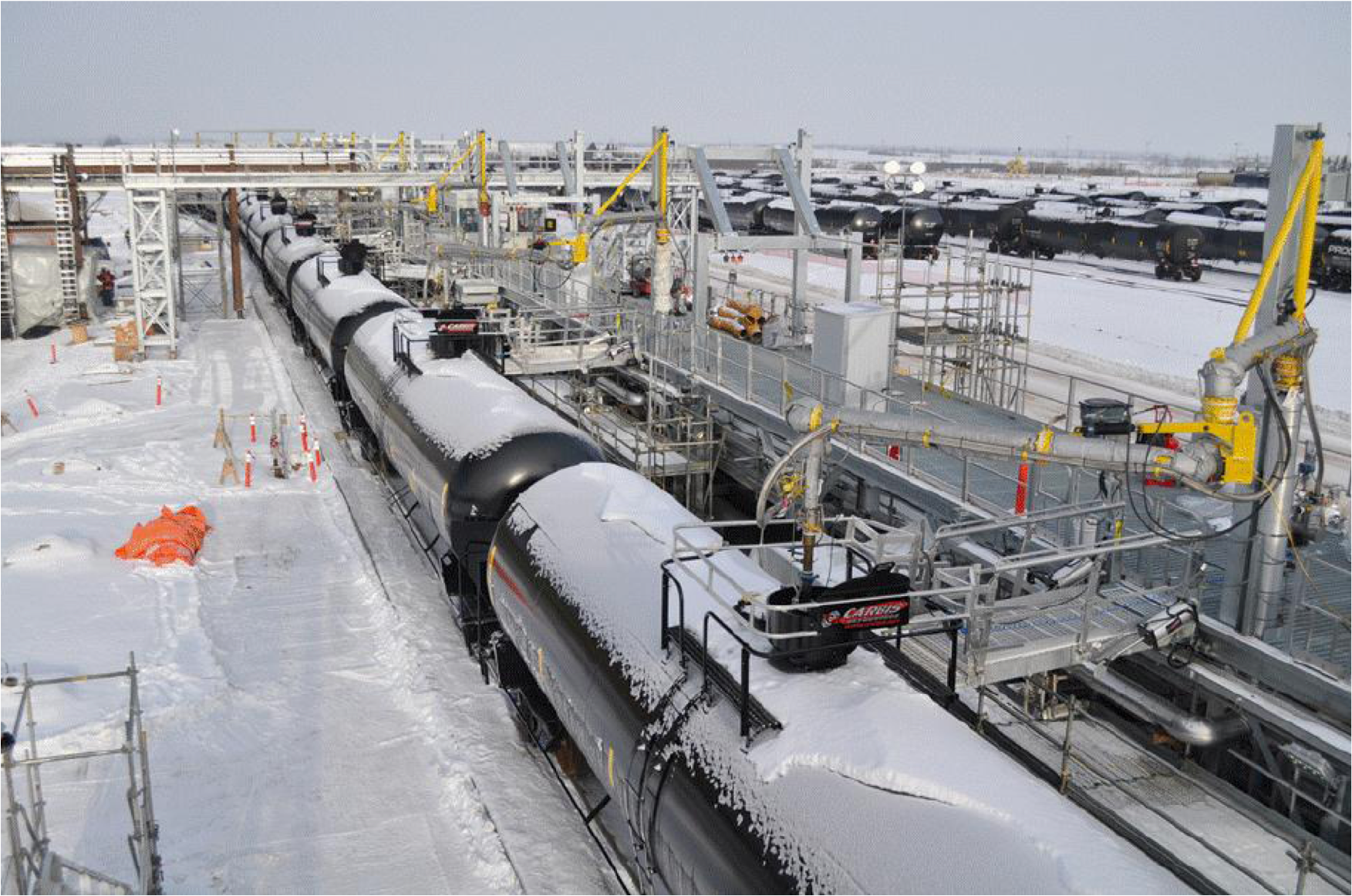
Canexus Bruderheim NATO Terminal (Source: Canexus)