The development of Appalachia’s Marcellus and Utica shales has flipped regional natural gas prices in the U.S. Northeast from their long-time premiums to Henry Hub, to trading at a significant discount and, in the process, reversed inbound gas flows, including from Eastern Canada. But there is an exception: from an entry point at the northern edge of New York, the Iroquois Gas Transmission pipeline is still importing Canadian gas supply nearly year-round to help meet local demand, despite its proximity to Marcellus/Utica production via other Northeast pipelines. This has kept prices along the Iroquois pipeline system at a premium to the other points in the region. And with the new, 1,100-MW Cricket Valley Energy Center power plant due online this spring, Iroquois prices are likely to strengthen. Today, we examine the dynamics driving Iroquois prices and gas flows.
Natural gas pricing is not uniform across the Northeast; the magnitude of the discount varies with how constrained the local pipe is and the location of the pricing point relative to the constraints. But in general, from eastern Ohio and Pennsylvania up through New England, prices tied to robust Marcellus/Utica shale production have traded at a significant discount to Henry Hub ever since Appalachian gas production surpassed Northeast demand and the region became a net supplier to the Midwest and Gulf Coast regions in the mid-2010s. Of course, during extreme wintry weather, prices in the East Coast market area, particularly New York and New England, are prone to spikes, where they jump not only above Henry Hub, but above all global gas prices or even above an oil parity price. These markets have maintained discounts to Henry on most days, however — that is, except for points along the Iroquois pipeline, which, because of the system’s reliance on gas imports from Canada, have escaped the worst of the discounted pricing and trade above the rest of the region year-round.

Visualize the infrastructure behind U.S. NGL movement.
The U.S. NGLs Map provides a comprehensive view of the transport, processing, and export networks moving NGLs across the U.S.
The Iroquois system (green line in Figure 1) is a 414-mile natural gas pipeline, built in 1985, that runs from the New York-Canada border at Waddington, NY (green pentagon), south and east through New York and southwestern Connecticut, then under Long Island Sound to termination points on Long Island and in the Bronx — New York City’s northernmost borough. Iroquois serves demand along the way in both New York and Connecticut, and also interconnects with other Northeast-area pipes, including Dominion Pipeline, Tennessee Gas Pipeline and Algonquin Gas Transmission. Before the Shale Era, gas flowed from TC Energy’s Canadian Mainline through Waddington to Iroquois, where it could be used to serve demand off the Iroquois system or flow through to other Northeast pipes. Despite the prolific supply growth in the region since then — and although flows from Canada have lessened somewhat over the past few years — that is largely how Iroquois still operates. Its connections with the other Northeast pipelines are mostly bidirectional, and whether Iroquois is a net-receiver of Marcellus/Utica gas or a net-deliverer of Canadian gas fluctuates day to day and throughout the year.
About the song
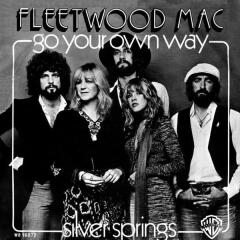
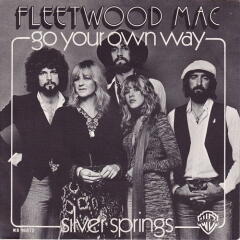
“Go Your Own Way” was written by Lindsey Buckingham and was the fifth cut on side one of Fleetwood Mac’s 11th studio album, Rumours. Released in December 1976 as the first single from the upcoming Rumours album, the song went to #10 on the Billboard Hot 100 Singles chart and became Fleetwood Mac’s first Top 10 single in the U.S. Buckingham wrote the song about his breakup with longtime girlfriend and Fleetwood Mac vocalist Stevie Nicks. Buckingham had drummer Mick Fleetwood go for the unusual drum groove that Rolling Stones drummer Charlie Watts had on their song “Street Fighting Man” for “Go Your Own Way.” Buckingham's guitar solo was pieced together from six different takes by producer Ken Caillat. Personnel on the record were: Lindsey Buckingham (lead and backing vocals, electric and acoustic guitars), Mick Fleetwood (drums, maracas), John McVie (bass), Christine McVie (Hammond organ, backing vocals) and Stevie Nicks (backing vocals).
Rumours was recorded between February and August 1976 at The Record Plant in Sausalito, CA; Wally Heider Studios in Los Angeles; and Criteria Studios in Miami. It was produced by Fleetwood Mac, Richard Dashut and Ken Caillat. The album was released in February 1977 and went to #1 on the Billboard Top 200 Albums chart. It has been certified 2x Diamond by the Recording Industry Association of America and has sold more than 50 million copies worldwide. It won a Grammy Award for Best Album of the Year in 1978.
Fleetwood Mac is an English-American rock band originally formed in London in 1967. Starting out as a British Blues band, there have been three different versions of the band over the years, with 18 different members passing through its ranks. The band has released 18 studio albums, nine live albums, 23 compilation albums, one EP and 62 singles. They have won four American Music Awards, two Brit Awards and three Grammy Awards, and were inducted into the Rock and Roll Hall of Fame in 1998. The band last toured in 2019 with long-time members Mick Fleetwood, Christine McVie, and Stevie Nicks. They were joined for the tour by Neil Finn (Crowded House) and Mike Campbell (Tom Petty and the Heartbreakers, Dirty Knobs). After the death of Christine McVie in November 2022, the band’s future is unknown.