U.S. propane production from natural gas processing has doubled over the past five years, but domestic demand has hardly moved the needle. So the only way the propane market has balanced is through exports, and it is no overstatement to say that the ship has really come in for U.S. propane exporters. All those exports have also helped support the U.S. propane market, holding inventories down to about where they were last year, and supporting propane prices at about 43% of crude oil versus 35% this time last August. But it looks like the market may be shifting, possibly pulling some of the export safety net out from under the market. That’s because the economics from exports are looking pretty dismal –– so bad, in fact, that cargos are being cancelled right and left. Today, we examine the market for propane exports, why the market is changing now, and what it means for propane over the next few months.
Propane exports have been a frequent topic here in the RBN blogosphere. Back in 2012 we posted Exports Prescribed For Propane Relief. In 2013, we covered export volumes beginning to surge in She Don’t Lie, She Don’t Lie, Propane. Exports Take Off! and in 2014 we highlighted propane export volumes as they escalated further in Sail Away – Propane Exports Exceed 400 Mb/D For The First Time. Then, earlier this year in Spinning Wheel, we talked about the possibility that propane exports may be headed back down in a couple of years as propane’s use in ethylene steam crackers and propane dehydrogenation (PDH) plants ramps up. We remain convinced that Gulf Coast exports will stay at historically strong levels until petrochemical demand (and growth in East Coast propane exports) take some barrels out of the market, but it is also clear that export volumes have the potential to swing widely between now and then, depending on the price spread – the arbitrage value – between U.S. propane markets and those in Asia and Europe. That is what is going on right now.
For the second month in a row, total U.S. exports of liquefied petroleum gas (LPG- propane and some butane) were down in July and are likely headed lower still in August. As shown in Figure 1 (green dashed oval), LPG exports averaged 887 Mb/d in June and 760 Mb/d in July, compared to 968 Mb/d in May. Over the May-to-July period, Gulf Coast exports were off 23% (887 Mb/d to 681 Mb/d, red dashed oval) while East Coast exports were down 25% (60 Mb/d to 45 Mb/d, blue dashed oval). The only bright spot for exports was Ferndale (WA) on the West Coast, where LPG exports to Asia have held up above 30 Mb/d for the past four months.
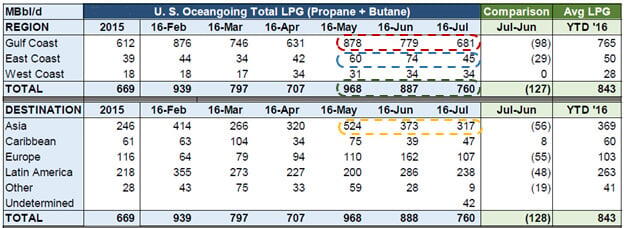
Figure 1- U.S. LPG Exports; Source: RBN’s NGL Voyager Report
On a volumetric basis, most of the recent decline in LPG export volumes was tied to Asia, where total LPG imports from the U.S. were down nearly 40%, from 524 Mb/d in May to 317 Mb/d in July (yellow oval, Figure 1). In fact, almost all of the decline 90%) was propane, and the biggest piece of that (70%) came out of propane sourced from Enterprise, destined for Asia.
How do we know those details? We know such things because RBN tracks all LPG and ethane ships departing the U.S. for anywhere in the world in our new NGL Voyager report that we publish twice each month. For more information, see below.

About the song
“When My Ship Comes In” was recorded by Clint Black in 1992 for his album The Hard Way and was released in January 1993. That year the song hit #1 on the country charts.