
Condensates are quirky as heck — everyone’s got his or her own definition of what they are, for one thing — and their very quirkiness has sent condensates on a wild ride during the Shale Era. For example, the U.S. government for years categorized “conde” as a very light crude oil, and the long-standing ban on most crude exports meant you couldn’t export the stuff to anywhere but Canada. Unless, that is, you ran conde through a splitter to make NGLs, naphthas, and kerosene — those are petroleum products and they could (and still can) be exported, no questions asked. Then, as condensate production started soaring, especially in the Eagle Ford, the feds said that if you “processed” conde in special equipment to make it less volatile you could export it — no splitting required. That made the folks who invested in splitters shout in unison, “Huh?!” The roller-coaster for conde didn’t end there. The U.S. soon lifted the ban on all crude exports, and suddenly you didn’t need to process condensate at all to export it. More upheaval ensued. Today, we discuss this peculiar grouping of hydrocarbons.
This blog is based on one of the nearly 40 presentations at RBN’s Fall 2020 School of Energy Virtual last month. All of the videotaped presentations and their slide decks are now available for purchase; click here for more information about School of Energy Encore.
Condensates don’t fit into any neat category. They can be an ultralight crude oil, or an NGL. They can be dark, clear, or in-between. And they can go by any number of names. But there are some commonalities to them as well, such as they are all mixtures of light hydrocarbons and they are all liquids at atmospheric pressure and temperature.

Canadian crude output is rising, requiring new export routes. As traditional pathways face constraints, the U.S. Rockies—especially the Guernsey, WY hub—are emerging as key corridors for moving Canadian heavy crude to downstream markets, including the Gulf Coast.
Rather than try to shoe-horn condensates into a tight, one-line definition, it might be best to describe them as a family of products alternatively known as “lease condensate” or “field condensate” or “raw condensate” when produced at the wellhead … OR natural gasoline, pentanes-plus or “plant condensate” when produced at natural gas processing plants … OR “drip gas” when liquids settle in natural gas pipelines … OR some refinery naphthas when they are traded in global markets. The complications don’t end there. Natural gas processing plants produce natural gasoline, but natural gasoline is also called condensate by much of the world, including the Canadian market. That same product is also called pentanes-plus, or C5+, because it has five or more carbon atoms per molecule. And condensates are sometimes called crude oil. In fact, most of the field condensate produced in the U.S. ends up being called crude oil in EIA (Energy Information Administration) production statistics and by many of the companies that produce condensates. (An aside: financial markets like it better when a producer calls it oil, versus calling it condensate, because oil usually gets a better price — even if the condensate itself does not get a better price.)
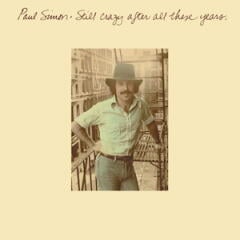
About the song
"Still Crazy After All These Years" was written by Paul Simon, and appears as the first song on Simon's fifth studio album of the same name. Released as the third and final single from the album in March 1976, it went to #5 on the Billboard Easy Listening chart, and #40 on the Billboard Hot 100 Singles chart. Ray Charles, Rosemary Clooney, Karen Carpenter, and Willie Nelson have covered the song. Personnel on the record were: Paul Simon (lead vocals), Michael Brecker (tenor sax), Barry Beckett (Fender Rhodes electric piano), Roger Hawkins (drums), David Hood (bass), and Hubert Laws (flute).
The album Still Crazy After All These Years was produced by Paul Simon and Phil Ramone at A&R Recording in New York City. Released in October 1975, it went to #1 on the Billboard Top 200 Albums chart and has been certified Gold by the Recording Industry Association of America. Three singles were released from the LP.
Paul Simon is an American singer, songwriter, musician, and actor whose career has spanned over six decades. He first reached fame and commercial success as half of the pop duo Simon & Garfunkel, which he started with Art Garfunkel in 1956, when they were known as Tom & Jerry. After releasing five successful studio albums, Simon & Garfunkel split up in 1970, and Simon began a solo career. As a solo artist, he has released 14 studio albums, four live albums, 11 compilation albums, and 61 singles. He has won one Brit Award, and four Grammy Awards, as well as the Library of Congress Gershwin Award, MusiCares Person of the Year, and a Kennedy Center Honor. Simon is a member of the Rock and Roll Hall of Fame as one half of Simon & Garfunkel, and as a solo artist. He announced his retirement from touring in 2018; he still records, though, and his latest album was In the Blue Light, which was released in September 2018. Now 79 years old, Simon resides in New York City with his family.