


US waterborne exports of propane, normal butane and isobutane – known collectively as liquefied petroleum gases or LPGs - are growing rapidly – up from 148 Mb/d in 2011 to 316 Mb/d in 2013. RBN expect these volumes to continue growing from 466 Mb/d this year to 825 Mb/d in 2018 as LPG production from gas plant processing increases more rapidly than domestic demand. The two largest export terminals operated by Enterprise and Targa will add 400 Mb/d of capacity between 2013 and 2018 and as many as 8 more terminals could be built. Today we begin a deep dive series into LPG shipping.
The LPG Rosetta Stone
We begin our odyssey with a primer on the weights and measures used in international waters. From the US perspective, understanding the international trade in LPG’s requires coming to grips with unfamiliar terminology used to measure quantities, prices and shipping volumes. In this country we keep track of propane and butane quantities in units of volume the same way we do crude oil - in barrels containing 42 gallons. Those units of volume are measured at a standard temperature of 60 degrees Fahrenheit – don’t forget that volumes expand or contract as the temperature changes. Convention in the US is to keep track of movements in thousands or millions of barrels per day (MMb/d). Prices are quoted and traded in cents per gallon (Cnts/Gal). To help foreign adventurers understand how these measures change once LPG volumes cross the terminal dock onto vessels bound for overseas ports, we have created a handy Rosetta Stone (see Figure 1).
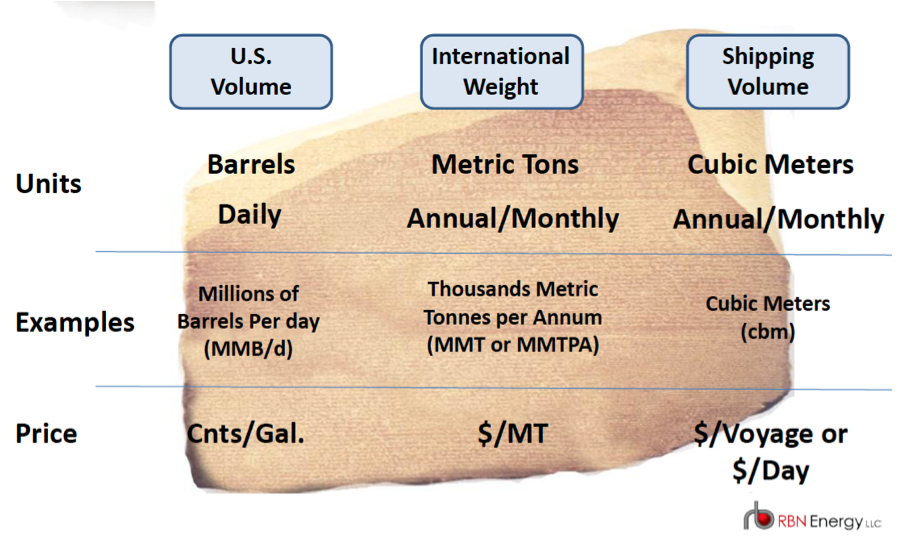
Figure 1
Source: RBN ENergy (Click to Enlarge)
In international markets natural gas liquids and refined products are measured and traded in units of weight (although crude oil is universally measured in barrels – a unit of volume). The good thing about units of weight is that they are absolute – there is no need to worry about standard temperatures until you convert back to volume. The principal unit of weight used for internationally traded LPGs is the Metric Ton (MT). The spelling tonne is used interchangeably with ton but the important distinction to be aware of is the one between metric tons (that contain 2204 lbs) and other variations on the ton such as long tons (a UK measure containing 2240 lbs) and short tons (a US measure containing exactly 2000 lbs). When quoting quantities of metric tons shipped abroad over time it is customary in international markets to do so per month or year - as in thousand metric tonnes per annum (MMTPA) - rather than the US convention of quantity per days – as in barrels per day (b/d). Thankfully for those looking after the nickels and dimes, US financial power crosses international boundaries – requiring hapless foreigners to carry out their trades in US currency – as in US $/MT (no bitcoin yet).

About the song
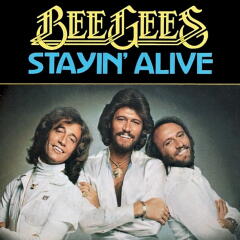
"Stayin' Alive was written by Barry, Robin, and Maurice Gibb, and appears as the first song on side one of the soundtrack album, Saturday Night Fever, featuring the Bee Gees. Recorded at Château d'Hérouville in Hérouville, France, and Criteria Studios in Miami, the song was produced by the Bee Gees, with Albhy Galuten and Karl Richardson. Released as a single in December 1977, it went to #1 on the Billboard Hot 100 Singles chart. It has been certified 3x Platinum by the Recording Industry Association of America (RIAA). Personnel on the record were: Barry Gibb (lead, harmony vocals, rhythm guitar), Robin Gibb (harmony vocals), Maurice Gibb (harmony vocals, bass), Alan Kendall (lead guitar), Dennis Bryon (drum loops), Blue Weaver (keyboards, synthesizer), and Joe Lala (percussion).
Saturday Night Fever is the soundtrack album from the hit 1977 movie of the same title, starring John Travolta and featuring music from the Bee Gees. It is the second best-selling soundtrack album of all time, with over 45 million copies sold worldwide (as a double-disc album). Recorded between 1975 and 1977 and released in November 1977, the LP went to #1 on the Billboard Top 200 Albums chart, where it stayed for 24 straight weeks. It has been certified 16x Platinum by the RIAA. Six singles were released from the album.
The Bee Gees were a pop music group formed in Australia in 1958. Consisting of brothers Barry, Robin, and Maurice Gibb, the group started out in the rock era of the mid ‘60s, then later migrated to the disco era of the late ‘70s. They released 22 studio albums, two live albums, four soundtrack albums, 15 compilation albums, and 83 singles. They have sold over 120 million records worldwide. They have won seven Grammy Awards, three American Music Awards, and one Brit Award. The Bee Gees are members of the Grammy Hall of Fame (with a Lifetime Achievement Award) and the Rock and Roll Hall of Fame. Maurice Gibb died in 2003 and Robin Gibb in 2012. Barry Gibb continues to record and occasionally tour as a solo artist.






Comments
Cities Service NGL had built an import terminal, for NGL, at Hackberry, LA in the early 1980's, for it's LLDPE Polyethylene plant adjacent to its Lake Charles refinery. Maximum sized vessel was 40,000 cubic meter, with storage in the Hackberry salt dome. These particular caverns were carved out by Olin and PPG for brine used in their chlor/alkalai plants.
When the plastics plant closed, the NGL division was sold to Occidental. Oxy turned the import terminal into an export terminal at a time when the dollar exchage rate was low and began exporting to markets in all the countries surrounding the Caribbean basin, even Venezuela. Due that NGL was not loaded in a liquid state and had a methane content often exceeding 4%, liquid LPG carriers had to use their onboard refrigeration compressors to turn the cargo into liquid. This took up to a week to load 2,000 - 3,000 tons of LPG. Oxy didn't mind paying the several days of demurrage. Liquid cargoes usually went to Venezuela.
There were a couple of ships owned by Tropigas International which had pressure LPG tanks and these loaded quickly. They usually went to Central American and Island ports.
That particular LPG terminal is now occupied by Sempra's Cameron LNG Terminal, built several years ago for imports of LNG and construction of liquefaction units for export of LNG about to begin.
LPG CARGO, LD PT TARGA GALENA PARK USG DIS PRT ARA/NWE. Laycan MCH 22-27, 80,000 CBM +- 5% MOLOO REDEL HOUSTON APR 28, $30,600/DAY.
Navigating the commodities markets with Freight and Spreads
Freight basis is rich +10500 over the March BALTIC T/C LPG INDEX 2014/03/07) Commodities Spreads justify the T/A ARB: FOB arnd $600/MT, LP NWE swap basis April $740/MTGross Profit over $ 4.5M (one cargo)
abnormal profit but no uncommon in the USG LP export business over the last 2 years:
massive growth in supply of LPG deriving from Wet Gas extraction.extreme bottleneckning of the LPG exports infrastructure in the Gulf. to continue in 2014 ??? very unlikely in my view.Simon