


Natural gas producers in the Canadian province of Alberta have had a heck of a time in recent years. Marcellus/Utica gas production has flooded markets in eastern Canada and the U.S. Northeast and Midwest, squeezing out Alberta gas in the process. Also, Alberta gas producers’ dreams of piping gas west to the British Columbia coast for export to Asia as LNG have been thwarted. Lucky for them, though, gas demand within Alberta is on the rise, thanks to increasing use of gas in the oil sands and a decision by the province’s largest power generator to shift from coal- to gas-fired generation and renewables. Today we update gas output and consumption trends in Canada’s Energy Province.
For the first time in memory, Alberta in 2016 consumed more than half of the natural gas produced within its borders, and the same holds true today. That’s really extraordinary when you consider that the Texas-size province is Canada’s largest energy producer and is home to only 4.1 million people—two-thirds as many as metropolitan Houston. Also, Alberta gas production is off sharply; it now averages only 10.4 billion cubic feet/day (Bcf/d), compared with more than 14 Bcf/d in 2006. What’s going on here?
The challenges faced by western Canadian gas producers are years in the making, and have been a frequent topic in the RBN blogosphere. In Stuck in the Middle, we discussed Alberta’s world-class gas reserves—hundreds of trillions of cubic feet, some accessible via conventional vertical wells and much more waiting to be freed via horizontal wells and hydraulic fracturing—and the fact that Alberta accounts for about two-thirds of Canada’s total gas production. Then, in One Way Or Another, we examined the game-changing impact that rising Marcellus/Utica gas production has had in eroding Alberta gas producers’ traditional markets in Ontario, Quebec and the U.S. Midwest and Northeast, and on the dimming prospects for piping large volumes of western Canadian gas to the British Columbia coast and exporting it as LNG.

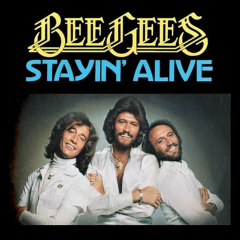
About the song
"Stayin' Alive was written by Barry, Robin, and Maurice Gibb, and appears as the first song on side one of the soundtrack album, Saturday Night Fever, featuring the Bee Gees. Recorded at Château d'Hérouville in Hérouville, France, and Criteria Studios in Miami, the song was produced by the Bee Gees, with Albhy Galuten and Karl Richardson. Released as a single in December 1977, it went to #1 on the Billboard Hot 100 Singles chart. It has been certified 3x Platinum by the Recording Industry Association of America (RIAA). Personnel on the record were: Barry Gibb (lead, harmony vocals, rhythm guitar), Robin Gibb (harmony vocals), Maurice Gibb (harmony vocals, bass), Alan Kendall (lead guitar), Dennis Bryon (drum loops), Blue Weaver (keyboards, synthesizer), and Joe Lala (percussion).
Saturday Night Fever is the soundtrack album from the hit 1977 movie of the same title, starring John Travolta and featuring music from the Bee Gees. It is the second best-selling soundtrack album of all time, with over 45 million copies sold worldwide (as a double-disc album). Recorded between 1975 and 1977 and released in November 1977, the LP went to #1 on the Billboard Top 200 Albums chart, where it stayed for 24 straight weeks. It has been certified 16x Platinum by the RIAA. Six singles were released from the album.
The Bee Gees were a pop music group formed in Australia in 1958. Consisting of brothers Barry, Robin, and Maurice Gibb, the group started out in the rock era of the mid ‘60s, then later migrated to the disco era of the late ‘70s. They released 22 studio albums, two live albums, four soundtrack albums, 15 compilation albums, and 83 singles. They have sold over 120 million records worldwide. They have won seven Grammy Awards, three American Music Awards, and one Brit Award. The Bee Gees are members of the Grammy Hall of Fame (with a Lifetime Achievement Award) and the Rock and Roll Hall of Fame. Maurice Gibb died in 2003 and Robin Gibb in 2012. Barry Gibb continues to record and occasionally tour as a solo artist.





Comments
"Alberta’s increasingly stranded gas "
This is an economic stranding, not a physical one. TransCanada is more than half empty going east, thus the proposal to convert to oil for Energy East, so this isn't a stranding in the traditional sense. The problem is that no one should be investing in production that far from markets when the investment can be made locally. And the industry understands that and is putting its money in the right place. The free markets are working as they should be.