Only 20 years after Colonel Edwin Drake drilled the first commercial oil well in Titusville, PA, in 1859, the U.S. was responsible for 85% of global crude oil production and refining. But over the next century, the country became increasingly dependent on oil imports — concerningly so at times. Thanks to the Shale Revolution, the U.S. is now on the verge of a sea change in the supply-and-demand dynamics for crude oil, gasoline, diesel, jet fuel and other petroleum products. In the coming years, as U.S. crude production continues to increase, essentially all incremental barrels will flow to export markets, possibly through one or more of the new offshore terminals under development off the U.S. Gulf Coast. Export growth — and the midstream infrastructure needed to facilitate it — was one of many topics covered at our recent xPortCon 2023 and the subject of today’s RBN blog, which also announces the availability of videos from last Thursday’s packed-to-the-gills conference.

At the time of our previous xPortCon, held all the way back in 2019, U.S. crude production had surged to nearly 12 MMb/d, oil exports had shot up to about 2.5 MMb/d and we were on the cusp of a huge increase in pipeline capacity out of the Permian Basin, with an additional 2.1 MMb/d headed to Corpus Christi, most of which was destined for export markets. But thanks to a series of unforeseen events — a global pandemic, the Russian invasion of Ukraine, inflation-fueled price spikes, and a newfound focus on capital discipline by E&Ps — things didn’t turn out the way we, or anyone else, expected. We thought U.S. production would be at 15 MMb/d by now, with exports at 5 MMb/d. Instead, production has only recently ticked up to 12.4 MMb/d (after getting to 13.1 MMb/d right before COVID), which is pretty close to where we were back in 2019.
But even though U.S. crude production dropped to around 11 MMb/d in the depths of COVID, the percentage of that crude sent out in the form of exports, which had steadily risen to 30% prior to the pandemic, only tapered off modestly, and never dipped much below the 3 MMb/d mark. Even with production just now catching up to 2019 levels, crude oil exports are up as a percentage of overall production. The U.S. now exports about one-third of its crude oil output — averaging 4.1 MMb/d over the past six months, in some weeks soaring past 40% of total production. Data from the Energy Information Administration (EIA) puts exports at 4.8 MMb/d in March and 4.0 MMb/d in April, with weekly volumes topping 5 MMb/d three times this year — including an all-time high of 5.6 MMb/d in February (see Figure 1 below). So far, crude exports are up 15% over the 2022 average, which was up more than 20% from the 2021 average.
About the song
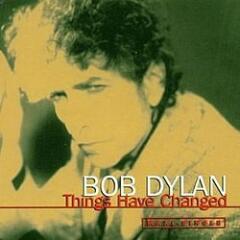
“Things Have Changed” was written, produced, and performed by Bob Dylan, and appears as the first track on the Wonder Boys (Music from the Motion Picture) soundtrack album. The song was recorded in July 1999, with Dylan’s touring band at the time backing him up. The session took place at Sony Studios in New York City. Two takes were recorded, with the second take being the one used on the album. According to Dylan drummer David Kemper, “In about five hours we learned the song, recorded it, and mixed it.” Personnel on the record were: Bob Dylan (vocals, piano), Charlie Sexton (guitar), Larry Campbell (guitar), Tony Garnier (bass) and David Kemper (drums). “Things Have Changed” was released as a single in May 2000 but failed to chart on the Billboard Hot 100. The song went on to win a Golden Globe Award for “Best Original Song” in 2000 and an Oscar at the 2001 Academy Awards, also for “Best Original Song.”
Wonder Boys (Music from the Motion Picture) was released in February 2000. “Things Have Changed” was the only single released from the album, which also contained three other Dylan songs. The album went to #155 on the Billboard Top 200 Albums chart. The soundtrack album also had contributions from Neil Young, Leonard Cohen and Clarence Carter, among others.
Bob Dylan is an American singer, songwriter, musician, actor, author, poet, painter and illustrator. He has been a popular culture icon in a career that has spanned more than six decades. He is considered by many to be the greatest songwriter of all time. He has released 40 studio albums, 16 live albums, 31 compilation albums, 24 EPs, seven soundtrack albums and 102 singles, and has sold more than 125 million records worldwide. He is a member of the Rock and Roll Hall of Fame and the Songwriters Hall of Fame and is a recipient of Kennedy Center Honors, a Presidential Medal of Freedom, a Polar Music Prize, France’s Legion d’Honneur, and a Nobel Prize in Literature. Dylan is also known for his paintings, drawings and books. His most recent book, “The Philosophy of Modern Song,” contains essays on 66 songs by artists who have influenced him. Dylan continues to record and tour and performed at the 40th annual Farm Aid benefit in Minnesota in September. He will be on tour in Europe in October and November.