If there’s one word that sums up the U.S. LNG export market over the past year, it’s resilience. After taking a pummeling last year, feedgas demand and exports have roared back, reaching new heights in recent weeks, and are headed still higher in the coming months as new liquefaction capacity is commissioned at a faster pace than expected. Train 3 at Cheniere Energy’s Corpus Christi LNG facility came online on March 26, increasing U.S. LNG export capacity to 75 MMtpa (~9.9 Bcf/d), which equates to a total feedgas demand of nearly 11 Bcf/d. Two more export projects — 18 modular trains at Venture Global’s new Calcasieu Pass facility and the sixth train at Cheniere’s existing Sabine Pass — are on track to ship their first commissioning cargoes later this year, ahead of their originally proposed construction schedules, and will be fully operational in 2022. This is quite a different picture from last year, when nothing but uncertainty loomed on the horizon in a COVID-hit world and progress for just about every project was in jeopardy. Today, we start a short series providing an update on the status of operational and under-construction export capacity and where LNG feedgas demand is headed this year.
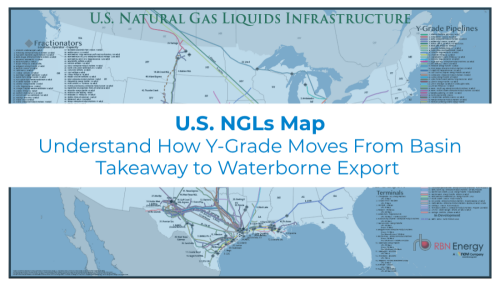
Visualize the infrastructure behind U.S. NGL movement.
The U.S. NGLs Map provides a comprehensive view of the transport, processing, and export networks moving NGLs across the U.S.
As we discussed recently in Wild Thing, feedgas demand and U.S. LNG production over the past year faced unprecedented volatility, first because of economically driven cargo cancellations due to COVID-19 and the subsequent crash in prices globally (see Break It to Me Gently, Undone and LNG Interruption for more). Then, later last year, just as global demand and prices were rising again, a record-setting hurricane season wreaked havoc on the operations of Gulf Coast LNG terminals, particularly in Louisiana, hampering exports (see You Spin Me Round). Feedgas consumption recovered by winter, but the Gulf Coast terminals continued to see intermittent disruptions, even as global prices and demand remained strong. Earlier this year, we saw a slowdown in exports, albeit relatively modest, stemming from constraints on passage through the Panama Canal, which in turn led to voyage delays and a vessel shortage. Then came Winter Storm Uri, which created a severe gas shortage in Texas and curtailed production as export facilities sent gas back into the market to help meet domestic demand (see Feed Me). That was followed by a period of foggy conditions along the Gulf Coast that intermittently interrupted marine traffic. However, as the weather turned warmer, most facilities returned to full operating capacity and feedgas demand rebounded. Feedgas consumption averaged about 10.9 Bcf/d in the second half of March (orange line in Figure 1) after peaking above 11 Bcf/d on multiple days and breaking the single-day record three times as Corpus Christi Train 3 reached the final days of its commissioning and entered service on March 26. In the first few days of April, feedgas volumes have continued to top 11 Bcf/d.
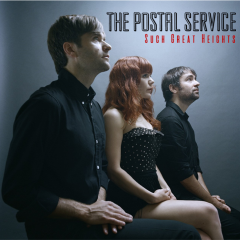
About the song
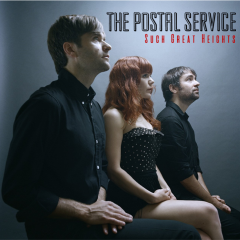
“Such Great Heights” was written by Ben Gibbard and Jimmy Tamborello, and appears as the second song on The Postal Service's debut album, Give Up. Released as the first single in January 2003, the song went to #21 on the Billboard Hot 100 Singles chart. It has been certified Gold by the Recording Industry Association of America (RIAA). Many artists have covered the song, and it has appeared in several television commercials. Personnel on the record were: Ben Gibbard (lead vocals, guitar, keyboards), Jimmy Tamborello (keyboards, synthesizers, electronic drums, programming), and Jen Wood (backing vocals).
Give Up was recorded between 2001 and 2002 at Dying Songs in Los Angeles and Computerworld in Seattle. The album was produced by The Postal Service and released in February 2003. It has remained the only studio album from the partnership of Gibbard and Tamborello. The LP went to #1 on the Billboard Top Dance/Electronic Albums and Heatseekers charts. It also reached #3 on the Billboard Independent Albums chart and #45 on the Billboard Top 200 Albums chart. It has been certified Platinum by the RIAA. Three singles were released from the LP.
The Postal Service was an American indie-pop group from Seattle consisting of singer Ben Gibbard, producer Jimmy Tamborello, and singer Jenny Lewis. Formed in 2001, the band remained inactive from 2005 until 2013, when they reunited for a tour to celebrate the 10th anniversary of the release of their debut and only studio album. Gibbard is the front man of Death Cab for Cutie, and Tamborello (also known as "Dntel") is a musician/producer who is known for his work in glitch music and electronica. The group added Jenny Lewis to provide background vocals. They have released one studio album, one live album, and seven singles. In August 2013, Gibbard announced that the group was disbanding. Gibbard still plays in Death Cab for Cutie and performs in solo projects. Tamborello still performs as Dntel. Jenny Lewis performs as a solo artist.