U.S. LNG exports via Cheniere Energy’s Sabine Pass LNG export facility are poised to be a major demand driver of the domestic natural gas market in 2017. Pipeline deliveries to the terminal have more than tripled since mid-2016 and are set to climb further as more liquefaction capacity ramps up. With two liquefaction trains already operational, the Federal Energy Regulatory Commission last month approved Train 3 to begin operations and also green-lighted the start-up of Train 4 commissioning. Today, we provide an update of Sabine Pass’s export activity and its potential effect on U.S. gas demand this year.
Exports are a significant and growing driver of the U.S. natural gas supply/demand balance. As our analysis of gas supply and demand data a few weeks back in You Keep Me Hangin’ On showed, gas exports, including pipeline deliveries to Mexico and Cheniere Energy’s Sabine Pass LNG export facility, soaked up 4.2 Bcf/d of U.S. supplies in 2016, 1.3 Bcf/d (46%) more than in 2015. That incremental demand went a long way toward helping offset the effects of a mild winter (from November 2015 to March 2016) that had led the U.S. gas storage inventory to the highest March-ending level in more than five years. In fact, despite gas demand in the power sector setting records in most months in 2016, the biggest increase in demand in 2016 versus 2015 came from exports. For the full year on average, about 0.8 Bcf/d of the increase came from exports to Mexico and 0.5 Bcf/d from Sabine Pass LNG. But by the end of the year, LNG exports were nearly a third of all U.S. natural gas exports. More recently, they’ve grown to be more than 40% of total average U.S. gas exports. And that is the case in spite of exports to Mexico also growing substantially during the same period. As such, LNG exports are expected to be a major contributor to a tighter gas supply/demand balance this year versus 2016.
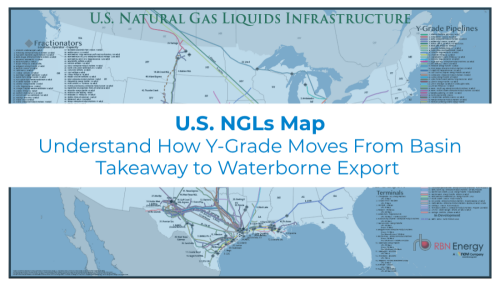
Visualize the infrastructure behind U.S. NGL movement.
The U.S. NGLs Map provides a comprehensive view of the transport, processing, and export networks moving NGLs across the U.S.
The Sabine Pass LNG export terminal is one of four brownfield projects currently targeting gas exports from the contiguous United States, and the first of those four to begin operations. The terminal—located on the Gulf Coast near the Texas-Louisiana border in Cameron Parish, LA—will ultimately include six liquefaction trains, each with the capacity to supercool up to 650 MMcf/d of natural gas, turning it into LNG. Sabine Pass eventually will have the capacity to produce 3.8 Bcf/d for loading and shipment overseas. The facility also has 17 Bcf of LNG storage capacity on site.
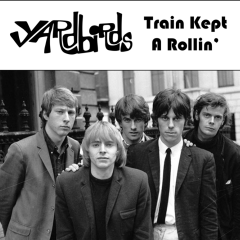
About the song
“Train Kept A-Rollin’” was written by Tiny Bradshaw, Howard Kay, and Lois Mann (Syd Nathan). It appears as the second song on side two of Aerosmith’s second studio album, Get Your Wings. The song is in two parts, the first is slower and funky, and the second is faster and made to appear as a live recording with crowd noises. Producer Jack Douglas used crowd noise and applause from a tape he had procured while working on the soundtrack album, The Concert for Bangladesh. An edited, shorter version of the song was released as a single in October 1974, but the longer, complete version got wings as a staple on FM radio with constant rotation in the 1970s. Steven Tyler’s band had opened for The Yardbirds in Westport, CT, in October 1966 and he was blown away by the heavy version of the song The Yardbirds did with Jimmy Page on guitar. The song would become a feature of Aerosmith concerts starting with their first show in 1970. Personnel on the record were: Steven Tyler (lead vocals), Joe Perry, Brad Whitford (rhythm guitar), Tom Hamilton (bass), Joey Kramer (drums), Steve Hunter (guitar solos, first half), and Dick Wagner (guitar solos, second half).
Guitarists Hunter and Wagner were working at an adjacent studio at the Record Plant in New York City when Aerosmith producer Jack Douglas invited them to play the solo sections on “Train Kept A-Rollin’.” The history of the song goes back to the original version by Tiny Bradshaw released as a single in December 1951. It was presented as a jump blues with lyrics based on “Cow-Cow Boogie,” a 1942 country blues song. The song was next released in July 1956 by Johnny Burnette and the Rock and Roll Trio, with session guitarist Grady Martin providing the distorted guitar riffs. The Yardbirds recorded their version in 1965, featuring Jeff Beck utilizing volume swells on his Fender Esquire guitar to simulate a train whistle, and taking his distorted guitar into the signature Yardbirds “rave-up” territory of extended jams. The Yardbirds, featuring both Jeff Beck and Jimmy Page on guitars, performed the song rewritten with new lyrics as “Stroll On” in Michelangelo Antonioni’s classic 1966 film, Blow-Up. In their performance in the movie, they appear at a facsimile of the London Ricky-Tick Club, where during the song, Beck smashes his guitar to pieces. There are no adequate words to describe the electricity and magic of those beginning notes of harmonic feedback from Beck and Page’s guitars at the start of the song in the film. On a side note, the 1959 Fender Telecaster that Page is playing in Blow-Up was a gift from Beck to Page. The guitar would later be known as “The Dragon” and was used on all of Led Zeppelin’s debut album. When Led Zeppelin first started doing live shows, “Train Kept A-Rollin’” was in their sets.