Crude oil inventory levels aren’t the only thing in a constant state of flux at the crude storage hub in Cushing, OK. A year ago, we blogged extensively about Cushing’s major players, storage assets and incoming and outgoing pipelines, as well as plans for new pipes that highlight the hub’s continued significance, even in an increasingly Permian- and Gulf Coast-focused energy sector. A lot has changed since then, though. Some pipeline projects into and out of Cushing have advanced to final investment decisions (FIDs), while others have floundered or foundered. Also, brand-new pipeline projects have been announced, as was a big acquisition that will make Energy Transfer a major player in Cushing storage. Today, we begin a short series on recent developments at the Oklahoma oil hub and how they reflect changes in the ever-evolving U.S. energy markets.

In the first episode of our eight-part Oklahoma Swing blog series in the summer and fall of 2018, we said that Cushing, a small town in central Oklahoma, fully deserved its nickname: “Pipeline Crossroads of the World.” With 94 MMbbl of crude oil tankage, 3.7 MMb/d of incoming pipeline capacity and 3.1 MMb/d of outbound pipes, Cushing has long played a crucial role in (1) receiving crude oil from an array of production areas, (2) storing and blending crude, and (3) distributing oil to Midcontinent, Midwest and Gulf Coast refineries — and, more recently, to export docks for loading onto ships. As a testament to its market significance, Cushing for the past 36 years has served as the delivery point for the CME/NYMEX futures contract for benchmark West Texas Intermediate (WTI) crude. In Part 3 and Part 4 of the Cushing series, we reviewed the existing pipelines into and out of the Oklahoma hub, and in Part 6 and Part 7, we looked at projects to either expand the capacity of existing pipes or build new, greenfield pipelines.
Today, we turn our attention to what’s transpired since last fall on the Cushing-related midstream development front. We’ll start with a look at new inbound pipeline capacity to the hub. The biggest news here was the June 2019 decision by Phillips 66 and Bridger Pipeline to proceed with the construction of the 24-inch-diameter Liberty Pipeline (dashed orange line in Figure 1) from the Bakken to the Rockies to Cushing. The capacity of the new, $1.6 billion pipeline, which is backed by long-term shipper commitments, has not been announced, and will depend on the outcome of a supplemental open season the co-developers posted in July, but it will likely be at least 300 Mb/d and perhaps 400 Mb/d or more. The new pipe is scheduled to come online in the first quarter of 2021.
About the song
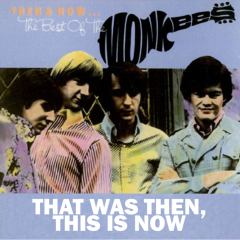
"That Was Then, This Is Now" was written by Vance Brescia. When Arista Record label head Clive Davis heard the song, he decided it would be the comeback single featured on the new Monkees hits collection, Time & Now...the Best of The Monkees, which would also coincide with the group’s 20th anniversary tour. The album, released in July 1986, included three new recordings from the band. "That Was Then, This Is Now" went to #20 on the Billboard Hot 100 chart. A video of the song received heavy rotation on MTV. Contemporary Christian musician Josh Wilson has a different song by the same title released in 2015.
The Monkees are an American pop rock band formed in 1966 for the television show The Monkees. The highly successful show ran from 1966 to 1968. The group has done sporadic tours since their official breakup in 1971, with various members participating. The Monkees have sold more than 75 million records worldwide. They have released 13 studio albums, eight live albums, 31 compilation albums, and 19 singles, and are members of the Pop Music Hall of Fame. Personnel in the band were: Micky Dolenz, Michael Nesmith, Peter Tork and Davy Jones. Davy Jones died in 2012, and Peter Tork in February 2019. Michael Nesmith and Micky Dolenz still tour together as The Mike and Micky Show.