After dodging the huge tariffs on exports of U.S. LPG and ethane to China — at least until August 12 — a new wrinkle has emerged. Enterprise Products Partners said in a filing May 29 that the U.S. Bureau of Industry and Security (BIS) has flagged its exports of butane and ethane to China as a security risk; specifically, that they pose an “unacceptable risk of use in or diversion to a military end use.” Details about the licenses and how they will apply are limited at this point, but it appears they will be required for these exports to continue. In today’s RBN blog, we examine the potential impact on the ethane and butane markets.
Visualize the infrastructure behind U.S. NGL movement.
The U.S. NGLs Map provides a comprehensive view of the transport, processing, and export networks moving NGLs across the U.S.
In its 8-K filing to the Securities and Exchange Commission (SEC), Enterprise indicated that it is unable to determine, as yet, whether it will be able to acquire such licenses for its exports in a reasonable amount of time, if at all. (An 8-K filing is a mandatory disclosure that public companies must file with the SEC to inform their shareholders and the public about major, unscheduled material events or corporate changes.) There has been no direct word from the other ethane exporter, Energy Transfer, nor exporters of butane, including Targa Resources and Phillips 66 (P66). However, it is reasonable to assume that they received similar letters from the BIS regarding their exports. The location of LPG (propane and butane) and ethane export terminals and the products they export are shown in Figure 1 below. (For more on U.S. LPG and ethane exports, see Hot To Go!)
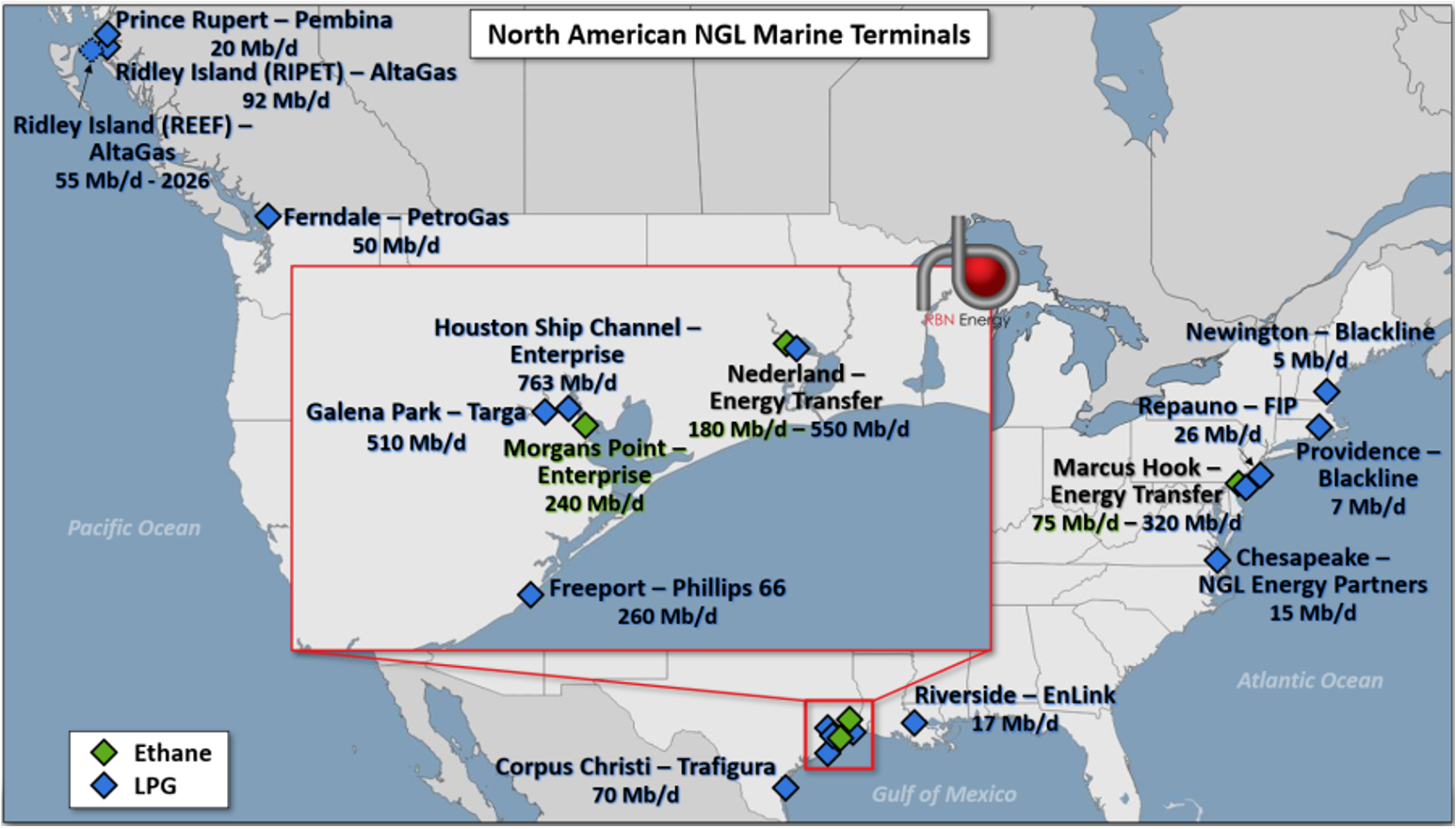
Figure 1. North American NGL Marine Terminals. Source: RBN
The BIS decision has the potential to ruin the U.S. ethane market and disrupt global flows. The U.S. is the sole source of long-distance ethane exports to China. In the short term, there are no markets that could replace China’s ethane imports nor are there markets that can take most of the U.S. ethane previously destined for China. The impact on the butane market is less severe, as only 5% of U.S. butane exports head to China and the smaller volume can easily be diverted to other countries. For example, butane that would typically head to China from the U.S. could instead be sent to India, and the volume destined for India from, say, the Middle East would then go to China.
About the song
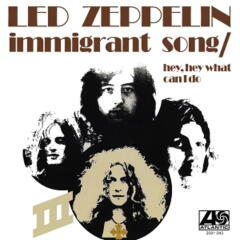
“Hey, Hey, What Can I Do” was written by John Bonham, John Paul Jones, Jimmy Page and Robert Plant. It appears as the B-side of the single “Immigrant Song,” which was the first song on side one of Led Zeppelin’s third studio album, Led Zeppelin III. The song was recorded at Headley Grange in Hampshire, England, during the sessions for Led Zeppelin III. It would later appear on The New Age of Atlantic in 1972, Led Zeppelin Box Set in 1990, The Complete Studio Records in 1993, and the Led Zeppelin Definitive Collection in 2008. “Immigrant Song” was released as a single in November 1970 and went to #16 on the Billboard Hot 100 Singles chart. Personnel on the record were: Robert Plant (vocals), Jimmy Page (acoustic six- and 12-string guitars), John Paul Jones (bass, mandolin) and John Bonham (drums).
Led Zeppelin III was recorded between November 1969 and August 1970 at Headley Grange in Hampshire, England, on the Rolling Stones Mobile Recording unit, and Island and Olympic studios in London. Jimmy Page and Robert Plant wrote most of the material for Led Zeppelin III at Bron-Yr-Ayr (hill of gold), an 18th-century cottage in Wales. Produced by Jimmy Page, it was released in October 1970 and went to #1 on the Billboard 200 Albums chart. It has been certified 6x Platinum by the Recording Industry Association of America. One single was released from the LP.
Led Zeppelin was an English rock band formed in London in 1968 by guitarist Jimmy Page, vocalist Robert Plant, bassist/keyboardist John Paul Jones and drummer John Bonham. They released nine studio albums, four live albums, 10 compilation albums and 19 singles. They have sold more than 300 million records worldwide. They are members of the Rock and Roll Hall of Fame, the UK Music Hall of Fame, have an Ivor Novello Lifetime Achievement Award, a Grammy Lifetime Achievement Award and are in the Grammy Hall of Fame. In 2012, they received Kennedy Center Honors. Page was awarded an OBE in 2005 and Plant was awarded a COBE in 2009. The band broke up in October 1980, following the death of drummer John Bonham. In 2007, the band reunited with Jason Bonham on drums for a concert at the O2 Arena in London. In February 2025, they released a biographical documentary, Becoming Led Zeppelin. John Bonham died in September 1980 in Berkshire, England, at 32. Jimmy Page, Robert Plant and John Paul Jones continue to work as solo and collaborative artists. Plant just finished a European tour with Alison Krauss. Page has two signature guitars issued by Fender and two by Gibson.