Week by week, more than 20 terminals along the U.S. Gulf Coast export crude oil, but nearly half of the total export volumes are being loaded at just three facilities: the Moda Midstream terminal near Corpus Christi, the Enterprise Hydrocarbon Terminal in Houston, and the Louisiana Offshore Oil Port (LOOP) off the Louisiana coast. What gives these “Big 3” their edge? Location? Pipeline connectivity? Storage capacity? Loading rate? The answer, of course, is “all of the above.” There is more to the story, though, and other terminals are angling to become bigger players, presumably at the expense of the Big 3 themselves. Today, we begin a series on Texas and Louisiana’s largest oil export facilities, what they offer, how they’ve fared, and what they’re planning next.

To truly understand Cushing — what it does and how it works — you need to know the hub’s assets and how they fit together. RBN’s Cushing Crude Oil Playbook provides the first one-stop, comprehensive guide to the hub’s assets.
When you consider what a strange and difficult year last year was — not just for the energy industry, but for the whole planet — it’s kind of amazing that, as far as U.S. crude oil exports are concerned, 2020 was just another year of volume gains and terminal expansions. Data from the Energy Information Administration (EIA) shows that since the ban on most crude oil exports was lifted in December 2015, export volumes have ratcheted up every year: from about 700 Mb/d in 2016 to 1.2 MMb/d in 2017, 2.0 MMb/d in 2018, 3.0 MMb/d in 2019, and just under 3.2 MMb/d in wild-and-crazy 2020. We covered each of the export terminals in detail last year in our Drill Down report, How Much More Can She Stand. As for the first couple of months of 2021, crude exports have averaged 2.8 MMb/d, according to RBN’s weekly Crude Voyager report — not much of a drop when you consider the Deep Freeze and power disruptions that put a lot of Texas crude oil production, export terminal activity, and Texas itself on ice in mid-February.
In the past 14 months (all of 2020, plus January and February of this year), about 48% of all U.S. crude exports have been loaded and sent out from only three terminals; the other 52% was scattered among 18 other marine facilities. As we said in our introduction, the biggest export terminals by average volume have been the Moda Ingleside Energy Center (MIEC), the Enterprise Hydrocarbon Terminal (EHT), and, to a lesser extent, LOOP. MIEC is on top by a considerable margin, with exports averaging about 780 Mb/d over the 14-month period (blue bar segments in Figure 1), or about 24% of total crude oil exports. EHT is in the runner-up spot, with volumes averaging more than 420 Mb/d (orange bar segments), or 13% of the total, since January 2020, and LOOP ranks third, averaging about 340 Mb/d (gray bar segments), or 11%.
About the song
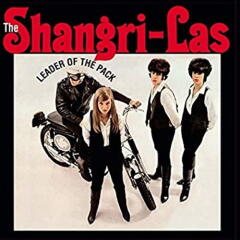
“Leader of the Pack" was written by Shadow Morton, Jeff Barry and Ellie Greenwich. It appears as the second song on side one of The Shangri-Las’ debut album of the same name. Released in September 1964, the song went to #1 on the Billboard Hot 100 Singles chart. The instrumental parts were recorded in July 1964 at Ultrasonic Studios in Hempstead, NY, and the vocals were recorded at Mira Sound Studio in New York City, with Shadow Morton producing. Personnel on the record were: Mary Weiss (lead, backing vocals), Betty Weiss (lead, backing vocals), and Marge and Mary Ann Ganser (backing vocals). Uncredited session musicians played on the record. In 1985, heavy metal band Twisted Sister released a cover of the song from their album Come Out and Play. It went to #53 on the Billboard Hot 100 Singles chart.
The album, Leader of the Pack, was compiled and released in February 1965 to capitalize on the success of The Shangri-Las’ hit singles, “Remember (Walking in the Sand)” and “Leader of the Pack.” Produced by Shadow Morton, the album went to #114 on the Billboard Top 200 Albums chart. Four singles were released from the LP.
The Shangri-Las were an American pop girl group who were popular in the 1960s. The two sets of singing sisters were discovered by Artie Ripp in New York City. The group took its name from the Shangri-La restaurant in Queens, NY. They released four studio albums, nine compilation albums, and 17 singles before officially breaking up in 1968. Mary Weiss served as the front person and main vocalist for the group. All the girls sang backup and were at times featured as the lead vocalist. Betty Weiss retired from the music business and lives on New York’s Long Island. Mary Ann Ganser died in 1970, Marge Ganser in 1996, and Mary Weiss in January 2024.