Clean ammonia, which is produced by reacting clean hydrogen with nitrogen and capturing and sequestering the resulting carbon dioxide (CO2), is gaining momentum. In just the past few months, several more new clean ammonia production projects have been proposed along the U.S. Gulf Coast, many of them made possible by commitments from Japanese and South Korean companies that see the low-carbon fuel as an important part of the Far East’s future energy mix. Taken as a group, the dozen-plus projects now under development have the potential to produce tens of millions of tons of clean ammonia annually, and to create yet another massive energy-export market for U.S. producers. In today’s RBN blog, we discuss the new projects moving forward — and one being put on hold — and what’s driving the clean ammonia market.
A year and a half ago, in Something to Believe In, we looked at Japan and South Korea’s growing interest in co-firing coal plants with clean ammonia as a way to reduce the plants’ greenhouse gas (GHG) emissions. We emphasized there — and do so again here — that there is a lot of skepticism regarding the outlook for clean hydrogen and clean ammonia as “fuels of the future,” or more specifically about whether these commodities can ever be produced efficiently and cheaply enough — and in sufficient volumes — to result in their widespread use. Also, there’s a lot of concern that co-firing Japanese and South Korean coal plants with clean ammonia would result in only a modest reduction in GHG emissions and would extend the use of coal, which is widely viewed as the dirtiest fossil fuel.
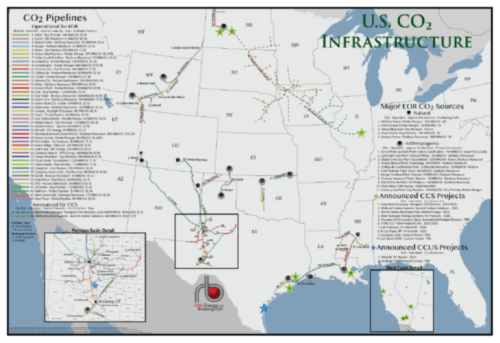
RBN Energy’s US CO₂ Infrastructure map brings together legacy Enhanced Oil Recovery (EOR) assets, as well as announced large-scale Carbon Capture and Sequestration (CCS) and Carbon Capture, Utilization and Sequestration (CCUS) projects, all in our signature concise, accurate, and intelligible style.
Still, both Japan and South Korea see the co-firing of coal and clean ammonia as an important element in their energy transition plans. Both countries are on pretty much the same timeline, with plans to demonstrate the effectiveness of co-firing by 2027, commercializing the technology and co-firing coal plants with 20% clean ammonia by 2030, ramping up ammonia’s share of the fuel mix through the 2030s and ’40s, and phasing out coal use entirely — and running plants on 100% ammonia — by 2050. (China, the world’s largest coal consumer, also has experimented with clean ammonia co-firing but has no plan in place to shift to that approach.)
About the song
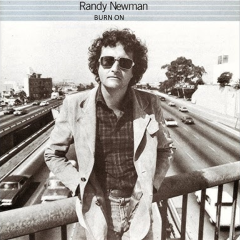
“Burn On” was written by Randy Newman and appears as the second song on side two of Randy Newman’s third studio album, Sail Away. The burning river referred to in the song’s chorus is the Cuyahoga River, which flows into Lake Erie in Cleveland. In June 1969, the river actually caught on fire due to excessive industrial waste. It burned for about 30 minutes before being extinguished by land-based firefighters and a tugboat. (The event brings an interesting twist to the concept of “smoke on the water.”) The song can be heard over the opening credits of the 1989 movie, Major League, which takes place in Cleveland. Personnel on the record were: Randy Newman (vocals, piano), Russ Titelman (guitar), Jim Keltner, Earl Palmer (drums), Chris Ethridge, Wilton Felder, Jimmy Bond (bass), Milt Holland (percussion), and Louis Kaufman (orchestrations).
Sail Away was recorded in 1971-72 at Amigo Studios in North Hollywood and Western Studios and Poppi Studios in Hollywood with Lenny Waronker and Russ Titelman producing. Randy Newman wrote all the songs on the LP. Released in May 1972, the album went to #163 on the Billboard 200 Albums chart.
Artists covering Newman songs from this album over the years include Alan Price, Nilsson, Joe Cocker, and Tom Jones. The Beach Boys’ Brian Wilson has said that this album profoundly affected him at the time of its release and he ranked it third in his top five list of “albums I can't live without” for Spin magazine in 2021.
Randy Newman is an American singer, songwriter, composer and musician. He began his career in Los Angeles at the age of 17, penning hits for The Fleetwoods, Cilla Black, Gene Pitney, and Alan Price. Since the 1980s he has mainly worked as a film composer, with 28 hit movie scores to his credit. He has released 15 studio albums, two live albums, five compilation albums, 23 soundtrack albums and 12 singles. He has won two Academy Awards, three Emmys and seven Grammy Awards and is a member of the Rock and Roll Hall of Fame and Songwriters Hall of Fame. He continues to write film scores for motion pictures.