Permian Basin crude production more than doubled since 2011 to reach nearly 2 MMb/d today, but that rate of increase has leveled off since prices crashed last year. Meantime 750Mb/d of long-haul pipeline takeaway capacity came online in the first half of 2015 - greatly exceeding today’s take-away requirements. And there is more to come next year when the 470 Mb/d Enterprise Midland-to-Sealy pipeline is expected online – leading to fears regional pipeline infrastructure is overbuilt. How about inside the Permian Basin? Today we start a series reviewing Permian gathering system build out.
We recently looked at changing differentials between prices for Permian West Texas Intermediate (WTI) crude at the Midland, TX gathering hub close to producing areas and WTI prices at Cushing, OK the Midwest crude trading and storage hub (see What’s The Story Midland Premium?). In theory – if there is no congestion on pipelines between Midland and Cushing, the crude price differential between the two points (Cushing minus Midland) should equal the cost of transportation or less than $1/Bbl (depending on shipper commitments). And that is the way the differential traded for years before Permian crude production took off in 2011 after producers applied shale drilling technologies in the basin. Since then crude output in the region has more than doubled – reaching close to 2 MMb/d in July 2015 according to the Energy Information Administration (EIA) drilling productivity report. Increasing production put pressure on crude takeaway capacity from the region as midstream companies scrambled to keep up with soaring output. When production exceeded takeaway capacity, producers had to accept discounted prices to get their barrels onto busy pipelines – causing prices at Midland to dip well below Cushing. Then as new pipelines came online the pressure was relieved and the differential narrowed. Over the summer we saw Midland prices at a rare premium to Cushing when a spate of new pipelines came online together creating the opposite of congestion – a shortage of crude - when shippers could not source enough barrels to meet their commitments to the new pipelines and bid up the price at Midland above Cushing. In the last month that situation has reversed again as refinery maintenance in the Permian Basin has freed up barrels at Midland. Between October 2, 2015 and last Friday (November 13, 2015) WTI Midland once again traded under Cushing – by an average of $0.57/Bbl.
All this price volatility between Midland and Cushing (as well as between Midland and Houston – where a lot of Permian production is now headed) is arguably just part of the growing pains associated with such a huge increase in production over a short period of time. And the pain is likely to continue now that the rate of increase in production in the Permian has slowed down within the past year in response to lower crude prices. The chart in Figure #1 below shows our latest view of the balance between takeaway capacity in the Permian Basin and production. The shaded areas on the chart stack up crude pipeline capacity in order of construction on top of the local refinery capacity (green shading). In rapid succession since the end of last year we saw the 300 Mb/d Magellan/Plains BridgeTex pipeline come online in December 2014, the 250 Mb/d Plains Cactus pipeline in March 2015 and the 200 Mb/d Sunoco Logistics Permian Express II pipeline in June 2015 – between them adding 750 Mb/d of new capacity. If you look inside the black dashed box on the chart you can see that these additions boosted pipeline capacity far above actual crude production (represented by the red line) creating the scramble for barrels we just described that pushed Midland prices above Cushing.
About the song
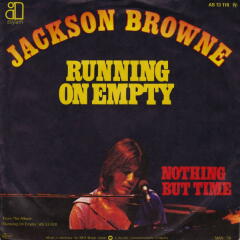
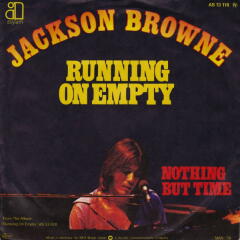
“Running on Empty” was written by Jackson Browne and appears as the first song on his fifth album of the same name. Released as a single in February 1978, the song went to #11 on the Billboard Hot 100 Singles chart. It was recorded live at the Merriweather Post Pavilion in Columbia, MD, in August 1977. Personnel on the record were: Jackson Browne (lead vocals, guitar), Danny Kortchmar (guitar), David Lindley (lap steel guitar), Craig Doerge (piano), Leland Sklar (bass), Russ Kunkel (drums), and Rosemary Butler and Doug Haywood (backing vocals).
Running on Empty was a unique album in that all the song’s themes focused on life on the road. The album was recorded at various locations, including concert venues, the tour bus, and hotel rooms. None of the tracks had been released on an album before, and they included Browne’s road band at the time. Recorded in August and September 1977 and produced by Jackson Browne, the album was released in December 1977 and went to #3 on the Billboard Top 200 Albums chart. It has been certified 7X Platinum by the Recording Industry Association of America. Three singles were released from the LP.
Jackson Browne is an American singer, songwriter and musician. He has released 15 studio albums, three live albums, two compilation albums, and 44 singles. He is a member of the Rock and Roll Hall of Fame and Songwriters Hall of Fame, and has received the John Steinbeck Award, the Harry Chapin Humanitarian Award, the Golden Plate Award, and the Gandhi Peace Award. Browne released his latest album, Downhill from Everywhere, in July 2021, and begins his latest tour this month.