Available ethane in the Marcellus/Utica is expected to increase 70% by 2022 to 800 Mb/d, from about 470 Mb/d this year. That should be good news for the slew of ethane-only steam crackers coming online in that time frame, primarily along the Gulf Coast. But unfortunately, there is limited ethane pipeline takeaway capacity out of the region and today more than half of the potential ethane supply is being rejected into the natural gas pipeline stream. Without additional takeaway capacity, that rejected volume is expected to grow and few additional ethane barrels will make their way to the Gulf Coast. The question is, will transportation economics support additional pipeline development to where the demand is growing the most? Today, we will explore how the changing ethane market is likely to impact the Marcellus/Utica producing region.
This is Part 4 of a series in which we look forward based on RBN’s most recent forecasts of ethane supply and demand. In Part 1, we began with a discussion of how the ratio of Mont Belvieu ethane prices to the Henry Hub natural gas price on a per-Btu basis influences the decision of whether to extract ethane or reject it and send it into the natural gas stream. As we noted, that’s one of the most important market factors for understanding how the current ethane market transformation will unfold. The higher the ratio of ethane to natural gas prices/Btu, the greater the volume of ethane that is recovered as a liquid feedstock for the petrochemical industry. This year, that ratio has shifted to 1.4:1, up from 1:1 last year. As a result, ethane production is up about 90 Mb/d in 2017 year-to-date from the 2016 average.

Visualize the infrastructure behind U.S. NGL movement.
The U.S. NGLs Map provides a comprehensive view of the transport, processing, and export networks moving NGLs across the U.S.
Next, in Part 2, we turned our focus to the five-year outlook for ethane demand and looked at what is happening on the demand side of the ethane equation, including the timing of new steam-cracker startups, how much additional ethane they will use, the pace of ethane export growth, and the trends in the cents-per-pound margin for producing ethylene from ethane.
Part 3 delved into the factors that will determine how much supply will be available for the growing demand and the economics of how it will get to where most of the demand is located — along the Gulf Coast. Since there are major differences between supply regions when it comes to gas processing infrastructure, access to nearby fractionation capacity, and takeaway capacity, among other factors, we first split U.S. ethane production into five major regions, shown in Figure 1 below: (1) Texas/New Mexico/Louisiana, (2) Midcontinent, (3) Rockies, (4) Williston/Bakken and (5) Marcellus/Utica.
About the song
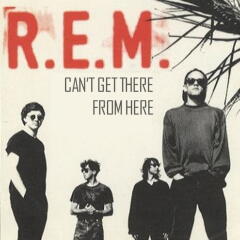
"Can't Get There from Here" was written by Bill Berry, Peter Buck, Mike Mills and Michael Stipe, and appears as the first cut on side two of R.E.M.'s third studio album, Fables of the Reconstruction. Released as the first single from the album in June 1985, the record went to #14 on the Billboard Top Rock Track Singles chart. It was the first R.E.M. song to feature a horn section. Personnel on the record were: Bill Berry (drums, backing vocals), Peter Buck (guitar, banjo, harmonica), Mike Mills (bass, piano, backing vocals), Michael Stipe (lead vocals), David Bitelli (tenor, baritone sax), Jim Dvorak (trumpet) and Pete Thomas (tenor sax).
Fables of the Reconstruction was recorded at Livingston Studios in London between February-March 1985, with Joe Boyd producing. Lyrically, the album explores the mythology of the American South in the same manner that many of the songs on Tom Petty and the Heartbreakers March 1985 release, Southern Accents, did. Both bands have roots in the Deep South. Released in June 1985, the album went to #28 on the Billboard 200 Album chart, and has been certified Gold by the Recording Industry Association of America.
R.E.M. was an American rock band formed in Athens, GA, in 1980 by Michael Stipe, Peter Buck, Mike Mills and Bill Berry. The band released 15 studio albums, four live albums, 16 compilation albums, one soundtrack album, six EPs and 63 singles. They have sold more than 85 million records worldwide. R.E.M. has won two Billboard Music Awards, three Grammy Awards, 12 MTV Music Video Awards, and are members of the Rock and Roll Hall of Fame. The band disbanded amicably in September 2011. The former members have continued on with various solo musical projects.