Drilling and completion activity in the Permian Basin doesn’t only produce vast quantities of energy, it consumes a lot of energy too, mostly in the form of diesel fuel to power the trucks, drilling rigs, fracturing pumps, compressors and other equipment needed to keep the oil patch humming. And while refineries within or near the Permian meet a portion of the region’s needs, rising demand for diesel there is spurring the development of new infrastructure — and the repurposing of existing assets — to bring additional fuel into the Permian from refineries along the Gulf Coast. Today, we discuss efforts to move more diesel to the oil fields of West Texas.
Texas consumes far more distillate — most of it ultra low sulfur diesel (ULSD) — than any other state: an estimated 485 Mb/d (or 20.4 million gallons a day) in 2016, the most recent year that state-by-state statistics are available from the Energy Information Administration (EIA). That was 82% more than California, and more than triple the distillate consumption of other high-population states like New York, Pennsylvania and Florida. Four-fifths of Texas’s distillate/diesel consumption is by the transportation sector, the vast majority of it by tractor trailers and other trucks that transport everything from petrochemicals to corn chips across the Lone Star State. In the past few years — and especially in the past two or three — diesel consumption has been on the rise in the red-hot Permian Basin in West Texas, and in neighboring counties in southeastern New Mexico. There, diesel is the king of fuels. It powers almost everything: the trucks that haul oilfield equipment, frac sand and water to well sites, the trucks that haul produced water from the lease to disposal wells, and, increasingly in recent months as takeaway pipelines out of the Permian have filled up (see No Time), the trucks that transport crude oil long distances to downstream pipeline injection points (and sometimes all the way to Corpus Christi and Houston).

Crude Oil TradeView provides up-to-date data and insights into the behavior of differentials for 33 crude assessments across North America. Each week, it also walks you through the reasoning of why differentials widen, narrow, flip (premium vs. discount), or blow out.
And trucks aren’t all that diesel fuel powers. There are the motors that run drilling rigs, fracturing pumps and a host of other oilfield equipment. Take drilling rigs. The active rig count in the Permian stood at 477 as of June 1 (2018), according to Baker Hughes — double what it was a year and a half ago — and each drilling rig consumes as much as 50 b/d of diesel. The massive pumps used for high-intensity hydraulic fracturing use large volumes of distillate too.
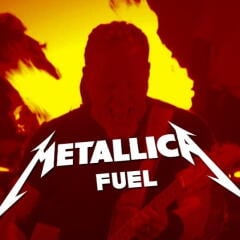
About the song
“Fuel,” written by Metallica band members James Hetfield, Lars Ulrich, and Kirk Hammett, was a hit single off the heavy metal group’s seventh album, Reload, which was released in November 1997. The video for "Fuel" features several classic American muscle cars drag racing. Since its release, the song has been featured on television coverage of NASCAR events, and was used prominently in a 2016 television ad campaign for Dodge Chargers and Challengers. The personnel on "Fuel," which rose to #6 on Billboard’s Mainstream Rock Tracks chart, are James Hetfield (vocals and guitar), Kirk Hammett (lead guitar), Lars Ulrich (drums), and Jason Newsted (bass). The Reload LP shot to the top of the Billboard 200 chart of best-selling albums and remained on the list for 75 weeks.
Metallica was formed in Los Angeles in 1981 by Lars Ulrich and James Hetfield, but has been based in the San Francisco area for most of its career. The group has had four bass players over the years: Ron McGovney, Cliff Burton (who died in a tragic tour bus accident in Europe in 1986), Jason Newsted (from Flotsam and Jetsam) and current bass player Rob Trujillo (from Suicidal Tendencies). Dave Mustaine was the original lead guitarist for the band, but was fired in 1983, after which he formed Megadeth, which went on to a successful run of its own. After Mustaine, Metallica recruited Kirk Hammett (from Exodus), who has been the group’s lead guitarist ever since.
Metallica to date has sold more than 110 million records worldwide. The band received the MTV Icon Award in 2003, was inducted into the Rock & Roll Hall of Fame in 2009, and has received nine Grammy Awards.