Texas consumes far more diesel fuel than any other state and almost as much gasoline as car-crazy California, which also has 10 million more people. The long-distance distribution of refined products within the Lone Star State is handled largely by tanker trucks, but in the past couple of years, midstream companies have been adding a lot of new refined products pipeline capacity, not just to help deliver diesel and gasoline within Texas — including the diesel-hungry Permian Basin — but also to move motor fuels to the Mexican border for export. And more diesel and gasoline pipe capacity is on the way. Today, we discuss the new and expanded refined products pipelines criss-crossing Texas.
Energy consumption by Texas’s transportation sector totaled more than 3.3 quadrillion Btus in 2017, the most recent year for which state-by-state data from the Energy Information Administration (EIA) is available, and it’s surely higher now, after another two years of economic expansion. (Vermont ranked last among the states, using only 48 trillion Btus to power all its bumper-stickered Priuses, Subarus and Volvos.) Distillate consumption in Texas — most of it ultra-low-sulfur diesel — is sky-high, averaging about 515 Mb/d, or nearly 22 MMgal/d, in 2017, including more than 350 Mb/d by cars, trucks and buses and upwards of 40 Mb/d by the oil and gas industry to power the motors that run drilling rigs, fracturing pumps and a host of other oilfield equipment. As for motor gasoline, Texas accounts for an even 10% of total U.S. consumption: more than 930 Mb/d, or about 39 MMgal/d. It must be all those Ford F350s and GMC Yukon XLs you see on highways throughout the state.
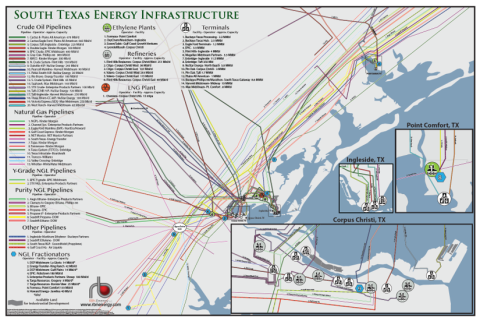
RBN Energy’s South Texas Energy Infrastructure Map brings together all the pieces of the critical and complex puzzle of the greater Corpus Christi region. Spanning from Point Comfort, TX to Corpus Christ, TX and south of the Agua Dulce natural gas hub, the map details the processing, transportation and export facilities in RBN Energy’s classic clear, concise and easy to comprehend style.
The problem is that while most of the state’s diesel and motor gasoline is produced along the Texas Gulf Coast, a lot of these fuels are consumed inland, scores or even hundreds of miles from coastal refineries. The most efficient, cost-effective means for transporting diesel and gasoline long distances is by pipeline, and while there are a number of pipes in place that move refined products to inland markets, demand for diesel and gasoline in these markets has been rising with population and economic growth. The good news from a cost and distribution-efficiency perspective is a number of existing pipelines have been — or are being — expanded, and a couple of entirely new pipelines are being added.
About the song
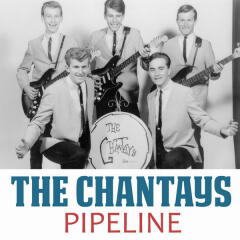
"Pipeline" is an instrumental surf rock song by The Chantays, and was written by the group’s guitarists, Brian Carman and Bob Spickard. Originally titled "Liberty's Whip," the song was renamed "Pipeline" after The Chantays saw a surf movie featuring scenes of the Banzai Pipeline in Hawaii. "Pipeline" was recorded for the independent Los Angeles-based Downey Records label, and released as a single in December 1962. After garnering airplay in the L.A. area, it was picked up for national distribution by Dot Records in January 1963. The song went to #4 on the Billboard Hot 100 and #11 on the R&B Singles chart.
The hit helped to establish the spring-loaded Fender Reverb effects unit as the signature sound-shaping device for surf guitar. "Pipeline" was featured on The Chantays' first studio album of the same name released in 1963. It has been covered by many artists, including The Ventures, Dick Dale (with Stevie Ray and Jimmie Vaughan), The Challengers, The Astronauts, Agent Orange, and Johnny Thunders, who often used it for his opening number at live shows. "Pipeline" has been featured in many commercials, television shows and movies over the years. It would be The Chantays only hit. Personnel on the record were: Bob Spickard (guitar), Brian Carman (guitar), Rob Marshall (piano), Warren Waters (bass) and Bob Welch (drums). Note: Bob Welch, the drummer for The Chantays, is not the same Bob Welch later of Fleetwood Mac and solo artist fame.
The Chantays are an American surf rock instrumental band formed in Santa Ana, CA, in 1961. One thing that set the band apart from other surf groups of that era is the use of electric piano in addition to reverb-soaked guitars. They have released four studio albums and eight singles. The band still performs live shows, with original members Bob Spickard and Bob Welch, joined by long-time members Gil Orr, Ricky Lewis and Brian Nussle. Founding member — and “Pipeline” co-writer — Brian Carman, died in Santa Ana at the age of 69 in March 2015.