With an announcement in late 2023 by Dow Chemical that it would be undertaking an enormous expansion of its ethylene production site in Fort Saskatchewan, AB, it was immediately clear that Alberta’s ethane supplies would need to increase by a significant 110 Mb/d. As we’ll discuss in today’s RBN blog, a deal was signed in February between Dow and Pembina Pipeline Corp. that calls for the midstreamer to provide up to 50 Mb/d of additional ethane supplies and, according to executives at Pembina’s investor day earlier this month, will require the company to invest between C$300 million (US$220 million) and C$500 million (US$367 million) to build out its existing NGL/ethane infrastructure.

Alberta, Canada’s energy-producing powerhouse, is also home to a large and sophisticated petrochemical industry. Since the 1970s, the industry has relied on an abundance of ethane, which like other NGL “purity products” is extracted from the raw (or unprocessed) gas that also contains a mix of methane (the primary component of natural gas) along with other liquids such as propane, butane and condensate (with that last one usually referred to as natural gasoline in the U.S.). The extraction of some portion of these purity NGL products from the raw gas stream is necessary to meet specifications for transportation in pipelines and for use by downstream consumers. Ethane typically accounts for the largest portion of the liquids that can be extracted from the raw gas and can be sent to nearby petrochemical plants for use as a feedstock for more complex chemical molecules such as ethylene. Ethylene forms the basis for the manufacture of everyday plastics such as bottles, grocery bags, food packaging and many other products.
Alberta hosts four large ethylene plants — three at Joffre owned and operated by NOVA Chemicals (green dot in Figure 1) and a fourth owned and operated by Dow Chemical in Fort Saskatchewan (red dot). The Joffre complex is estimated to have an ethane intake capacity of 180 Mb/d, while the Dow site pulls in up to 95 Mb/d, for a total of 275 Mb/d. According to Pembina, all these facilities receive ethane via the company’s Alberta Ethane Gathering System (AEGS; purple lines) and the pipelines that feed AEGS.

Figure 1. Western Canada Ethane Infrastructure. Source: RBN
About the song
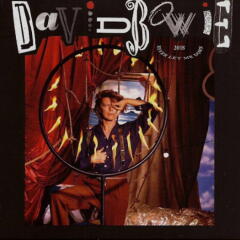
“Never Let Me Down” was written by David Bowie and Carlos Alomar and appears as the fourth song on side one of David Bowie’s 17th studio album of the same title. The song is about Bowie’s longtime personal assistant, Coco Schwab. Bowie said John Lennon was his inspiration for his vocals on the tune. A video shot in black and white, and set at a post-war dance marathon, was shot and directed by Jean-Baptiste Mondino. Released as the third single from the album in August 1987, it went to #15 on the Billboard Mainstream Rock and #27 on the Billboard Hot 100 Singles charts. Personnel on the record were: David Bowie (vocals, harmonica), Carlos Alomar (guitar), Steve Hodge (keyboards), Eral Kizilcay (bass, drums, keyboards), Spence Bernard (synthesizers), Crusher Bennett (percussion) and David Eiland (alto sax).
The album, Never Let Me Down, was recorded between September-November 1986 at Mountain in Montreux, Switzerland, and Power Station in New York City. Produced by Bowie with David Richards, it was released in April 1987. It went to #34 on the Billboard 200 Albums chart and has been certified Gold by the Recording Industry Association of America. The album featured Peter Frampton on lead guitar on most cuts. Three singles were released from the LP. After the Glass Spider Tour, which supported the album in 1987, Bowie formed Tin Machine, a project with guitarist Reeves Gabrels, bassist Tony Sales, drummer Hunt Sales, with Bowie on vocals and sax. It was a return to Bowie’s roots, where he became a member of a stripped-down rock and roll band.
David Bowie (David Robert Jones) was an English singer, songwriter, musician and actor. He is considered an iconic figure in popular music in the 20th century. Raised in London, he got his professional start in his teens with the King Bees, who released one single, “Liza Jane,” in 1964. He signed with Mercury Records in 1969 and released “Space Oddity,” which became a top-five hit in the UK. He has released 27 studio albums, 22 live albums, 27 compilation albums, three soundtrack albums, eight EPs and 128 singles. He has sold more than 100 million records worldwide. He has won an Ivor Novello Award, four Brit Awards, six Grammy Awards, a Saturn Award, and is a member of the Rock and Roll Hall of Fame and the Songwriters Hall of Fame. He starred in seven motion pictures and had a featured role in two others. Bowie died in New York City in January 2016 at the age of 69.