There may be ongoing uncertainty about the timing and volumes, but it’s not difficult to anticipate that natural gas flows through the Agua Dulce Hub near Corpus Christi will be rising significantly over the next few years as new LNG export capacity starts up and new gas-fired power plants come online in South Texas and south of the border in Mexico. In today’s RBN blog, we discuss the status of the pipelines under development to transport gas into and out of Agua Dulce and the LNG facilities and power plants being planned and built to receive that gas. We’ll also look at our forecast for pipeline-corridor flows in the Agua Dulce area.

The RBN NATGAS Haynesville is a weekly natural gas fundamentals analysis focused on supply, flow, and LNG-driven demand dynamics within the Haynesville basin.
We’ll begin with a brief recap of what we’ve said in recent blogs about the Agua Dulce Hub and why it’s been becoming an increasingly important crossroads for gas. As we said in Part 1 of this series, more than a dozen pipelines flow into the hub (see Figure 1 below) — five (soon to be six) from the Permian and Eagle Ford production areas and eight bidirectional pipelines along the Gulf Coast. The former group includes well-known giants like Gulf Coast Express (GCX), Whistler, and the planned Blackcomb pipelines as well as the Verde, Eagle Ford Midstream and Lobo systems. The latter group, in turn, includes decades-old mega-systems like Transco, Tennessee Gas Pipeline (TGP), TETCO and NGPL, plus Enterprise’s, Energy Transfer’s and Boardwalk’s Texas intrastate pipelines and the Houston Pipeline System (HPL).
As for the pipelines flowing gas out of the Agua Dulce area, these include (of course) the bidirectional coastal pipelines noted above that can flow north from the hub (TGP, TETCO, NGPL, etc.) as well as the new 1.7-Bcf/d ADCC Pipeline, which (as its acronym suggests) runs from Agua Dulce to Corpus Christi. Then there are the handful of pipes that run south out of Agua Dulce to (or at least toward) the Texas/Mexico border. These include the southern tips of five aforementioned coastal systems — Kinder Morgan’s Tejas intrastate pipe, Transco, NGPL, TGP and TETCO — plus Kinder’s NET Mexico Pipeline, which runs to the Rio Grande, where it connects to the Los Ramones pipeline in Mexico; and Enbridge’s Valley Crossing pipeline, which connects at the border to the Sur de Texas-Tuxpan Pipeline in Mexico.
In addition to these, there’s the planned Rio Bravo pipeline — actually a pair of pipes with a combined capacity of 4.5 Bcf/d — that will run from near Agua Dulce to NextDecade Corp.’s Rio Grande LNG export facility. (More on these later.)
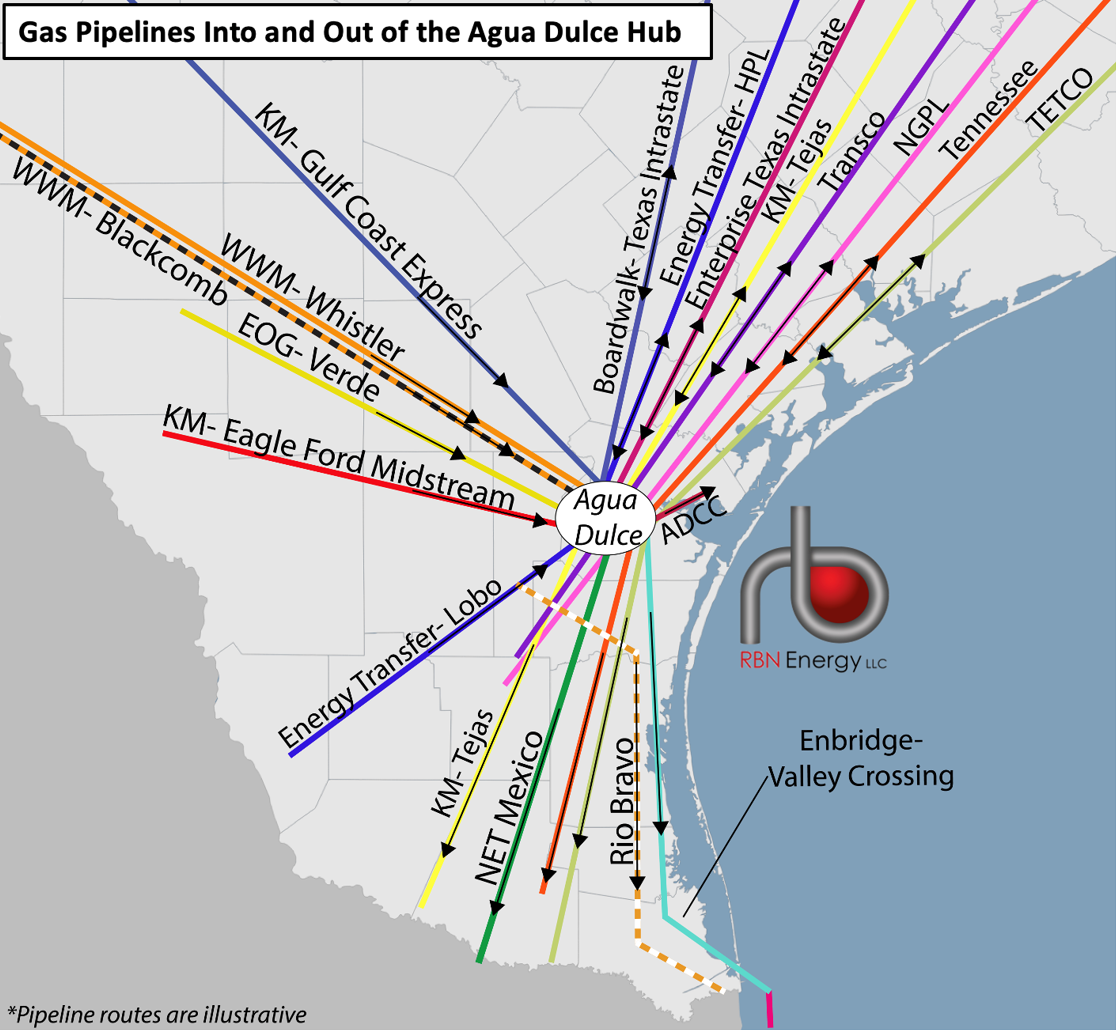
Figure 1. Gas Pipelines Into and Out of the Agua Dulce Hub. Source: RBN
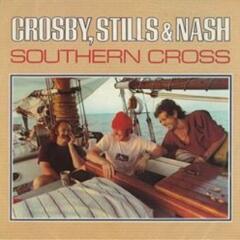
About the song
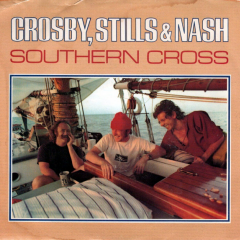
“Southern Cross” was written by Stephen Stills, Rick Curtis and Michael Curtis. It appears as the third song on side one of Crosby, Stills & Nash’s fourth studio album, Daylight Again. The song is based on Michael and Rick Curtis’s “Seven League Boots,” with a major rewrite by Stephen Stills. It features Stills on lead vocals and Graham Nash on harmony vocals. Released as a single in September 1982, it went to #18 on the Billboard Hot 100 Singles chart. It has remained the group’s last hit on the Billboard Hot 100 chart. The song has been covered by Jimmy Buffett, Dave Mason, and Weedeater. Personnel on the record were: Stephen Stills (lead vocals, guitar), Graham Nash, Timothy B. Schmit (backing vocals), Michael Sturgis (guitar), Mike Finnigan (keyboards, backing vocals), Richard T. Bear (keyboards), George Perry (bass), Joe Vitale (drums), and Joe Lala (percussion).
Daylight Again was recorded in 1980-81 at Rudy Records, Devonshire Sound and Sea West in Los Angeles and produced by Crosby, Stills and Nash. David Crosby joined the album project at the 11th hour and contributed two tracks to the LP. Released in June 1982, the album went to #8 on the Billboard 200 Albums chart and has been certified Platinum by the Recording Industry Association of America (RIAA). Three singles were released from the LP.
Crosby, Stills & Nash (CSN) was a folk-rock supergroup formed in Los Angeles in 1968 by David Crosby (ex-Byrds), Stephen Stills (ex-Buffalo Springfield) and Graham Nash (ex-Hollies). When Neil Young (ex-Buffalo Springfield) was added to the group, they were known as Crosby, Stills, Nash & Young (CSNY). With the members’ shared musical pasts, the pump was primed for the release of their debut album in May 1969. After their appearance at Woodstock (their second live show) in August 1969, the band’s LP exploded on the charts, resulting in 4x Platinum status by the RIAA and yielding two hit singles. They released eight studio albums, five live albums, six compilation albums, and 19 singles. CSN was inducted into the Rock and Roll Hall of Fame in 1997. All three members have also been inducted as members of their former bands. Neil Young has been inducted as a Buffalo Springfield member and as a solo artist. Stills, Nash and Young continue to record and tour as solo artists. David Crosby died in Santa Ynez, CA, in January 2023 at the age of 81.