Energy industry cheerleaders tout vast supplies of untapped U.S. oil and gas resources, but increasingly limited volumes that can be practically and profitably developed — and their desire to follow a cash-return model — have left producers struggling to organically replace proven reserves. The percentage of hydrocarbon production replaced through finding and developing has been cascading since 2018 and dipped below 100% in 2025 for the first time in more than a decade. In today’s RBN blog, we’ll review 2025 U.S. E&P reserve reporting and analyze the trends that are limiting the industry’s ability to ramp up future output.
First, let’s define oil and gas reserves and review how producers report them. Proved reserves are quantities of crude oil, natural gas and NGLs assumed to have at least a 90% chance of eventual recovery under existing economic and operating conditions (see Square One). In contrast, probable reserves have a 50% chance of technical and economic recovery, while possible reserves have only a 10% chance of recovery. Oil and gas companies are mandated to report their proved reserves in their annual Form 10-K’s. The changes result from four factors:
- Extensions and discoveries, the most impactful, are reserves unlocked through the development of existing fields and the successful exploration of new properties. These additions are funded by the company’s annual organic — or finding and development (F&D) — capital spending. The level and effectiveness of this investment is critical to the long-term sustainability of an E&P.
- Revisions of previous estimates generally result from changes in commodity prices — lower prices can make certain volumes uneconomic to produce, while higher realizations nudge volumes into the proved category. Poor or better-than-expected well performance can also change estimates of future recoverable volumes from a field.
- Purchases and divestitures reflect the net result of M&A activity.
- Production volumes are subtracted from beginning-of-year reserves and current-year reserve additions to arrive at current year-end reserves.
The key measures of the quality and long-term sustainability of a company’s oil and gas properties are the costs incurred in organically replacing reserves through extensions and discoveries — see the first bullet above. These include development activities, such as drilling and completing wells, adding infrastructure such as roads and processing facilities, water handling and disposal, and other expenses. They also include exploration costs for finding new oil and gas reserves. What producers call the F&D replacement rate is calculated by dividing their total organic reserve additions by their total production. F&D costs are calculated by dividing the total exploration and development costs by the volume of organic reserve additions.
As shown in Figure 1 below, reserve F&D replacement rates (orange line and right axis) declined from a high of 228% in 2018 to just 93% in 2025. The steep fall from the peak resulted from sharp cutbacks in organic capital investment as oil prices plummeted in late 2019 and cratered with the onset of the pandemic in early 2020. The rate temporarily rose on catch-up activity in 2021 but has fallen since. At the same time, F&D costs (blue bars and left axis) nearly doubled from the $6/boe range in 2016-21 to about $12/boe in 2023-25.
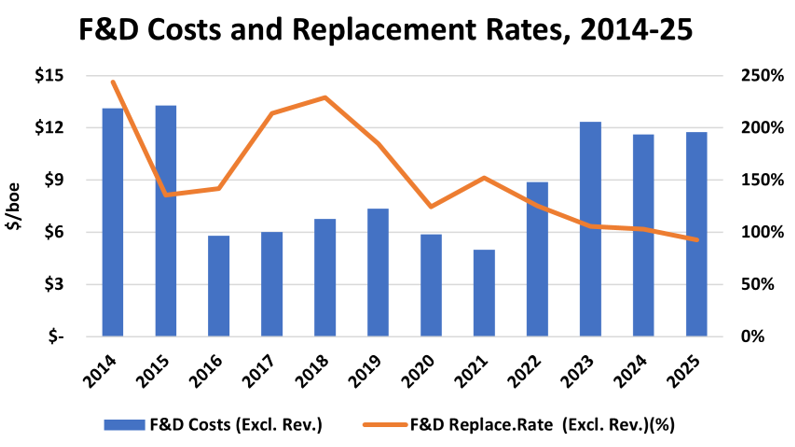
Figure 1. F&D Costs and Replacement Rates, 2014-25. Source: Oil & Gas Financial Analytics LLC
U.S. Crude Exports Soar Above 5 MMb/d to Highest Level Since 2023
U.S. Gulf Coast crude exports rose to 5 MMb/d (far right of graph below) for the week ended Friday, April 17, reaching their highest level since September 2023.

About the song
“Slip Sliding Away” was written by Paul Simon and has appeared on the compilation albums Greatest Hits, Etc. and Negotiations and Love Songs. The song was originally recorded and slated for release on Simon’s 1975 album, Still Crazy After All These Years, but at the last minute Simon decided not to include it on the album. Released as a single in October 1977, it went to #5 on the Billboard Hot 100 and #4 on the Easy Listening Singles charts. It has been certified Gold by the Recording Industry Association of America. Personnel on the record were: Paul Simon (lead vocals, acoustic guitar), Anthony Jackson (Bass), Richard Tee (Fender Rhodes electric piano), Steve Gadd (drums), Ralph McDonald (percussion), and The Oak Ridge Boys (backing vocals).
Simon was half of the popular duo Simon & Garfunkel, which was officially formed in 1964 and sold millions of records until their breakup in 1970. A little-known fact is that Paul Simon and Art Garfunkel had been a team since they were teenagers. Under the name Tom & Jerry, the duo got a record deal in 1957 with the independent New York record label, Big Records. They had a minor hit with the Simon-penned “Hey Schoolgirl,” which went to #49 on the Billboard Hot 100 Singles chart and led to an appearance on American Bandstand with Jerry Lee Lewis, who was promoting “Great Balls of Fire” at the time. Between 1957 and 1964, Simon wrote, recorded, and released more than 30 records.
As a solo artist. Paul Simon has released 15 studio albums, four live albums, 11 compilation albums, and 61 singles. With Simon and Garfunkel, he released five studio albums, four live albums, a soundtrack album, 13 compilation albums, an EP, and 26 singles. He has won 16 Grammy Awards and a Grammy Lifetime Achievement Award, and has been inducted into the Rock and Roll Hall of Fame twice: as a member of Simon & Garfunkel in 1990 and as a solo artist in 2001. He continues to write, record and make concert appearances. He released his latest solo studio album, Seven Psalms, in May 2023. It went to #25 on the Billboard Top Rock Albums chart and #153 on the Billboard 200 Albums chart. At 84, Simon began a European tour in April, to be followed by a U.S. tour in June.
"About the Song" -- written by Mickey McMahan , RBN Director of Musicology