Three months after a series of devastating wildfires wreaked havoc in Alberta’s oil sands region, production is essentially back to normal. Temporary shutdowns at several production sites initially reduced the oil sands’ output by more than 1 MMbbl/d –– or about one-third the area’s pre-fire production level –– which trimmed inventories and goosed world oil prices. But the short-term closures appear to have had little effect on the Canadian and U.S. refineries that process oil sands-sourced crude. Now, oil sands producers (stung more than many by the collapse in oil prices) are focused again on reducing production costs in an effort to stay profitable in a low-oil-price era. Today, we summarize the current, post-wildfires state of oil sands production and consider the region’s future in the new, tight-oil/Shale Revolution world.
The series of wildfires that swept through parts of Fort McMurray, AB and nearby oil sands production areas in early May 2016 caused damage totaling an estimated Canadian $3.6 billion (the equivalent of more than U.S. $2.7 billion), making the event the most expensive natural disaster in Canada’s history (by far, according to a July 2016 report by the Insurance Bureau of Canada). As we said in our initial look at the wildfires’ impact on oil sands production in mid-May (Over the Hills and Far Away), the wildfires consumed hundreds of thousands of acres (ultimately, more than 1 million acres had burned by the time the last, spotty fires were put out the first week of July) and forced tens of thousands of people from their homes. That spurred staffing shortages at many oil sands production facilities, prompting production scale-backs and a handful of temporary production shutdowns. As fierce and as far-reaching as the wildfires were, however, they didn’t cause any major damage to the oil sands production areas themselves, or to the pipelines that bring diluent in (to add to bitumen to improve its flow-ability) and crude oil out. Some pipeline flows were interrupted, though, and there was some damage to the electric grid ––but fortunately not enough to slow the rebuilding of oil sands production over the following few weeks.
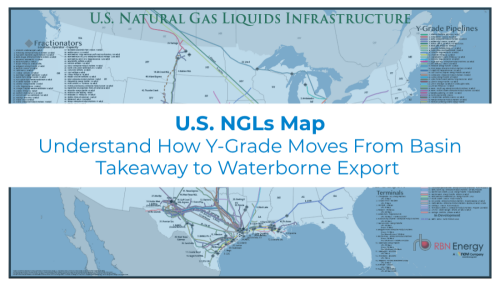
Visualize the infrastructure behind U.S. NGL movement.
The U.S. NGLs Map provides a comprehensive view of the transport, processing, and export networks moving NGLs across the U.S.
The wildfires certainly had a major effect on production. For example, Suncor Energy, which holds interests in several oil sands production facilities (including a 54% ownership stake in Syncrude, a big oil sands joint venture with Imperial Oil and others), reported that operations at Syncrude –– which was completely shut down in early May (for the first time in Syncrude’s 40-year history) –– started ramping back up in June and returned to normal in mid-July. Suncor’s other operations were back online weeks earlier. Still, Suncor’s second quarter 2016 oil sands production averaged only 178 Mb/d, down 58% from second quarter 2015, when production averaged 424 Mb/d. More than 90% of the 246-Mb/d decline was tied to the wildfires themselves; the rest is attributed to the early-April completion of “turnaround” work at Suncor’s 240-Mb/d Upgrader 2. (Oil sands upgraders use coking and distillation to “upgrade” super-thick bitumen into synthetic crude oil, or SCO.) The fires also forced a pause in work at the Fort Hills oil sands mining project north of Fort McMurray that is a joint venture of Suncor (51%), Total E&P Canada (29%)and Teck Resources (20%). Even with that setback, the co-owners of Fort Hills (which will mine and process 121 million tons/year of oil sands and produce 180 Mb/d of bitumen) plan to make up for lost time and still complete the project (and produce “first oil” there) by the end of 2017.

About the song
"Back in the High Life Again," written by Steve Winwood and Will Jennings, appeared on Winwood's fourth studio album of the same name, released in December 1986. It was recorded at Unique Recording Studio, the Power Station, and Giant Studio in New York City. The album was produced by Russ Titelman and Winwood. The single went to #1 for three weeks on the Adult Contemporary charts, and went to #13 on the Billboard Hot 100. “Back in the High Life Again" received a Grammy nomination for Record of the Year in 1988. The personnel on the single are: Steve Winwood (vocals, piano, synthesizer, Moog bass, mandolin, and drum programming), Jimmy Bralower (drum programming), Rob Mounsey (synthesizer), and John Robinson (drums). James Taylor sang harmony vocals on the cut. The LP reached #3 on the U.S. albums charts. Seven of the eight songs on the album were released as singles. It has sold over five million copies to date.
Steve Winwood, an English rock musician, is known primarily as a vocalist and keyboard player, but he also plays guitar, mandolin, bass, drums and violin. He started his professional career as the singer/keyboardist in The Spencer Davis Group, who had their first hit, "Gimme Some Lovin'," when Steve was 16 years old. He was also a featured player and vocalist in two other bands — Traffic and Blind Faith — before his solo career took flight. He has a long list of session work with various successful artists. Winwood has had two Billboard Hot 100 #1 singles: "Higher Love" and "Roll With It." He was inducted into the Rock and Roll Hall of Fame with Traffic in 2004. In 2005, he won a BMI Icon Award. He has received two Grammy Awards, and in 2011 he received the Ivor Novello Award for Outstanding Song Collection. He continues to record and tour to this date.