It will take at least a few weeks, but it seems likely that production in the Alberta oil sands will return to near normal levels, setting the stage for continued incremental growth over the next few years as expansion projects committed to when oil prices were much higher come online. Although fires are still burning, the devastation in and around Fort McMurray, AB--the unofficial capital of the oil sands region—that forced tens of thousands of people from their homes, prompting oil sands staffing shortages, production scale-backs and a handful of temporary production shutdowns has moved beyond most oil sands operations. But the wildfires’ chain of effects didn’t end there; at one point, crude oil output declines were estimated at upwards of 1 MMb/d (about one-third of Alberta’s normal production of 3.1 MMb/d) caused world oil prices to inch up, some refineries in the U.S. Midwest that depend on Alberta-sourced oil have been forced to scramble for replacement crude, and natural gas prices fell to near zero for a brief period. Today, we begin a two-part look at post-wildfire prospects for the region, and—looking ahead--at the possible need for more pipeline takeaway capacity.
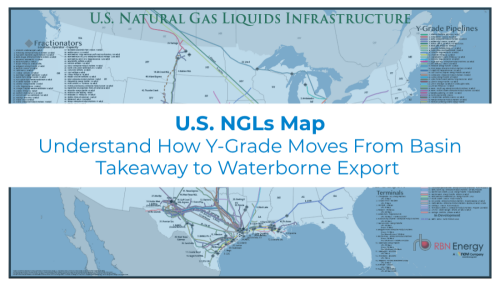
Visualize the infrastructure behind U.S. NGL movement.
The U.S. NGLs Map provides a comprehensive view of the transport, processing, and export networks moving NGLs across the U.S.
It’s been a difficult spring for the people of Fort McMurray, AB. In recent days their lives have been up-ended by wildfires that consumed some 600,000 acres and caused the largest mass-evacuation in North America since the San Francisco earthquake more than a century ago. Entire neighborhoods burned to the ground. Fortunately, though—and despite the very dire nature of some media reports—90% of the structures in Fort McMurray are still standing, support for those left homeless is pouring in, the first steps toward rebuilding are being taken, and the area’s economy (based largely on oil sands production) is poised to begin what will hopefully be a quick recovery. As fierce and as far-reaching as the wildfires were, they didn’t cause any major damage to the oil sands production areas themselves, or to the pipelines that bring diluent in (to add to bitumen to improve its flow-ability) and crude oil out, though (as we said) some production was slowed or stopped (mostly for safety concerns and lack of staff) and some pipeline flows have been interrupted. There was some damage to the electric grid (which, unlike pipelines, is largely aboveground), but apparently not enough to slow the rebuilding of oil sands production over the coming days and weeks. Here are a few highlights from some of the public announcements from companies operating in the region:
- Shell Canada on May 9 (2016) started ramping production back up at its 255 Mb/d Albian Sands bitumen mining operation north of Fort McMurray, which consists of the Athabasca Oil Sands Project’s (AOSP) two mines (Muskeg River and Jackpine). Shell (which operates and owns 60% of AOSP; Chevron Canada and Marathon Oil Canada own 20% each) had suspended operation of Albian Sands on May 3.
- ConocoPhillips soon plans to restart operation of the 150 Mb/d Surmount steam assisted gravity drainage (SAGD) bitumen facility it co-owns with Total E&P Canada.
- Imperial Oil on May 9 completed a controlled shutdown of its 200/Mb/d Kearl operation, whose physical plant and assets were not affected by the wildfires. An operational restart will begin soon.
- Canadian Natural Resources’ Horizon Oil Sands, which includes a surface oil sands mining and bitumen extraction plant (typical output, 130 Mb/d of synthetic crude oil), continues to operate.
- Syncrude Canada, a multiple-owner operation with the capacity to produce 315 Mb/d, on May 9 started transitioning from emergency response to planning the restart of its operations, some of which were shut down temporarily. On May 10, power generation resumed at its bitumen mine in Aurora, AB.
- Cenovus’s Christina Lake production remains in operation, though it did remove some non-essential personnel during the worst of the wildfires.
- Inter Pipeline has restarted its 139 Mb/d Polaris diluent pipeline from Edmonton to the Fort McMurray region, and restarted its 346 Mb/d Corridor pipeline, which links AOSP and Edmonton.
- Enbridge’s terminals and pipelines in the oil sands region were largely unaffected by the wildfires, but as a precaution the company on May 4 shut down and evacuated its Cheecham terminal and curtailed operations at its Athabasca terminal. It also shut down pipelines in and out of Cheecham and shut down or curtailed operations on other pipelines it operates in the region. At the emergency’s peak, deliveries from those pipelines were reduced by up to 900 Mb/d. On May 11, Enbridge reopened its Cheecham terminal and started injecting volumes into its Athabasca pipeline (blue line in Figure 1) and Waupisoo pipeline (thin dark-gray line from Cheecham to Edmonton). The Woodland pipeline (orange line) was also expected to restart soon.

About the song
“Over the Hills and Far Away” was written by Jimmy Page and Robert Plant and appears as the third song on side one of Led Zeppelin’s fifth studio album, Houses of the Holy. Page and Plant wrote the song at Bron-Yr-Aur, a small cottage they rented in the Welsh countryside after finishing a massive North American tour with Led Zeppelin in 1970. The tune was originally called “Many, Many Times.” The intro section is played by Page on acoustic guitars, utilizing Eastern-influenced pull-offs in the key of G that Page is fond of. The midsection of the song is led by the band and guitar-driven riffs, followed by a quiet outro featuring Page on guitar and pedal steel guitar. The song was released as the first single from the album in May 1973 and went to #51 on the Billboard Hot 100 Singles chart. Personnel on the record were: Robert Plant (vocals), Jimmy Page (guitars, pedal steel), John Paul Jones (bass, piano, organ, Mellotron, synthesizer), and John Bonham (drums).
Houses of the Holy was recorded between December 1971-August 1972 with The Rolling Stones Mobile Studio at Headley Grange and Stargroves, and at Island and Olympic studios in London, with Jimmy Page producing and Eddie Kramer engineering. The album was released in March 1973 and went to #1 on the Billboard 200 Albums chart. It has been certified 11x Platinum by the Recording Industry Association of America. Two singles were released from the LP.
Led Zeppelin were an English rock band formed in London in 1968 by Jimmy Page, Robert Plant, John Paul Jones, and John Bonham. The iconic band is one of the best-selling bands of all time, with close to 300 million records sold worldwide. They have released eight studio albums, four live albums, 10 compilation albums, and 16 singles. They are members of the Rock and Roll Hall of Fame, UK Music Hall of Fame, and are recipients of Kennedy Center honors. They have Lifetime Achievement Awards from the Ivor Novello Awards and the Grammy Awards. In 2005, Page was appointed an Officer of the Order of the British Empire, and in 2009, Plant was honored as a Commander of the Order of the British Empire. After the death of drummer John Bonham in September 1980, the band broke up. The surviving members of Led Zeppelin have sporadically participated in one-off reunions, most notably in 2007, with John Bonham’s son, Jason, on drums. All three surviving members of the band have gone on to successful solo and collaborative careers. An upcoming documentary film, recently renamed Introducing Led Zeppelin, is awaiting a release date.