The U.S. crude oil market has undergone a drastic shift since the Shale Revolution. After a quarter-century of declining production and increasing dependence on imported oil, the U.S. has become the world’s leading producer. This transformation turned the U.S. into a major exporter and a critical supplier to the international market and also led to an evolution in crude oil trading. In today’s RBN blog, the first in a series, we’ll explore the history of West Texas Intermediate (WTI) futures contracts.
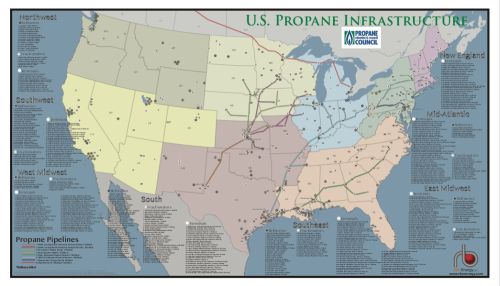
The RBN Energy U.S. Propane Infrastructure map provides a comprehensive view of the propane supply network in the lower 48 states.
Before the export market blossomed for U.S. crude oil in the late 2010s, most domestic production flowed through the important Midcontinent hub of Cushing, OK (see Give and Take). That location might seem odd on the surface for a global energy hub — the closest major cities are Tulsa and Oklahoma City, and the nearest refineries (HF Sinclair in Tulsa and Phillips 66 in Ponca City, OK) only account for about 325 Mb/d of demand. However, if you look a little deeper, you’ll see that Cushing has a rich history (see The Heart of the Matter), an astonishing 94 MMbbl of aboveground storage, and a long-standing role as a “trading post.”
(RBN’s recently updated Cushing Crude Oil Playbook provides a one-stop, comprehensive guide to the hub’s assets and details the infrastructure each company controls with maps and comparable attribute tables. Click here for more information.)
The strong physical trading liquidity at Cushing attracted paper traders, allowing market participants to hedge their physical business and bet on the market via the WTI Light Sweet Crude Oil futures contract (contract symbol: CL) on the New York Mercantile Exchange (NYMEX). This contract, which launched more than 40 years ago, became important in the domestic market and internationally. In 2008, NYMEX was acquired by the Chicago Mercantile Exchange (CME), which currently manages the CL contract. CL remains the most liquid contract for U.S.-originated crude oil. While this contract was initially supplied with WTI directly from West Texas, it did not exclude crude oil that originated elsewhere but met the contract standards. (See Trading in the U.S.A.; more on this in the next blog in this series.)
About the song
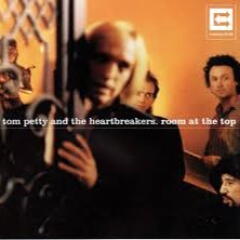
“Room at the Top” was written by Tom Petty and appears as the first cut on Tom Petty and the Heartbreakers’ 10th studio album, Echo. The single of “Room at the Top” went to #19 on the Billboard Top Mainstream Rock Songs chart. Personnel on the song were: Tom Petty (lead and backing vocals, rhythm guitars, harmonica), Mike Campbell (lead guitars), Benmont Tench (piano, organ, Chamberlain, clavinet), Scott Thurston (rhythm guitars, backing vocals), Steve Ferrone (drums) and Howie Epstein (bass guitar, backing vocals).
Echo was released in April 1999 and was produced by Tom Petty, Mike Campbell and Rick Rubin. It went to #10 on the Billboard Top 200 Albums chart and was certified Gold by the Recording Industry Association of America. Three charting singles were released from the album. Mike Campbell sang lead vocals on the song “I Don’t Wanna Fight,” making Echo the only Tom Petty and the Heartbreakers’ album on which Tom Petty didn't sing lead vocals on every song. It was also the last Heartbreakers album to feature bass guitar and backing vocal contributions from Howie Epstein, who left the band during its recording because of a heroin addiction.
Tom Petty and the Heartbreakers were an American rock band with roots in Gainesville, FL; the band officially formed in Los Angeles in 1976. They made 13 studio albums, three live albums, six compilation albums and 24 singles. Tom Petty and the Heartbreakers won two MTV Video Music Awards and were inducted into the Rock and Roll Hall of Fame in 2001. Howie Epstein died in 2003, and Tom Petty passed away in 2017, putting an end to the Heartbreakers. Lead guitarist and songwriter Mike Campbell has released three studio albums with his band, The Dirty Knobs, since that time.