The race is on and here comes WTI up the backstretch. On November 5, CME Group launched a Houston WTI futures contract, challenging a similar trading vehicle from Intercontinental Exchange (ICE) that started up in mid-October. Ever since crude flows to the Gulf Coast took off five years ago, the crude market has been clamoring for a trading vehicle that would accurately reflect pricing in the region that dominates U.S. demand from refineries, imports and exports. Now there are two. But their features are quite distinct. ICE’s contract reflects barrels delivered to Magellan East Houston, while CME’s contract is based on deliveries into Enterprise’s Houston system. The specs are different, as are the physical attributes of the two delivery points. Will both survive? Probably not. Futures markets tend to concentrate liquidity — trading activity — into a single vehicle that best meets the needs of the market. So, which of these will come out on top? That’s what the crude oil market wants to know. In today’s blog, we delve into the differences between the two new futures contracts for West Texas Intermediate (WTI) crude delivered to Houston and ponder the market implications of these new hedging and trading tools.

The Crude Voyager is a weekly analysis of U.S. Gulf Coast loading activity that explains the ebbs and flows of crude loadings, destinations, and geopolitical issues impacting U.S. exports. It outlines the major paths for laden tankers hauling U.S. crude all over the world and reflects the change in tanker departures to the main regions that consume U.S. crude.
Delivery Points and Exchanges
Let’s first consider the ICE contract, officially called “Permian WTI (Houston)” and referenced by the ticker HOU. Its delivery point is Magellan East Houston (MEH). MEH has been a frequent topic in the RBN blogosphere, most recently in We Gotta Get Out of This Place. The terminal (highlighted by the orange circle in the map in Figure 1) is located about five miles northeast of downtown Houston, a couple of miles north of the west end of the Houston Ship Channel, and receives barrels from the Longhorn and BridgeTex pipeline systems (orange lines coming into MEH from Colorado City and Crane, TX, in the Permian Basin) and TransCanada’s Marketlink pipeline from the Cushing, OK, crude hub. MEH has the capacity to store more than 9.0 MMbbl; ICE tells us that after barrels are delivered to MEH via its HOU contract, shippers have the option to take delivery there or nominate them to move elsewhere across the Gulf Coast, including all refineries along the Houston Ship Channel and in Texas City; Shell’s Zydeco Pipeline to Louisiana; and other crude oil storage terminals in the Houston area. The Argus and Platts price reporting services have been posting daily numbers for MEH for years. ICE has the advantage that it is the trading exchange for the global crude benchmark Brent futures contract, which started trading in 1988 on the International Petroleum Exchange (acquired by ICE in 2001). Two-thirds of the world’s crude streams price against Brent and over 95% of the 2.3 million lots of open interest in Brent is on ICE’s Clear Europe clearinghouse.
CME Group’s contract for WTI Houston futures, referenced by the ticker HCL, provides for delivery at three different Enterprise terminals: Enterprise Crude Houston (ECHO; highlighted by lower-right blue circle in Figure 1), Enterprise Houston Ship Channel (EHSC; top blue circle) and Genoa Junction (lower-left blue circle) –– collectively the “Enterprise Delivery Locations.” The Enterprise Delivery Locations span the Houston Ship Channel area. They allow for receipts from the Enterprise-operated Midland to ECHO Pipeline, Midland to ECHO II Pipeline (NGL conversion in-service in the second quarter of 2019), and Eagle Ford Pipeline, all through the Rancho II Pipeline into ECHO, as well as receipts from Seaway Crude Pipeline and most other crude pipes in the area. The Enterprise Delivery Locations directly house almost 32 MMbbl of crude storage: 8.3 MMbbl at ECHO and 23.5 MMbbl at EHSC. Market participants have access through Enterprise’s distribution system (which includes links to Seaway’s Port Arthur Lateral and Shell’s Zydeco Pipeline) to all of the Houston Ship Channel, Texas City and Port Arthur refineries, and 14 of the 18 Enterprise-operated docks in the area. CME has the advantage that the exchange is the trading platform for the Cushing (OK) WTI contract — the godfather of all crude futures contracts — which has been actively traded since 1983 (back then on the New York Mercantile Exchange, or NYMEX, which was acquired by CME in 2008) and underlies the pricing mechanisms for most U.S. crudes no matter where they are located (see The CMA Roll Adjust and WTI P-Plus).
About the song
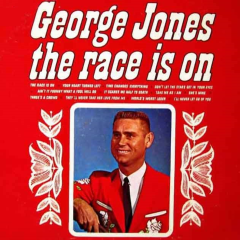
“The Race is On” was written by Don Rollins and appears as the first song on George Jones’s 22nd studio album of the same name. Released as a single in September 1964, the song went to #3 on the Billboard Hot Country Songs and #96 on the Billboard Hot 100 Singles charts. Don Rollins wrote the song after a visit to the Turf Paradise Race Course in Phoenix. George Jones first heard the song when promoter Dewey Groom played a demo of it for him in his office at the Longhorn Ballroom in Dallas. The Longhorn has an interesting history in the fact that it was owned by Bob Wills, then Jack Ruby (who killed Lee Harvey Oswald after he assassinated JFK), before Groom bought the ballroom. It was also the site of one of the 12 concerts that the Sex Pistols played in the U.S. in 1978 before breaking up. “The Race is On” has been covered by many artists, including Jack Jones, Dave Edmunds, Sawyer Brown, and The Georgia Satellites. Known personnel on the record were: George Jones (lead vocals), Jimmie Gray (high harmonies, bass) and Kelso Herston (six string bass solo).
The Race is On album was originally titled I Get Lonely in a Hurry but was changed after “The Race is On” single became a hit. The album was recorded at Columbia Recording Studios in Nashville in August 1964, with Pappy Daily producing. Released in November 1964, the album went to #10 on the Billboard Country Albums chart. After being retitled The Race is On, it was re-released in April 1965 and went to #3 on the Billboard Country Albums chart.
George Jones was an American country music singer, songwriter and musician. Known as “The Possum,” Jones released 87 studio albums, three live albums, 43 compilation albums and 134 singles. With Tammy Wynette, he released nine studio albums, five compilation albums and 14 singles. He is a member of the Country Music Hall of Fame and won many awards from Billboard, Cash Box, ACM and CMA. He won three Grammy Awards and is the recipient of a Pioneer Award from the ACM, a U.S. National Medal of Arts and a Kennedy Center Honor. When Johnny Cash was once asked who his favorite country music singer was, he replied: “You mean besides George Jones?” Jones died in Nashville in April 2013 at the age of 81.