The Northeast gas market has come a long way since 2013, when it first began net exporting gas supply to the rest of the U.S. The past several years were marked by dozens of pipeline expansions to relieve takeaway constraints and to balance oversupply conditions in the region; as a result, takeaway capacity is finally outpacing production growth. How much spare capacity is there now, and how long will it be before production growth hits the capacity wall again? Today, we continue our series on Northeast gas takeaway capacity vs. production, this time examining the utilization of pipes in the Northeast-to-Gulf Coast corridor.
In Part 1 of this series, we started with an overview of where the Northeast natural gas market stands heading into the 2019 summer season. After years of languishing under the pressure of persistent takeaway constraints and oversupply conditions, pipeline capacity out of the region has finally caught up to and is outpacing production growth — the culmination of many projects to reverse traditionally inbound flows to the region. As a result, prices at the Dominion South pricing hub — representative of Appalachian supply — have strengthened relative to the national benchmark Henry Hub. This marks a new phase in the big reversal of gas flows out of the Northeast, which has gone from being almost strictly a gas-consuming region to being nearly gas-supply sufficient and, eventually, also a net supplier of gas to surrounding regions in the U.S. and Canada. The question now becomes, how long before production again outgrows takeaway capacity and constraint-driven prices return? To answer that, in Part 2, we began an assessment of the capacity vs. flows (i.e. utilization rates) on the various transportation outlets out of the Northeast, taking a pipe-by-pipe look at just how much spare capacity there is currently and where. We started with the pipes along the Northeast-to-Midwest corridor — comprising Enbridge/DTE Energy’s NEXUS Gas Transmission line, Energy Transfer’s Rover Pipeline, a portion of Tallgrass Energy’s Rockies Express Pipeline (REX) and the westerly leg of Enbridge’s Texas Eastern Transmission (a.k.a., TETCO “24-inch”) — and the Northeast-to-Canada corridor, with National Fuel’s Empire Pipeline and Kinder Morgan’s Tennessee Gas Pipeline (TGP).
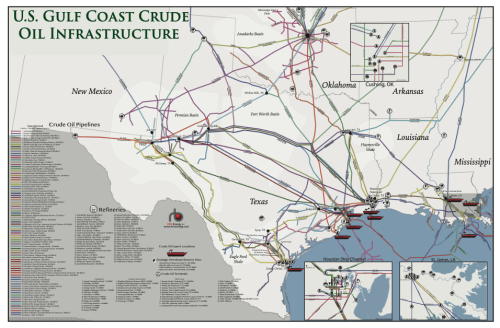
RBN’s US Gulf Coast Crude Oil Infrastructure Map - is up-to-date and provides a clear and comprehensive view into North America’s most dynamic and important crude oil market landscape.
Next, we turn to the pipelines that move Marcellus/Utica gas to the Gulf Coast via the Ohio-to-Gulf and Southeast/Atlantic corridors (see Part 1 for the flow corridor map). These routes include the four major long-haul pipes that once moved most of the Northeast’s gas supplies north from the Gulf Coast producing regions — they’re known as the “T pipes” because their names happen to start with the letter “T.” They include Williams’s Transco, Kinder’s TGP, Boardwalk Pipeline Partners’ Texas Gas Transmission (TGT) and TETCO’s easterly leg (a.k.a. the “30-inch” line), as well as another legacy pipe: TC Energy’s Columbia Gulf Pipeline. This group also includes deliveries from Energy Transfer’s Rover Pipeline into third-party pipelines that direct some of their gas toward the Gulf Coast. We should note that some of the southbound volumes on a few of these routes also capture Gulf Coast-bound gas supply delivered from Tallgrass’s REX.
About the song
“Room at the Top” was written by Tom Petty and appears as the first cut on Tom Petty and the Heartbreakers’ 10th studio album, Echo. The single of “Room at the Top” went to #19 on the Billboard Top Mainstream Rock Songs chart. Personnel on the song were: Tom Petty (lead and backing vocals, rhythm guitars, harmonica), Mike Campbell (lead guitars), Benmont Tench (piano, organ, Chamberlain, clavinet), Scott Thurston (rhythm guitars, backing vocals), Steve Ferrone (drums) and Howie Epstein (bass guitar, backing vocals).
Echo was released in April 1999 and was produced by Tom Petty, Mike Campbell and Rick Rubin. It went to #10 on the Billboard Top 200 Albums chart and was certified Gold by the Recording Industry Association of America. Three charting singles were released from the album. Mike Campbell sang lead vocals on the song “I Don’t Wanna Fight,” making Echo the only Tom Petty and the Heartbreakers’ album on which Tom Petty didn't sing lead vocals on every song. It was also the last Heartbreakers album to feature bass guitar and backing vocal contributions from Howie Epstein, who left the band during its recording because of a heroin addiction.
Tom Petty and the Heartbreakers were an American rock band with roots in Gainesville, FL; the band officially formed in Los Angeles in 1976. They made 13 studio albums, three live albums, six compilation albums and 24 singles. Tom Petty and the Heartbreakers won two MTV Video Music Awards and were inducted into the Rock and Roll Hall of Fame in 2001. Howie Epstein died in 2003, and Tom Petty passed away in 2017, putting an end to the Heartbreakers. Lead guitarist and songwriter Mike Campbell has released three studio albums with his band, The Dirty Knobs, since that time.