


Today is a sad day for the world of oil tankers. Unless a miracle happens by 10 a.m. local time at the Hawaii Department of Transportation's Harbors Division, the last surviving iron-hulled, sail-driven oil tanker is headed to Davy Jones’ Locker. The once-proud, four-masted, 143-year-old windjammer will soon be scuttled by deliberately sinking her at sea off the shores of Honolulu. How could things have come to this? In today’s blog, we’ll take a trip down memory lane to explore how a spectacular, fully rigged oil tanker could have survived for so long, plying the oceans for this author’s former employer, only to be betrayed in her final years.

Canadian crude output is rising, requiring new export routes. As traditional pathways face constraints, the U.S. Rockies—especially the Guernsey, WY hub—are emerging as key corridors for moving Canadian heavy crude to downstream markets, including the Gulf Coast.
The “Falls of Clyde.” That’s the ship, named after a group of waterfalls on the River Clyde in Scotland, which runs through Glasgow. She was built in Port Glasgow (Inverclyde), and launched on December 12, 1878, the first of nine iron-hulled, four-masted ships for Wright, Breakenridge & Co.'s Falls Line, a Scottish shipping firm that operated in the late 19th and early 20th centuries. In her maiden voyage she was off to Karachi (Pakistan) and for the next 21 years she sailed the seas as a British merchantman, hauling wheat, jute, cement, and lumber to and from Australia, India, New Zealand, the British Isles, and the U.S. West Coast.
Then, in 1899, the Falls of Clyde was shipped off to Honolulu and registered under the Hawaiian flag, just before Hawaii was annexed by the U.S. A special act of the U.S. Congress gave the Falls of Clyde the right to sail as an American-flagged vessel. At about the same time, the ship was rigged as a barque, meaning that her masts were reconfigured, a deckhouse and charthouse were added, and the owner did some work on the cabins so she could accept paying passengers. Over the next eight years, she made over 60 voyages between Hawaii and San Francisco carrying merchandise west, sugar east, and passengers both ways.
About the song
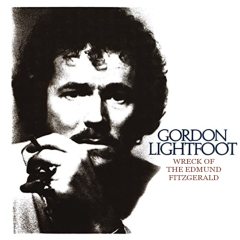
"Wreck of the Edmund Fitzgerald" was written by Gordon Lightfoot and appears as the second cut on side two of his 12th studio album, Summertime Dream. Recorded at Eastern Sound Studios in Toronto in December 1975, the song was released as a single in August 1976. It went to #2 on the Billboard Hot 100 Singles chart. Lightfoot drew his inspiration for the song from an article in a Newsweek magazine from November 1975 about the sinking of the bulk carrier SS Edmund Fitzgerald in Lake Superior. He considers the song to be his finest work. Personnel on the record were: Gordon Lightfoot (vocals, six- and 12-string acoustic guitars), Terry Clements (lead acoustic, electric guitars), Pee Wee Charles (pedal steel guitar), Rick Haynes (bass), and Barry Keane (drums, percussion).
Summertime Dream was recorded in December 1975 and January 1976, with Lenny Waronker and Gordon Lightfoot producing. Released in June 1976, the album went to #12 on the Billboard Top 200 Albums chart. It has been certified Platinum by the Recording Industry Association of America. Three singles were released from the LP.
Gordon Lightfoot is a Canadian singer-songwriter and guitarist who was instrumental in defining the folk-rock sound of the 1960s and ’70s. His songs have been covered by a plethora of artists in the pop music field. He has released 19 studio albums, three live albums, 19 compilation albums, and 47 singles. Lightfoot has received 16 Juno Awards and four ASCAP Awards, and is a member of the Songwriters Hall of Fame. He is the subject of the documentary film, Gordon Lightfoot: If You Could Read My Mind. Gordon Lightfoot, now 82, continues to record and tour.
** There is some debate that the ship sailing under the Golden Gate Bridge is actually the “Star of Shetland,” a vessel owned at the time by the Alaska Packers Association. This point is contested by the Getty Oil archives. But granted, the ships do look similar. Regardless of the evidence supporting this theory, we choose to believe that the ship in question is, in fact, the Falls of Clyde. If it is not the Falls of Clyde, it ought to be.





Comments
Super interesting article today folks, even to this long time land-locked trader. Great pic of the ship near the Golden Gate under construction too - I might've picked it up to had I seen it for sale somewhere!
(big fan of Gordan Lightfoot as well, another proud canuck)
Thank you. Very nice.
David K