The Energy Information Administration (EIA) estimates that natural gas gross production in the Rockies’ Niobrara region increased to a record 5.1 Bcf/d in September 2018, narrowly beating the previous high mark set almost seven years ago. And, with major, crude oil-focused producers in the Powder River Basin (PRB) and Denver-Julesburg Basin (D-J) planning for expanded crude output in 2019 and beyond, production of associated gas is expected to continue rising. All this growth — actual and anticipated — is spurring the development of new midstream capacity, especially gas processing plants, in both the PRB and the D-J Basin. So, what’s already in place, what’s being built and planned, and how soon will it need to come online? In today’s blog, we continue our review of Rockies crude oil, gas and NGL production, processing capacity and takeaway pipes, this time with a look at the gas side of things in the PRB.

To truly understand Cushing — what it does and how it works — you need to know the hub’s assets and how they fit together. RBN’s Cushing Crude Oil Playbook provides the first one-stop, comprehensive guide to the hub’s assets.
Colorado is the nation’s highest state — and no, not only in the way you’re thinking. The state’s mean altitude is about 6,800 feet, and it has more than 50 distinct peaks with an elevation of 14,000 feet or higher (more than all of Canada). Wyoming ranks #2 in “highness,” with a mean altitude of 6,700 feet (but no “fourteeners,” as peaks of at least 14,000 feet are commonly known among mountain climbers). In part because of their unique geologic history, these two states at the heart of the U.S. Rockies also comprise the epicenter of the Niobrara shale play, which — as we said in Part 1 of this blog series — has experienced a significant rebound in drilling activity and hydrocarbon production since the beginning of last year. Crude oil output in the Niobrara’s D-J Basin and PRB now tops 620 Mb/d (also based on EIA statistics) for the first time ever and, as we said in our intro, gas production is in record territory too. Ditto for NGLs output — to the point that the development of new NGL takeaway capacity is a top priority.
Recall that there is no real consensus on the boundaries of the Niobrara or of the D-J Basin and PRB within it. The dashed red line in the map in the left of Figure 2 shows how RBN outlines the extent of the Niobrara surface geography, with the D-J (green area) including most of northeastern Colorado, four counties in southeastern Wyoming and small parts of western Kansas and Nebraska. Under our definition, the PRB (blue and light blue areas) includes six counties in northeastern Wyoming and parts of southern Montana and western South Dakota. The EIA, which tracks Niobrara oil and gas production (and new-well production per rig), gives the region a slightly different shape (red area in Figure 1) — adding four counties in western Colorado, for instance, and not counting four others that we do in Montana, Wyoming and South Dakota. The point is, the vast majority of Niobrara oil and gas production is in the counties where our and EIA’s view of the boundaries overlap.
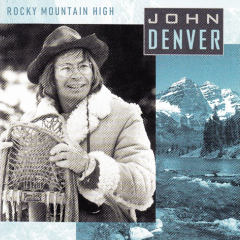
About the song
“Rocky Mountain High” was written by John Denver and Mike Taylor and appears on Denver’s sixth studio album of the same name. The Milt Okun-produced single was recorded in August 1972 and released in October of that year. It rose to #9 on the Billboard Hot 100 and #3 on the Adult Contemporary charts. The song was inspired by Denver’s move to Aspen, CO, in the late 1960s, and his love for the state. It is one of Colorado’s two official state songs, the other being “Where the Columbines Grow.” (Denver wrote another official state song, “Take Me Home, Country Roads,” one of four state songs of West Virginia.)
John Denver (Henry John Deutschendorf Jr.) was an American singer-songwriter, record producer and actor. He released 25 studio albums, sold over 33 million records worldwide, and has 12 gold and four platinum records. His career took off when his “Leaving on a Jet Plane” became a #1 hit for Peter, Paul and Mary on the Billboard Hot 100 in 1969. Denver has won one American Country Music Award, two Country Music Association Awards, one Emmy and two Grammys. He was selected poet laureate of Colorado in 1977, and inducted into the Songwriters Hall of Fame in 1996. Denver died in a plane crash in 1997.