Gross production of natural gas in the Niobrara region topped 5 Bcf/d for the fourth consecutive month in November 2018, according to the Energy Information Administration, and it's estimated that regional output this month will hit another record: nearly 5.2 Bcf/d. These production gains, and the concentration of new wells in or near Weld County, CO — the epicenter of the Niobrara’s Denver-Julesburg Basin — are straining the ability of existing gas processing plants to keep up, and spurring the rapid development of new processing capacity. The scale of the build-out in the D-J is impressive: some 2.7 Bcf/d in new cryogenic plants are either under construction or in various stages of pre-construction planning in northeastern Colorado. Today, we continue our review of Rockies crude oil, gas and NGL production and infrastructure, this time focusing on gas-processing needs in the sky-high D-J.
This is the fourth blog in this series. In Part 1, we discussed the Niobrara’s geography and hydrocarbon production history. By our assessment, the play includes the D-J Basin and the Powder River Basin (PRB), with the heart of PRB in northeastern Wyoming and the D-J taking up much of northeastern Colorado and part of southeastern Wyoming. The Niobrara has been producing oil and gas for more than a century. Total production of natural gas took off there in the late 1990s and early 2000s, and production held relatively steady through most of the 2010s at between 4.3 Bcf/d and 4.9 Bcf/d, breaching the 5-Bcf/d mark only once (in January 2012) until this past August; since then, production has ratcheted up month by month, hitting a record 5.15 Bcf/d in November.
As for crude oil, production in the D-J Basin and PRB took off during the Shale Era, soaring from less than 140 Mb/d in January 2010 to a peak of nearly 500 Mb/d in April 2015. Drilling activity and production sagged with crude prices in 2014-16, and by January 2017, the play’s oil output was down to just a hair above 400 Mb/d. Since then, though, it’s been on a tear — up to 664 Mb/d as of November, again according to EIA. The agency doesn’t specifically track NGL production in the Niobrara, but its data show NGL output rising generally in the Rockies — Petroleum Administration for Defense District (PADD) 4 — by one-third since 2013, with a substantial portion of those gains likely occurring within the Niobrara.
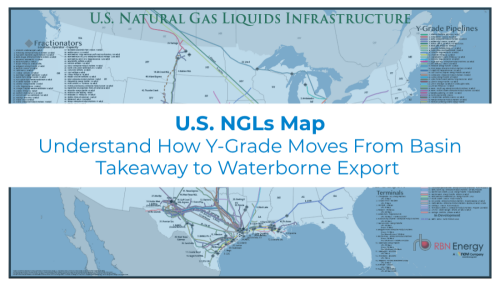
Visualize the infrastructure behind U.S. NGL movement.
The U.S. NGLs Map provides a comprehensive view of the transport, processing, and export networks moving NGLs across the U.S.

About the song
“Rocky Mountain High” was written by John Denver and Mike Taylor and appears on Denver’s sixth studio album of the same name. The Milt Okun-produced single was recorded in August 1972 and released in October of that year. It rose to #9 on the Billboard Hot 100 and #3 on the Adult Contemporary charts. The song was inspired by Denver’s move to Aspen, CO, in the late 1960s, and his love for the state. It is one of Colorado’s two official state songs, the other being “Where the Columbines Grow.” (Denver wrote another official state song, “Take Me Home, Country Roads,” one of four state songs of West Virginia.)
John Denver (Henry John Deutschendorf Jr.) was an American singer-songwriter, record producer and actor. He released 25 studio albums, sold over 33 million records worldwide, and has 12 gold and four platinum records. His career took off when his “Leaving on a Jet Plane” became a #1 hit for Peter, Paul and Mary on the Billboard Hot 100 in 1969. Denver has won one American Country Music Award, two Country Music Association Awards, one Emmy and two Grammys. He was selected poet laureate of Colorado in 1977, and inducted into the Songwriters Hall of Fame in 1996. Denver died in a plane crash in 1997.