We’ve been talking about growing natural gas liquid (NGL) production in recent weeks from the Williston Basin, the Eagle Ford, the Northeast and other geographies. We have also previously discussed the mismatch between NGL production growth and incremental domestic demand, but we have yet to answer the question: are we likely to run into storage issues with NGLs while we are waiting for infrastructure and demand side projects such as export terminals and petrochemical facilities to be built out? Today we start a series of blogs examining regional storage capacity and the mismatch between expected U.S. NGLs supply - an incremental 1.5 MMb/d between 2012 and 2018, and demand growth. In today’s blog, we set the stage for the series and take a broad look at NGL Storage.
Starting with a brief recap from our previous blog, Smoky and the Salt Caverns – A Saga of NGL Storage, U.S. NGL production from gas processing is increasing steadily, but the rate of production does not match up with demand. Demand swings with petchem feedstock economics, the gasoline blending season, the impact of temperature on propane use and a myriad of other factors. Total demand also lags behind total production. Overall it will be exports that balance supply and demand. But on any given day the flywheel that balances NGL markets is storage. But not just any storage. You can’t put these products in regular petroleum storage tanks. For NGLs, storage of large volumes means salt caverns. Huge caverns thousands of feet below the surface.
Salt storage exists not only in and around Conway, KS as discussed in Smoky and the Salt Caverns, but also in Mont Belvieu, TX, the granddaddy of all NGLs storage locations. Since the 1950’s, Mont Belvieu has been the center of the universe for Natural Gas Liquids (NGLs), sitting next to the Houston Ship Channel and on top of Barbers Hill, one of the largest underground salt dome formations in the world. This salt dome is about 2,000 feet below sea level and was originally “mined” (washed out with a water solution) by Warren Petroleum to create hundreds of individual wells used to store NGLs under pressure to maintain their liquid state. For more on Mont Belvieu storage and the major players in that market see Can Mont Belvieu Handle the NGL Supply Surge? - Part I.
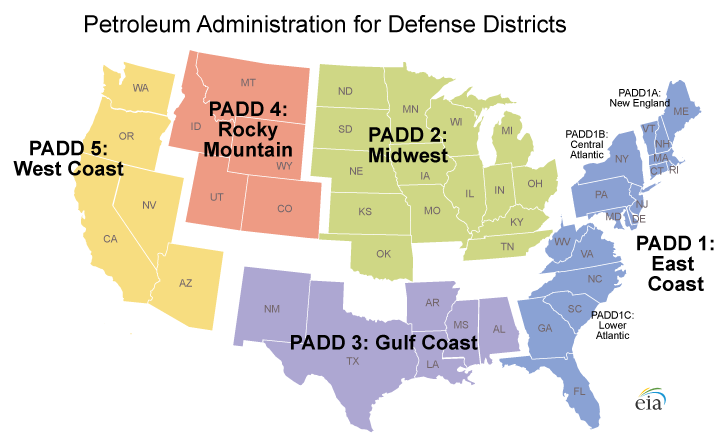
Now lets get back to today’s topic - and Breakin’ It Up! For this blog series we are going to break up the country into regions and look at storage capacity and NGL production by Petroleum Administration Defense Districts (otherwise known as PADDs) according to the U.S. Energy Information Administration (EIA). See the map below. For a more detailed description of the PADDs click here.