


Net crude oil imports to the U.S. Gulf Coast in 2016 have been running well above the pace set last year, the increase driven by a combination of lower U.S. crude oil production, rising import levels and relatively flat export volumes. The trend toward higher net imports –– an outgrowth of the end of the ban on U.S. crude exports –– is significant in that it affects oil inventories and oil prices. What’s driving this trend, and how soon might net imports peak? Today, we survey recent developments on the crude oil import/export front, with a focus on the Gulf Coast.
Crude oil traders and the audience at the U.S. Open in Flushing Meadows, NY had one thing in common recently: their heads have been whirling, side to side and up and down. In the case of crude oil traders this was due to a sharp drop in imports in the week ending September 2, followed by a sharp rise the following week. The rollercoaster was caused primarily by the coincidence of three factors: a hurricane preventing discharges at Chevron's Pascagoula, MS refinery and disrupting offloading at the Louisiana Offshore Oil Port; the Labor Day holiday slowing operations elsewhere; and the decision by importers in Texas to reduce their intake of imported barrels ahead of the ad valorem tax assessment on September 1. Soon after tax day, the crude came flooding back in (see Figure 1).
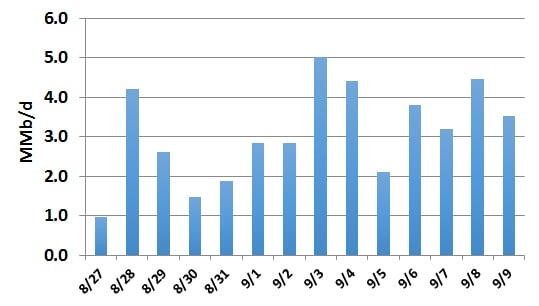
Figure 1; U.S. Crude Oil Imports, Late August/Early September 2016; Source: Clipper Data
Beyond the short-term whiplash caused by these transient factors, there is a real concern among traders about the level of imports, and what they mean for the health of the market. In many ways it’s not surprising that import volumes are up. After all, U.S. oil production is way down –– from a peak of more than 9.6 MMb/d in April 2015 to less than 8.5 MMb/d as of September 2, according to the Energy Information Administration (EIA) –– so U.S. refineries have turned to overseas suppliers to help fill the gap. Also, lifting the U.S. ban on crude oil exports in December 2015 released domestic crude oil from its confinement to a limited market. And it put domestic and import barrels on an even footing in the U.S. market; before the ban ended, domestic barrels often were cheaper because they had nowhere else to go. With U.S. crude now able to be shipped overseas, more oil could flow out, and more oil needed to be imported to make up the difference.

About the song
"Tangled Up in Blue" was written by Bob Dylan and appears as the first song on Dylan's 15th studio album, Blood on the Tracks. Recorded in December 1974 at Sound 80 in Minneapolis, the song was produced uncredited by Dylan's brother, David Zimmerman. Released as a single in May 1975, the song went to #31 on the Billboard Hot 100 Singles chart. Personnel on the record were: Bob Dylan (vocals, guitar, harmonica), Kevin Odegard and Chris Weber (guitar), Gregg Inhofer (keyboards), Billy Peterson (bass), and Bill Berg (drums). The song has been covered by artists such as Jerry Garcia, T-Bone Burnett, The Indigo Girls, and Robyn Hitchcock.
Blood on the Tracks was recorded between September and December 1974 at A&R Recording in New York City and Sound 80 in Minneapolis. Produced by Bob Dylan, with some assistance from his brother David Zimmerman, the album was released in January 1975. It went to #1 on the Billboard Top 200 Albums chart and has been certified 2x Platinum by the Recording Industry Association of America. Only one single, “Tangled Up in Blue,” was released from the LP.
Bob Dylan (Robert Allen Zimmerman) is an American singer, songwriter, author, and visual artist. He has been a major figure in pop culture for over six decades, with record sales of over 125 million worldwide. He has released 39 studio albums, 15 live albums, 29 compilation albums, 17 EPs, and 95 singles, and has won10 Grammy Awards, one Academy Award, and one Golden Globe Award. Dylan has been inducted into the Rock and Roll Hall of Fame and the Songwriters Hall of Fame, and is a recipient of the Presidential Medal of Freedom, a Nobel Prize in Literature, and a special citation from the Pulitzer Prize Board. His archives will be housed at The Bob Dylan Center in Tulsa, scheduled to open in May 2022. Dylan still records and tours, and will begin his Rough and Rowdy World Wide Tour in November 2021.







Comments
After reading your article, I'm still left with the question as to why imports aren't down given high levels of domestic inventories. I realize that US production is down considerably from its recent peak, but why aren't inventories decreasing at a faster rate instead of relying on imports (particularly with the Brent-WTI spread now over $2)? I know this ties back to refining capacity and its ability to process lighter crudes. Moreover, domestic infrastructure, particularly pipeline capacity, needs to increase to transport barrels out of the Permian to the Gulf and East Coast. Can you provide some data points and thoughts on these issues and how they tie in to the still stubbornly high levels of imports?
In reply to Taking a step back by Karthik Srinivasan
"I believe the answer to your comment is quite simple (hopefully not simplistic): there's not enough domestic oil. Transportation infrastructure is not the issue. You could of course argue that domestic production can ramp up. After all, we've reduced output dramatically. But that is is precisely the point: The domestic production that was cut was from wells that could not compete in the global market. Rising prices will eventually bring back domestic production and reduce imports. Until then, I believe we'll see high net inflows."
Abudi Zein
(posted by hforman)
The middle east exporters seem to be resorting to a strategy of pushing their excess barrels to the US while reducing the glut in their own backyard (East of Suez market). This way they are able to improve cash differentials in Asia for their oil and at the same time squeeze the cash differentials for US grades in their domestic market (i.e. US) thereby putting additional pressure on the US domestic producers. Purely, based on economics, the exports should have dwindled as the arb doesn't work. In fact its more like a reverse arb with oil moving from high price region to low price region. However, if the exporters are willing to take a hit and subsidize the transportation between the two regions what can really stop them. What is even more surprising is the fact that Brent / WTI spread is around $2/bbl despite the inventory at Cushing rising to more than 62 MMBBLs from around 20 MMBBls in mid 2014. I guess, a widening of the spread would most likely be more beneficial to the domestic US producers.