Data center power demand is soaring as AI — artificial intelligence — rapidly expands across all sorts of applications. That statement is certainly the top buzz factor in today’s energy markets. These facilities need 24x7, super-reliable power, and there’s only one power generation fuel that has any hope of keeping up with the demand surge: natural gas. While most data center developers would prefer green energy to cover their power requirements, the intermittent nature of wind and solar means that for many facilities, it can't happen, at least for the short-to-medium term hyped-up market we are seeing right now. But how much incremental power are we talking about? And how much natural gas will be needed? That’s what we’ll explore in today’s RBN blog.
“Ever wondered why your smart speaker keeps asking for more power? It’s not just craving a caffeine boost — it’s trying to keep up with the insatiable demand of AI’s appetite for electricity!” Those aren’t our words. Instead, they’re what ChatGPT gave us (exclamation point included!) when we asked it to write a humorous first sentence for an RBN blog about AI and power demand. Not bad, really, but we’ll stick with human bloggers. (Well, for the time being at least!)

Seriously, it’s a feeding frenzy out there — AI is the next big thing. It’s just like Wall Street’s obsession with Nvidia. It seems like energy markets are salivating over ChatGPT and anything related to generative AI, with energy BizDev reps looking to reel in some of those high-demand, energy-hog projects. That’s definitely the sense we get from RBN’s informal crowd-sourced market intelligence system — meaning questions and comments from our 45,000 blog recipients. Mostly, you all want to separate the hype from the reality and figure out what’s really going on in this market.
In response, we’ve been doing our own serious research to help put AI energy demand in perspective. Although we pulled information from many sources, much of what we’ve included in this blog is sourced from a very useful white paper published by EPRI — the Electric Power Research Institute — in May 2024 titled “Powering Intelligence — Analyzing Artificial Intelligence and Data Center Energy Consumption.” We took up the challenge to validate, triangulate and corroborate the paper, and to make the information a bit more digestible for natural gas folks who might consider providing fuel/infrastructure for power plants needed to meet AI demand.
U.S. Data Center Market
As of March 2024, the U.S. had 5,381 data centers, nearly doubling from around 2,700 in January 2021. This substantial growth in data center capacity has been driven largely by the increasing demand for what are generally classified as AI-powered tasks, such as speech recognition, image recognition, predictive analytics, personalized diagnostics/treatment, logistics/mapping applications, fraud detection, and of course, generative AI. The rapid rise in interest in generative AI is particularly noteworthy, catalyzed by the sudden success of ChatGPT (which launched in November 2022) and a few other AI chatbots that have popped up riding the ChatGPT wave, including Copilot, Claude, perplexity.ai and Jasper.
While the national-level growth estimates are substantial, the geographic concentration of the industry and the local challenges it creates are even more striking. As shown in Figure 1, nearly 50% of 2023 U.S. data center load was concentrated in only four states: Virginia, Texas, California and Illinois. Including another 11 states brings the total to 80% of the load. Virginia alone accounted for 22% of the national data center demand, benefiting from strong internet connections, minimal disruptive events, an available skilled labor force, proximity to population centers and users, and reliable backup power sources (for more, see Storm Front).
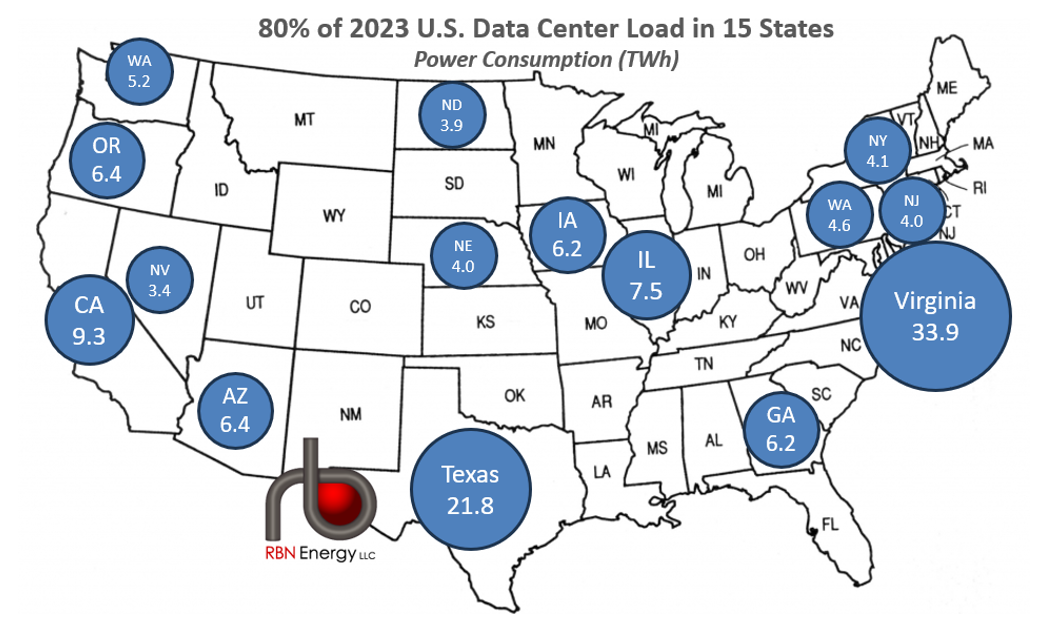
Figure 1. 2023 U.S. Data Center Load in TWh. Sources: EPRI, RBN

About the song
“Smarter Than U” was written by Michael Bradley and Damian O’Neill and appears as the 18th track on the March 2009 CD and download extended reissue of The Undertones’ debut album of the same name. The reissue includes 17 additional bonus tracks to the 14 on the original release. The bonus songs are in the same short, fast, and in-your-face style as those on the initial LP. Personnel on the record were: Feargal Sharkey (lead vocals), Damian O'Neill (lead guitar, backing vocals), John O'Neill (rhythm guitar, backing vocals), Michael Bradley (bass, backing vocals), and Billy Doherty (drums).
The album The Undertones was recorded at Eden Studios in London in January and February 1979 and produced by Roger Bechirian. The band had previously released two singles and two EPs before recording their first full-length album. Released in May 1979, it went to #31 on the UK Albums chart. One single, “Jimmy Jimmy,” was released from the LP.
The Undertones are a punk rock band formed in Derry, Northern Ireland, in 1974 by Feargal Sharkey, Damian O'Neill, John O'Neill, Michael Bradley, and Billy Doherty. The band broke up in July 1983 after Sharkey, the lead singer, announced he was leaving. They reformed in November 1999 with Paul McLoone as their lead singer. The Undertones have released six studio albums, 14 compilation albums, three EPs and 20 singles. Famous BBC DJ John Peel named The Undertones” single, “Teenage Kicks,” to be his favorite song of all time. After hearing “Teenage Kicks” on Peel’s show, Seymour Stein signed the band to his Sire Records label in 1979. The Undertones still perform live and recently wrapped up a European tour.