The U.S. natural gas market is primed for supply growth. The Lower 48 supply-demand balance is the most bullish it has been in years. Exports are at record levels and poised to increase with additional terminal expansions on the horizon, while international prices have recently notched record highs. Henry Hub gas futures prices are at the highest in over a decade. So, producers will unleash a torrent of natural gas, triggering a midstream build-out like we’ve seen in the past, right? Not so fast. The world has changed. For additional capacity to be built, you need producers or utilities to commit to use it. But Wall Street has drawn a hard line when it comes to capital and environmental discipline in the energy industry and regulatory approvals can also be an uphill battle. Therein lies the conundrum. More midstream capacity is needed for production to grow, but it’s harder than ever for that infrastructure to get built, which means constraints for some period of time are all but a certainty. Natural gas may not be as constrained as crude oil, but it is already butting up against capacity in parts of the Permian and Marcellus/Utica. And in the crude-focused Permian, those gas constraints will also cascade to crude production. In today’s RBN blog, we consider the implications of the new world order.
It used to be that higher prices meant higher production. If production outgrew transportation capacity and constraints trapped supply in the basin, then supply prices cratered and price spreads to downstream markets blew out, providing the economic incentives for midstream developers to swoop in and expand or build pipeline capacity to increase connectivity and balance the market again. Unable to grow volumes, producers were resigned to pay up for firm, long-term capacity to get the pipelines built. We saw this play out again and again over the past several decades, and during the Shale Revolution, midstream expansions were one of the stars of the show. During this time, the master limited partnership (MLP) model, in particular, became the mainstay of midstream infrastructure development for its ability to provide access to lower-cost capital and a great acquisition vehicle, primarily due to its tax benefits (see Masters of the Midstream).
As shale drilling and production activity ramped up, it called for dramatic changes in the natural gas infrastructure. MLPs mushroomed and accelerated midstream development across the shale landscape, including the Haynesville and later the Marcellus/Utica shales, which, in the latter case, drove the Great Flow Reversal — a mid-decade phenomenon that flipped gas flow patterns across just about every legacy long-haul pipeline in the eastern U.S. Without this midstream renaissance, Lower 48 gas production volumes would be nowhere near where they are today.

The Natural Gas Master Class is a one-day online event focusing on understanding flow analysis, interpreting pipeline data and forecasting future flows. This course is designed to equip you with the knowledge and skills to effectively analyze the complexities of natural gas markets, flow analysis, and pipeline modeling. Join us online
October 21 | Online
About the song
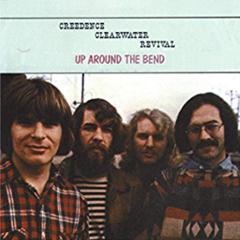
“Up Around the Bend” was written by John Fogerty and appears as the first song on side two of Creedence Clearwater Revival’s fifth studio album, Cosmo’s Factory. Released in April 1970 as a double-sided single — with “Run Through the Jungle” on the other side — “Up Around the Bend” went to #4 on the Billboard Hot 100 Singles chart. It has been certified Gold by the Recording Industry Association of America (RIAA). Both songs on the single were written and recorded for inclusion on Cosmo’s Factory just days before the band left on its 1970 European tour. Personnel on the record were: John Fogerty (lead vocals, lead guitar, keyboards), Tom Fogerty (rhythm guitar, backing vocals), Stu Cook (bass, backing vocals), and Doug Clifford (drums).
Cosmo’s Factory was recorded in 1969-70 at Wally Heider in San Francisco. Produced by John Fogerty, the album was released in July 1970 and went to #1 on the Billboard 200 Albums chart. It has been certified 4x Platinum by the RIAA. Four singles were released from the LP.
Creedence Clearwater Revival, also known as Creedence and CCR, were an American rock band formed in El Cerrito, CA, by John and Tom Fogerty, Stu Cook, and Doug Clifford. They had played together as a band since 1959, first as The Blue Velvets, then The Golliwogs, before changing their name to Creedence Clearwater Revival in 1967. The group officially disbanded in 1972. After years of legal battles, John Fogerty started playing CCR songs again in his live sets beginning in 1987. CCR released seven studio albums, three live albums, 41 compilation albums, and 29 singles. The band was inducted into the Rock and Roll Hall of Fame in 1993. Tom Fogerty died in September 1990. Stu Cook and Doug Clifford tour as Creedence Clearwater Revisited, playing CCR hits. John Fogerty continues to record and begins a new four-month tour in June.