Alberta natural gas storage, one of the largest regional storage hubs in North America, is experiencing one of its slowest cumulative storage injection rates in years and could be headed to a 13-year low for storage levels by the end of the current injection season. That may seem ominous for the chilly Alberta and Canadian winter heating season, not to mention gas exports to the U.S. So far, though, winter gas forward prices for the Western Canadian gas price benchmark of AECO have registered a relatively modest market response, staying in line with last winter’s average spot price. Today, we take a closer look at the market’s apparent lack of concern over low Alberta gas storage.
Canadian natural gas storage is not often a topic in the RBN blogosphere, but with Alberta — the province with more gas storage capacity than any other — showing remarkably low storage levels for late summer, and the U.S. still a steady gas taker of Western Canadian gas during the winter, the storage deficit there is likely to factor into how the North American gas market balances this winter. Alberta’s gas storage capacity is estimated at 499 Bcf by the Alberta Energy Regulator (AER) and easily dwarfs that of any other province in Canada. The next-closest competitor would be Ontario at 279 Bcf of storage capacity. Among the U.S. states, Alberta’s storage capacity would rank third, behind only Michigan (686 Bcf) and Texas (549 Bcf), based on capacity data compiled by the U.S. Energy Information Administration (EIA). On that basis, it’s safe to say that Alberta is a major player in the North American gas storage business.

Alberta’s total gas inventory is at its lowest point for this time of year in more than a decade (blue line, left graph in Figure 1). Moreover, the storage deficit versus this time last year, as well as the five-year average inventory levels (as shown by the red and black lines, respectively, in the right graph in Figure 1) has been widening. This stands in contrast to all other parts of North America, where gas storage levels are either at or above year-ago levels, and storage deficits versus their respective five-year averages are narrowing, not widening. Alberta’s seemingly price-bullish storage position also runs counter to what you’d expect from a North American market that is amply supplied (see Get Me Out of Here, Part 2) and contributing to the steady improvement in storage levels elsewhere. We are currently estimating that Alberta gas storage will finish the injection season on October 31, 2019, at approximately 330 Bcf (blue diamond, left graph), the lowest for the end of an injection season since 2007. How has Alberta ended up in such a storage hole (pardon the pun) in what is apparently such a well-supplied market?
About the song
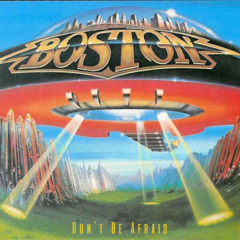
"Don't Be Afraid" was written by Tom Scholz and is the closing track on side two of Boston's second studio album, Don't Look Back. The song is from a demo that Scholz had recorded before Boston got its record deal. The album was produced by Scholz and recorded at his Hideaway Studio in Maynard, MA. Don't Look Back was two years in the making and released in August 1978 as a follow-up to Boston's highly successful and multi-Platinum 1976 debut album, Boston. Three singles were released from the album; "Don't Look Back" went to #4, and "A Man I'll Never Be" went to #31 on the Billboard Hot 100 chart. The LP went to #1 on the Billboard Top 200 Albums chart and has been certified 7x Platinum by the Recording Industry Association of America. Personnel on the album were: Brad Delp (lead and harmony vocals), Tom Scholz (lead and rhythm guitar, bass, organ, piano, percussion), Barry Goudreau (lead and rhythm guitar, slide guitar), Fran Sheehan (bass) and Sib Hashian (drums).
Boston is an American rock band formed in Boston in 1975. Band leader Tom Scholz is also an engineer and inventor. He was responsible for the development and marketing of the highly successful Rockman in 1982, a popular studio rack guitar amplifier that has been used by guitarists on many recordings. Boston has released six studio albums, one compilation album and 16 singles. They have sold more than 75 million records worldwide. Original Boston singer Brad Delp died in 2007; drummer Sib Hashian passed away in 2017. Founding member Tom Scholz still tours under the Boston banner with a rotating cast of musicians.