


Well, it finally happened. After several years of assessing the possible development of a large, integrated propane dehydrogenation (PDH) plant and polypropylene (PP) upgrader unit, a joint venture of Canada’s Pembina Pipeline and Kuwait’s Petrochemical Industries Co. (PIC) earlier this week announced a final investment decision (FID) for the multibillion-dollar project in Alberta’s Industrial Heartland. The new PDH/PP complex won’t come online until 2023, but when it does, it will provide yet another new outlet for Western Canadian propane, which has been selling at a significant discount in recent years. Today, we discuss Pembina and PIC’s long-awaited PDH/PP project, Inter Pipeline’s development of a similar project nearby, Western Canadian propane export plans — and what they all mean for propane prices.
The song-based title of our 2016 blog on Western Canadian propane — Stuck in the Middle With You — summed up the situation well: producers in the Western Canadian Sedimentary Basin (WCSB) were producing increasing volumes of propane but were having a harder and harder time finding markets for the NGL “purity product.” For one thing, Kinder Morgan’s Cochin Pipeline, which for many years had transported as much as 60 Mb/d of propane from Edmonton, AB, to Windsor, ON, in March 2014 was reversed to move condensate — used as a diluent to blend with bitumen produced in the Alberta oil sands — from Kankakee, IL, to Edmonton. (With Cochin no longer a propane-takeaway option, propane has needed to move out of Alberta by rail — a higher-cost alternative to pipelines.) Also, rising production of propane in the U.S. was nibbling away at a primary market for Western Canadian propane — namely, customers south of the 49th Parallel (the U.S.-Canada border out west).
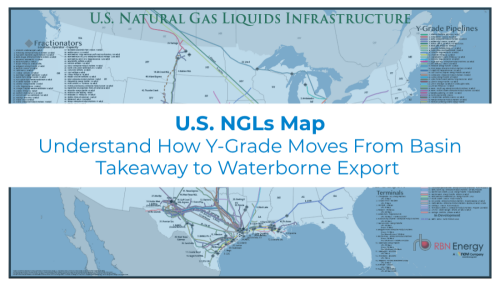
Visualize the infrastructure behind U.S. NGL movement.
The U.S. NGLs Map provides a comprehensive view of the transport, processing, and export networks moving NGLs across the U.S.
In that same blog, we also discussed two possible fixes to Alberta propane producers’ conundrum: (1) transport propane westward by rail to British Columbia, where it could be loaded onto ships and sent to Asia and other overseas markets, and (2) build PDH/PP complexes in Alberta and supply them with regionally produced, price-advantaged propane. Three years ago, both the Pembina/PIC joint venture and Inter Pipeline were hemming and hawing about whether to commit to building a PDH/PP project. Now, both have: Inter Pipeline made its FID in December 2017 and, as we said in today’s intro, the Pembina/PIC team — known (logically enough) as Canada Kuwait Petrochemical Corp. (CKPC) — announced its FID this past Monday, February 4 (2019).

About the song
"Things Can Only Get Better," written by Howard Jones, was the first single from his second studio album, Dream Into Action. Released in February 1985, the single went to #5 on the Billboard Hot 100 chart, #10 on Dance/Club Play Songs, and #21 on the Mainstream Rock Tracks. The members of the female singing group Afrodiziak are featured as background singers on the track. Dream Into Action was recorded at Farmyard Studios in Buckinghamshire, England, with Rupert Hine producing. Released in March 1985, it went to #10 on the Billboard Top 200 Albums chart, and was certified platinum by the Recording Industry Association of America. Personnel on the record were: Howard Jones (vocals, electric piano, synthesizers, drum programming, bass and synth bass), Martin Jones (bass), Afrodiziak and The Effervescents (backing vocals), TKO Horns (horns), and Helen Liebman (cello).
Howard Jones is a British singer, musician, songwriter and synth pop artist. He has made 12 studio albums and has had 15 Top 40 singles worldwide. Jones will start a concert tour in March of this year.







Comments
SAGD producers in the oil sands are starting to use more and more "solvents" to help extract bitumen with less steam. The primary solvent being used is propane. As the practice is just ramping up, I'm not sure what the potential propane volumes might be.