In case you hadn’t noticed, many of the largest, most successful companies in the U.S. and Canada are placing big bets on the energy transition. Take “blue” hydrogen, which is produced by breaking down natural gas into hydrogen and carbon dioxide and capturing and sequestering most of the CO2, and blue ammonia, which is made from blue hydrogen and nitrogen. Last fall, Air Products & Chemicals announced a multibillion-dollar project in Louisiana, and now it’s a joint venture of Enbridge and Humble Midstream, which is planning a large, $2.5 billion-plus blue hydrogen/ammonia project down the Texas coast, at Enbridge’s massive marine terminal in Ingleside. In today’s RBN blog, we discuss what we’ve learned about the companies’ plan.
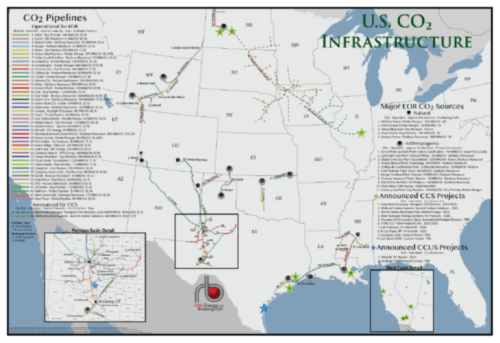
RBN Energy’s US CO₂ Infrastructure map brings together legacy Enhanced Oil Recovery (EOR) assets, as well as announced large-scale Carbon Capture and Sequestration (CCS) and Carbon Capture, Utilization and Sequestration (CCUS) projects, all in our signature concise, accurate, and intelligible style.
As we said in Tangled Up in Blue, our October 2021 blog about the Air Products’ project, none of us knows with any certainty how big a role hydrogen and ammonia will ultimately play in helping the U.S. and the rest of the world decarbonize. Sure, some true believers are convinced that low-carbon hydrogen is the next big thing, and many have similar faith in low-carbon ammonia, which contains a lot of hydrogen and which can be an efficient carrier, or “suitcase molecule,” for transporting hydrogen by ship. But even these advocates must acknowledge the economic and other challenges associated with scaling up the production of hydrogen and ammonia that emits little or no CO2, the predominant greenhouse gas.
Given that RBN’s primary area of expertise has historically been hydrocarbons, we needed to educate ourselves about the so-called “fuels of the future,” and brought you all along for the ride through our blogs. We started off a while back with our “Help!” series on hydrogen, where we tried to make sense of the hydrogen buzz (Part 1), explained how hydrogen is produced (Part 2), and looked at hydrogen production economics and the many “colors” that hydrogen can come in (Part 3). These include old-fashioned — and market-dominating — “gray” hydrogen, produced with natural gas via steam methane reforming (SMR) without carbon capture and sequestration (CCS; see Been Around a Long Time); blue hydrogen (see above and Bullet the Blue Sky); and “green” hydrogen, which is made by using renewables-powered electrolysis to break down water into hydrogen and oxygen.
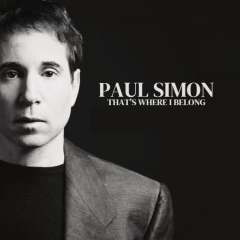
About the song
“That's Where I Belong” was written by Paul Simon and appears as song one on the first side of Simon's 10th studio album, You're the One. You're the One was recorded at The Hit Factory in New York City and produced by Paul Simon. Released in October 2000, it went to #19 on the Billboard 200 Albums chart. It has been certified Gold by the Recording Industry Association of America. The album garnered Simon a nomination for a Grammy Award for Album of the Year in 2001. Personnel on the record were: Paul Simon (vocals, guitar, sitar), Vincent Nguini, Mark Stewart (guitars), Peter Herbert, Bakithi Kumalo, Abraham Laboriel (bass), Larry Campbell (pedal Steel guitar), Steve Gadd (drums), Jamey Haddad, Steve Shehan (percussion), Steve Gorn (bamboo flute), Dan Duggan (dulcimer), Jay Elfenbein (vielle, vihuela), Skip LaPlante (harp, bowls, whirly tubes), Howard Levy (harmonica), Alain Mallet (keyboards), Andy Snitzer (saxes), Evan Ciporyn (clarinet, saxes), Clifford Carter (celeste, glockenspiel), and Stanley Silverman (French horn arrangements).
Paul Simon is an American singer, songwriter, musician and actor whose career spans over six decades. He began his professional career in 1956 in a duo with Art Garfunkel, his schoolmate from Queens, the New York City borough. The pair originally went under the moniker of “Tom & Jerry.” As “Simon & Garfunkel,” the duo released five studio albums, four live albums, 13 compilation albums, one EP and 26 singles. The pair were inducted into the Rock and Roll Hall of Fame in 1990 and the Vocal Group Hall of Fame in 2006. As a solo artist, Simon has released 14 studio albums, four live albums, 11 compilation albums and 61 singles. He has won 12 Grammy Awards, a Grammy Lifetime Achievement Award and a Library of Congress Gershwin Prize for Popular Song and was inducted into the Rock and Roll Hall of Fame as a solo artist in 2001. He continues to record and perform an occasional live show.