The clock is ticking for international shipping companies, cruise lines and others to determine how they will meet the much more stringent standard for bunker fuel sulfur content that will kick in just over two years from now. While many shipowners will likely meet the International Marine Organization’s 0.5% sulfur cap in January 2020 by shifting to low-sulfur marine distillate or a heavy fuel oil/distillate blend, a smaller number are investing in ships fueled by LNG. LNG easily complies with the sulfur cap, and while it costs more than high-sulfur HFO — the bunker that currently dominates world shipping — it is less expensive than the low-sulfur distillate and HFO/distillate blends that will be needed to meet the new standard. But there are catches with LNG, including the need to dedicate more onboard space for fuel tanks and (even more importantly) the lack of LNG fueling infrastructure in a number of ports. Today, we discuss the short and long-term outlook for LNG as a marine fuel.

The NATGAS Appalachia weekly report provides the data and insights to monitor the northeast natural gas market’s twists and turns and identify the risks and opportunities along the way, including tracking supply-demand trends, outbound capacity and their impact on takeaway pipeline utilization, and regional prices.
As we said in Against the Wind, the International Maritime Organization (IMO) — a specialized agency of the United Nations — in recent years has been implementing rules that gradually reduce emissions of sulfur (sulphur for many of our non-American readers) from the engines that power the 50,000-plus tankers, dry bulkers, container ships and cruise ships that ply international waters. In January 2012, the “global” cap on sulfur content in marine fuel (blue bars in Figure 1) was reduced to 3.5% (from the old 4.5%) and in January 2020 — only 24 and a half months from now — it will be reduced to a much stiffer 0.5%. There are even tougher standards already in place in the IMO’s Emission Control Areas (ECAs) for sulfur, which include Europe’s Baltic and North Seas and areas within 200 nautical miles of the U.S. and Canadian coasts. In July 2010, the ECA sulfur limit in marine fuel (red bars) was reduced to 1% (from the old 1.5%), and in January 2015, the limit was ratcheted down again to a very stringent 0.1% — a standard that will remain in force within the ECAs when the 0.5% sulfur cap for the rest of the world becomes effective in January 2020.
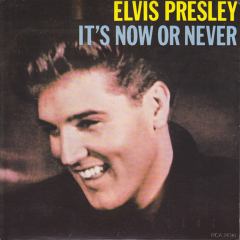
About the song
“It’s Now or Never” was a hit song by Elvis Presley in 1960 and one of the best-selling singles of all time. Elvis was still in the Army, stationed in Germany, when his publisher, Freddy Bienstock, came to visit him to talk about songs Elvis might like to record when he got back home. Elvis told Bienstock that he had recently heard the 1949 Tony Martin hit "There's No Tomorrow" — a re-working of one of Elvis' favorite Italian songs, "O Sole Mio." Elvis asked Freddy to see if he could have someone in his stable of songwriters come up with some new lyrics.
When Bienstock got back to New York, the only two writers in his building were Aaron Schroeder and Wally Gold. He gave them the Elvis assignment, and they came up with "It's Now Or Never" in less than 30 minutes. On April 3, 1960, at Nashville's RCA Studio, producers Steve Sholes and Chet Atkins joined guitarists Scotty Moore and Hank Garland, bassist Bob Moore, pianist Floyd Cramer, drummers D.J. Fontana and Buddy Harman, sax player Boots Randolph, and The Jordanaires on backing vocals. With engineer Bill Porter at the board, Elvis came in and sang "It's Now Or Never," a recording that would go on to be a #1 hit single on Billboard's Hot 100 in September, 1960. It was also included on Elvis' first album on his return from Army duty, the top-selling Elvis Is Back!
According to Elvis's ex-wife Priscilla Presley, of all the songs Elvis recorded, “It’s Now or Never” was his favorite.