A crude oil leak last Tuesday at the Enterprise Crude Houston (ECHO) terminal disrupted regional flows and caused crude differentials to move higher over the course of the week. While the spill was swiftly addressed by terminal owner Enterprise Products Partners, it still affected inbound and outbound operations for a few days. In today’s RBN blog, we discuss the role of the ECHO terminal and show how even an isolated incident can quickly have an impact on the market.

Crude Oil Permian provides detailed analysis of the fundamental drivers impacting the Permian Basin crude oil market including weekly data, analysis and market intelligence updates of: Permian crude oil supply and demand, pipeline outflows and capacity, prices, and infrastructure updates.
Let’s start with a refresher on the ECHO terminal (large orange tank icon in Figure 1 below) and its surrounding infrastructure. ECHO is one of the largest crude oil terminals along the Gulf Coast and its strategic location in the Houston area, just southeast of Hobby Airport, makes it a prime location for pipelines delivering crude for storage and/or blending, with connections to nearby refineries and export terminals. Designed by Enterprise in 2010, the terminal was originally intended to function as a central storage and distribution hub linking incoming crude from the company’s South Texas and Eagle Ford crude gathering systems and its Seaway Pipeline joint venture (dark-purple line) with Enbridge. It has grown significantly since then thanks to new pipeline connections to the Permian Basin, increased outbound connectivity, and storage capacity that now stands at about 9 MMbbl. In addition, the HOU Intercontinental Exchange (ICE) contract, a physically deliverable futures contract for Midland WTI crude oil, must be delivered into specific terminals, one of which is ECHO (see Let Me Be Myself and Room At The Top.)

Figure 1. Enterprise’s ECHO Terminal’s Crude Oil Connectivity. Source: RBN
Enterprise has two major oil pipelines from the Permian to the Gulf Coast that travel to ECHO. To the Houston area, the long-hauls include the company’s 620-Mb/d Midland to ECHO 1 (M2E-1; dark-pink line) and the 450-Mb/d Midland to ECHO 3 (M2E-3; light-pink line), which represents the company’s 29% undivided interest on the Wink to Webster (W2W) Pipeline. Together, these give Enterprise 1.07 MMb/d of crude takeaway capacity from the Permian to the Gulf Coast. (In addition, Enterprise’s M2E-2 pipeline — currently in NGL service and referred to as Seminole Pipeline — is expected to be converted back to crude service later this year.) M2E-1 flows to Sealy, then uses Enterprise’s Rancho II pipeline (lime-green line), which connects to ECHO. The ExxonMobil-operated 1.5-MMb/d W2W follows the same path for a portion of M2E-1, but flows from Midland directly to ECHO, bypassing Sealy and the Rancho II pipeline.
About the song
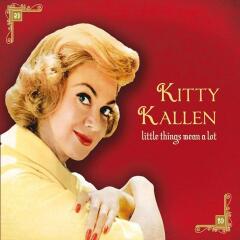
“Little Things Mean a Lot” lyrics were written by Edith Lindeman and music by Carl Stutz in 1953. It appears as the first song on side one of Kitty Kellen’s debut studio EP, Little Things. Lyricist Lindeman was the leisure editor at the Richmond Times-Dispatch and music composer Stutz was a disc jockey in Richmond, VA, when they wrote the song. Other artists who have covered the song are Alma Cogan, Joni James and Margo Smith. Kallen recorded the song at Decca Studios in New York City in December 1953, with producer Jack Pleis. Released as a single in March 1954, it went to #1 on the Billboard Pop Singles chart and remained there for nine consecutive weeks. It sold 2 million copies and won #1 Song of the Year at Billboard. Personnel on the record were: Kitty Kallen (vocals), Jack Pleis ( arranger, conductor, producer) and unnamed orchestra members.
The EP, Little Things, contained four songs, including the hit “Little Things Mean a Lot.” Recorded at Decca Studios in New York City and produced by Jack Pleis, it was released in August 1954.
Katie “Kitty” Kallen was an American singer who was popular from the 1930s into the 1960s. Her career encompassed three different eras of music: big-band swing, post-war pop music and early rock and roll. Her biggest hit was “Little Things Mean a Lot” in 1954. That year, she won the most popular female vocalist in polls in Billboard and Variety. She released six studio albums, an EP and 72 singles. She is in the Hit Parade Hall of Fame and has a star on the Hollywood Walk of Fame. She retired from recording in 1964 and gave her last live performance in 2015. Kallen died in January 2016 in Cuernavaca, Mexico, at 94.