


Way back in 2019, just about everyone in the refining world was talking about IMO 2020, the International Maritime Organization’s soon-to-be-implemented rule requiring much lower sulfur emissions from most ocean-going ships. A lot of forecasters were anticipating that major market dislocations would result — things like $50/bbl-plus diesel crack spreads, oversupply of high-sulfur fuel oil, and ultra-wide differentials between light and heavy crude oils. They did, but only briefly, in the last few months of 2019. The implementation of IMO 2020 turned out to be pretty much a non-event, and for much of 2020 and 2021, people didn’t think much about the new bunker fuel rule. Lately, things have been changing, as we discuss in today’s RBN blog.
Beginning January 1, 2020, the International Maritime Organization (IMO) mandated that most ships powered by fuel oil (the most common bunker fuel) use products containing less than 0.5% sulfur (S) by weight, a significant reduction from the previous specification of 3.5% S by weight. (An alternative for shipping companies is sticking with high-sulfur fuel oil and installing an onboard “scrubber” to remove most of the sulfur from the ship’s exhaust stack.) This new rule is colloquially referred to as “IMO 2020.” (For a more detailed description of IMO 2020 and its implementation, refer to our December 2019 blog, All Around the World.)

The Future of Fuels bi-annual report by RBN's Refined Fuels Analytics provides an in-depth analysis of the U.S. and global refinery industries, focusing on crude oil and fuel market dynamics, supply and demand, alternative fuels, refinery capacities, and price forecasts to help stakeholders navigate the evolving energy landscape.
Old-school, 3.5% S fuel oil is produced from the heaviest part of a barrel of crude oil: the vacuum column residual material — a.k.a. “vacuum resid” — that’s left over when a refinery has run crude through its atmospheric and vacuum distillation towers. It’s very difficult to remove sulfur from vacuum resid (via a hydrotreating process), so a “cracking refinery” (one without a coker and other equipment to break down the vacuum resid into middle distillates and other valuable products) must sell its resid either into the bunker fuel or asphalt markets or to coking refineries “as-is” for use as an intermediate feedstock. In contrast, IMO 2020-compliant 0.5% S fuel oil can be produced by running a sweet (low-sulfur) crude slate through a cracking refinery to produce vacuum resid that is similarly low in sulfur. In other words, lower-sulfur crude oil makes low-sulfur resid. (Another option is diluting the vacuum resid with large volumes of diesel, but there are flashpoint, compatibility and viscosity concerns that may limit the amount of diesel that can be blended into bunker fuels — a nuanced topic for another day.)
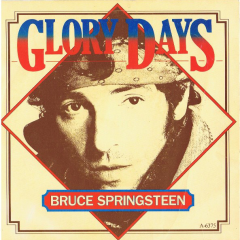
About the song
“Glory Days” was written by Bruce Springsteen and appears as the fourth song on side two of Springsteen’s seventh studio album, Born in the U.S.A. Released as the fifth single from the LP in May 1985, it went to #5 on the Billboard Hot 100 Singles chart. It has been certified Platinum by the Recording Industry Association of America. The song was recorded at the Power Station in New York City in May 1982. Springsteen recently surprised audiences at the Glastonbury Festival 2022, when he joined Paul McCartney on stage and performed a rousing rendition of “Glory Days” and The Beatles’ “I Wanna Be Your Man” with McCartney and his band. Personnel on the record were: Bruce Springsteen (lead vocals, lead guitar, acoustic guitar), Roy Bittan (piano, synthesizer), Clarence Clemons (sax, percussion, backing vocals), Danny Federici (organ), Garry Tallent (bass, backing vocals), and Steven Van Zandt (rhythm guitar, acoustic guitar, mandolin, backing vocals).
Born in the U.S.A. was recorded at The Hit Factory and Record Plant in New York City between January 1982-March 1984. Produced by Jon Landau, Chuck Plotkin, Bruce Springsteen, and Steven Van Zandt, the album was released in June 1984 and went to #1 on the Billboard 200 Albums chart. It is Springsteen’s biggest-selling album to date, with sales of over 30 million copies worldwide. It has been certified 15x Platinum by the RIAA. Seven top-ten hit singles were released from the LP.
Bruce Springsteen is an American singer, songwriter and musician. Nicknamed “The Boss,” his career has spanned six decades. Signed to Columbia records in 1972 by Clive Davis, he has released 20 studio albums, 23 live albums, eight compilation albums, one soundtrack album, seven EPs, and 73 singles. He has sold more than 150 million records worldwide. He has won twenty Grammy Awards, two Golden Globe Awards, an Academy Award, and a Tony Award. He is a member of the Rock and Roll Hall of Fame and the Songwriters Hall of Fame. He has received Kennedy Center Honors and a Presidential Medal of Freedom. In December 2021, Springsteen sold the masters of his entire catalog, and the music publishing rights to Sony Music for $500 million. He continues to record, and Springsteen and The E Street Band begin their first tour since 2017 in February 2023, with a string of US dates, followed by European stadium shows beginning in Barcelona in April, then a second North American tour starting in August.




Comments
For a fuller explanation of the logic behind how the market sets differentials see Chapter 20 in Petroleun Refining in Nontechnical Language 5th edition.