Hydrogen has been touted as a zero-emissions vehicle fuel, as a clean power generation source and, more generally, as a big part of the move toward decarbonization. Much of the current interest in hydrogen is its possible role as a grid-scale energy storage solution — one that might help support the growth of wind and solar renewable power generation. However, if we convert renewable energy to hydrogen, how do we store it? And how do we get it to end-use markets? As appealing as a hydrogen solution may be, these questions require thoughtful answers given some of hydrogen’s unique characteristics. With this in mind, a new set of stakeholders are beginning to take an interest in the natural gas pipeline network with an eye toward repurposing it to include hydrogen blends. In today’s RBN blog, we look at some reasons why hydrogen blending is being discussed and even being implemented on a limited basis in Europe and North America.
The U.S. has an extensive network of about 300,000 miles of natural gas transmission pipelines (not counting distribution systems) but only about 1,600 miles of dedicated hydrogen pipelines. Most of the latter are on the Gulf Coast — you can read about their development in Been Around a Long Time and find a map of them here. Nearly all of these hydrogen pipelines serve the major industrial gas companies that produce hydrogen using natural gas in a process called steam methane reforming (SMR; see Help! Part 2). But these days the renewed focus on hydrogen primarily stems from the potential of “clean hydrogen” produced either by running water through a renewables-powered electrolyzer (a.k.a. “green” hydrogen) or by using old-school SMR combined with carbon capture (a.k.a. “blue” hydrogen). Or, if you’re wary of the proliferating hydrogen color wheel, we’ll use the word “clean” hydrogen to denote low- or zero-carbon hydrogen generation.
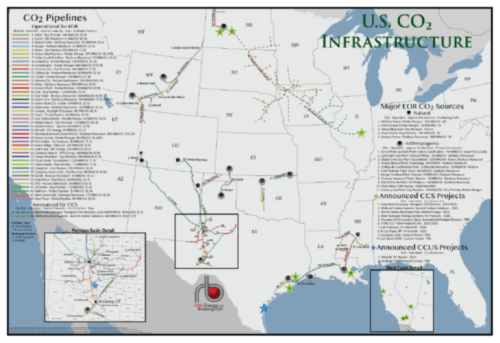
RBN Energy’s US CO₂ Infrastructure map brings together legacy Enhanced Oil Recovery (EOR) assets, as well as announced large-scale Carbon Capture and Sequestration (CCS) and Carbon Capture, Utilization and Sequestration (CCUS) projects, all in our signature concise, accurate, and intelligible style.
So, how do we transport this “clean” hydrogen to far-flung markets, given there is such a limited number of hydrogen pipelines? There are only a couple of commercially viable options today. One involves compressing hydrogen into high pressure cylinders or tubes and transporting these “tube trailers” via trucks (very expensive), and another involves liquefying it and transporting it on trucks as liquid hydrogen (still pretty expensive). A third option is emerging, namely injecting/blending hydrogen into a natural gas pipeline and transporting it as a hydrogen/natgas blend to end-use applications such as power generation or heating, producing fewer emissions than with natural gas alone. Hydrogen has about one-third the energy content of natural gas in the same volume, so a 30% hydrogen blend would reduce CO2 emissions by about 10%-11%. (Gas and hydrogen blends are not new, but more on that later.)
About the song
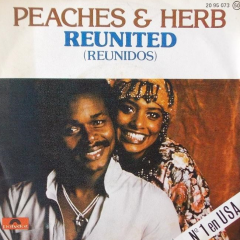
"Reunited" was written by Dino Fekaris and Freddie Perren and performed by Peaches & Herb. The song appears as the third track on Peaches & Herb's second studio album, 2 Hot! Released as a single in March 1979, the song went to #1 on the Billboard Hot 100 Singles chart. It has been certified 2x Platinum by the Recording Industry Association of America (RIAA). The has been covered by several artists and has appeared in various television shows and motion pictures. Personnel on the record were: Herb Fame (vocals), Linda "Peaches" Greene (vocals), Bob Bowles, David T. Walker and Wah Watson (guitar), Scott Edwards (bass), James Gadson (drums), Freddie Perren, Larry Farrow (keyboards), Electric Ivory Experience (synthesizers), Roger Glenn (flute), and Paulinho da Costa and Bob Zimmitti (percussion).
2 Hot! was recorded at The Mom & Pop's Company Store in Studio City, CA, in 1977-78, with Freddie Perren producing. All the songs on the album were written by Fekaris and Perren. Released in December 1978, the LP went to #1 on the Billboard Top R&B chart and #2 on the Billboard 200 Albums chart. The album has been certified Platinum by the RIAA. Three singles were released from the LP.
Peaches & Herb is an American vocal duo formed in Washington, DC, in 1966 by Herb Fame along with Francine "Peaches" Barker. Fame has remained a constant "Herb" in the duo while seven different women have sung as "Peaches." They have released 11 studio albums, 12 compilation albums and 32 singles. Peaches & Herb still tour, with Herb Fame and Wanda Tolson as "Peaches."