


With international gas prices ranging somewhere between ridiculous and ludicrous since last fall, the entire global trade of LNG is going through an unprecedented period of change as gas-consuming nations try to cope with the current situation and seek protection from tight supplies and high prices in the future. The problems of Europe in securing supplies for the imminent winter have been well documented here and elsewhere in the trade press. In addition to being a major struggle for consumers and a headwind to economic development, there are also numerous, less-obvious consequences of the tectonic shifts in gas fundamentals, including countries’ individual plans for long-term energy supplies, potential tax-related issues, the contractual structures used to transact LNG, and even the assessments of the commodity price itself. These issues aren’t new and, in many cases, have been discussed for years. What’s changed is that extremely high prices have thrown into sharp relief any inefficiency or risk that exposes market participants. In today’s RBN blog, we consider the impact of high global gas prices on countries in Asia and Europe and how pricing mechanisms might be affected.
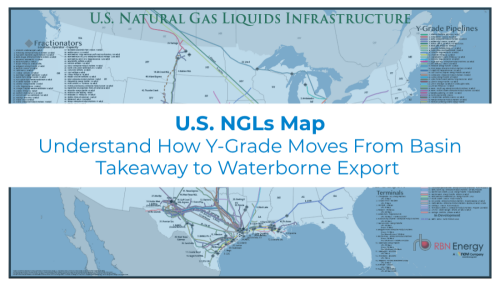
Visualize the infrastructure behind U.S. NGL movement.
The U.S. NGLs Map provides a comprehensive view of the transport, processing, and export networks moving NGLs across the U.S.
Months before the possibility of a Russian invasion of Ukraine became apparent, the Dutch TTF price for pipeline gas (blue line in Figure 1) and the JKM price of LNG in Asia (red line) had risen to historic, sustained highs. Russia’s actions and European sanctions since then have only made an already-expensive price environment even worse for gas buyers, not only in Europe but globally (start of war denoted by orange line). For prices to fall back to some semblance of normality requires a resetting of the supply/demand balance — one in which increased Russian pipeline gas flows are unlikely to play a part. Instead, there is increasing emphasis on U.S.-sourced LNG as a means of replacing Russian gas supplies (see Help Is On Its Way). Although U.S. exports to Europe are at all-time highs, considerably more LNG supply is needed and will take 3-4 years to facilitate as U.S. export infrastructure is built out and improvements are made to the European gas pipeline network to accommodate the new flows (see You Don’t Own Me). This is the thinking behind expectations that high LNG prices are likely to persist for several years.

About the song
“Simply Irresistible” was written by Robert Palmer and appears as the first song on his ninth studio album, Heavy Nova. Released as the first single from the album in June 1985, the song went to #1 on the Billboard Mainstream Rock chart and #2 on the Billboard Hot 100 Singles chart. It won Palmer a Grammy Award the following year. Personnel on the record were: Robert Palmer (lead, backing vocals), William Bryant, Misha Schneider, Jeff Bova, Richard Gibbs (keyboards, synthesizers, programming), Eddie Martinez, Dennis Budimir, John Grey (guitars), Frank Blair (bass), Dony Wyan (drums), and Claire Fischer (strings).
Heavy Nova was recorded during 1987 at Compass Point in Nassau with Robert Palmer producing. Released in June 1988, it went to #13 on the Billboard 200 Albums chart and has been certified Platinum by the Recording Industry Association of America. Five singles were released from the LP.
Robert Palmer was an English singer, songwriter, musician and record producer. He started his professional career with The Alan Bown Set, Dada, and Vinegar Joe before pursuing a solo career. During 1985-87 he was the singer in Power Station. As a solo artist he released 14 studio albums, three live albums, 11 compilation albums and 53 singles. Palmer died in Paris in September 2003.







Comments
Excellent article with many valid points with some historic backgound that help explain what is happening today. The international LNG 'market' is definitely going to remain very dynamic.