Alkylate is an important and valuable part of the U.S. gasoline pool, prized for its high octane, low volatility and low sulfur content. There are two primary catalysts that refiners can opt to use in the production of alkylate: hydrofluoric acid, or HF, and sulfuric acid, or H2SO4. Each is quite popular, with HF and sulfuric acid technologies each representing about half of domestic alkylation capacity — and with those shares varying significantly on a regional basis. While refiners have been safely operating both types of “alky” units for many decades, HF alkylation for some time has been in the crosshairs of the Environmental Protection Agency, which recently proposed that refiners be required to undertake extensive evaluations of potentially safer alternative technologies. It’s hard to know for sure, but if EPA’s proposed rule is made final it could ultimately force many refineries to make very costly changes — into the hundreds of million dollars per unit — or maybe even shut down entirely. In today’s RBN blog, we look at alkylate, how it’s made, and the potentially profound effects of the impending regulation.

The Future of Fuels bi-annual report by RBN's Refined Fuels Analytics provides an in-depth analysis of the U.S. and global refinery industries, focusing on crude oil and fuel market dynamics, supply and demand, alternative fuels, refinery capacities, and price forecasts to help stakeholders navigate the evolving energy landscape.
Refining is a complicated process — it makes getting tickets to a Taylor Swift concert look easy by comparison. To produce gasoline that meets quality and regulatory specifications, refineries and gasoline blenders need to assemble a carefully thought-out combination of many blendstocks, including reformate, FCC naphtha, alkylate and straight-run naphtha. Alkylate, which represents about 15% of the total gasoline pool, is a real standout among blendstocks, with perhaps the best combo of three high-value characteristics — high octane, low Reid vapor pressure (RVP) and low sulfur content. As we said in Drive My Car, the octane number in the gasoline you pump — typically 87 (regular), 91 (mid-grade) or 93 (premium) — indicates how much a fuel can be compressed before it self-ignites, which causes “knocking” (the higher the better to limit knocking), while the RVP measures how easily a fuel vaporizes (the lower the better under most weather conditions). Low sulfur content is required to meet federal and state emission standards.
Alkylate is produced at refinery alkylation — or alky — units (orange cylinder in Figure 1). Alkylation is a chemical process in which light gaseous butenes (and sometimes propylenes and/or pentenes) are reacted with isobutane in the presence of a catalyst (either hydrofluoric acid or sulfuric acid) to make heavier, high-octane alkylate. (More on the HF and H2SO4 parts of the process in a moment.) As shown by the brown box and the lower brown arrow in the graphic, the butenes, propylenes and pentenes used as alky-unit feedstocks are themselves primarily produced by the breakdown of gas oils (and sometimes atmospheric or vacuum residuum) in a fluid catalytic cracking unit (FCCU; lower red cylinder).
About the song
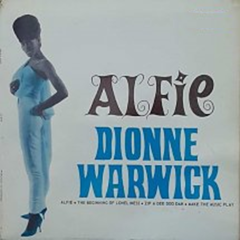
“Alfie” was written by Burt Bacharach and Hal David and appears as the first song on side two of Dionne Warwick’s sixth studio album, Here Where There Is Love. Although Bacharach has said that “Alfie” is one of his favorite songs, he and Hal David struggled with writing a song about a man named Alfie when Paramount requested it for the upcoming 1966 British comedy drama film of the same name. After viewing a rough cut of the movie, David utilized one of the lines that the film’s star Michael Caine used throughout the film, “What’s it all about,” as the opening phrase for the song. Since the film was set in England, Paramount wanted a British singer for the song. Cilla Black agreed to do the song only if Bacharach agreed to do the arrangement for the session. To her surprise, he did and conducted a 48-piece orchestra at Studio One at Abbey Road Studios with George Martin producing in the fall of 1965. Black released the single in the UK in January 1966 as a tease for the movie, and it went to #9 on the UK pop charts. Cher recorded her version of the song, which appeared at the end credits of the international version of the film, at Gold Star Studios in Hollywood, with Sonny Bono producing. Released as a single in July 1966, it went to #32 on the Billboard Hot 100 chart. When Dionne Warwick — Bacharach’s first choice to cut the song — released her version as a single in March 1967, it went to #5 on the Billboard R&B chart and #15 on the Hot 100 Singles chart.
Here Where There Is Love was recorded in late 1966 at Bell Sound in New York City, with Burt Bacharach and Hal David producing. Released in December 1966, it went to #1 on the Billboard R&B Albums chart and #18 on the Billboard 200 Albums chart. It was Warwick's first album to be certified Gold by the Recording Industry Association of America. She performed “Alfie” from the album at the 1967 Academy Awards show. Seven singles were released from the LP.
Dionne Warwick is an American singer, actress and television personality. After meeting Burt Bacharach in 1959, she started singing on demos for him and his writing partner Hal David. She signed with their production company and secured her first record deal with Scepter Records in 1962. Warwick has released 40 studio albums, five live albums, 25 compilation albums and 95 singles and has sold more than 100 million records worldwide. She has won six Grammy Awards and is a member of the Grammy Hall of Fame and the R&B Music Hall of Fame. Warwick has appeared in 16 motion pictures and numerous television shows and concert specials. She continues to record and make occasional personal appearances.