There’s good reason to believe that the international LNG market has turned a corner, with demand and LNG prices on the rise and with a number of new LNG-import projects being planned. That would be good news for U.S. natural gas producers, who know that rising LNG exports will boost gas demand and support attractive gas prices. It also would help to validate the wisdom of building all that liquefaction/LNG export capacity now nearing completion. Today we look at recent developments in worldwide LNG demand and pricing and how they may signal the need for more LNG-producing capacity in the first half of the 2020s.
Some have worried that the liquefaction “trains” and LNG export facilities being built along the U.S. Gulf Coast (plus one along Chesapeake Bay in Maryland) may be coming online at precisely the wrong time. After all, the pace of worldwide LNG demand growth slowed in 2014-15, new Australian and U.S. liquefaction/export capacity seem poised to flood an already over-supplied LNG market, and LNG spot prices only a few months ago, fell to less than $5/MMBtu—almost $15 lower than where they stood in early 2014. As we said in our Catch a Wave blog series, 14 liquefaction trains with a combined capacity of about 63 million tonnes per annum (MTPA) of LNG (enough to consume more than 8 Bcf/d of gas if all the trains were running most of the time) will be coming online in the 2016-20 period; the first two 4.5-MTPA trains at Cheniere Energy’s Sabine Pass LNG facility in southwestern Louisiana are already producing LNG that is being shipped to South American, European and Asian buyers. As many as two additional trains at Sabine Pass may start super-cooling natural gas into LNG in 2017, as may Dominion’s single-train, 5.25-MTPA Cove Point facility in Maryland. Another nine trains along the Gulf Coast (combined capacity, ~40 MTPA or nearly 6 Bcf/d) are slated to come online in 2018-20. All of that new capacity wouldn’t be so much of an issue if the U.S. were the only place where new liquefaction trains were being built. (Wouldn’t that be nice?) But Australia has been on a train-building binge of its own; it will be adding nearly 30 MTPA by 2020. That, plus a handful of other new liquefaction trains that will be starting up in Indonesia, Russia and Malaysia, will leave the world with considerably more LNG-producing capacity than it will need until sometime in the 2020s.
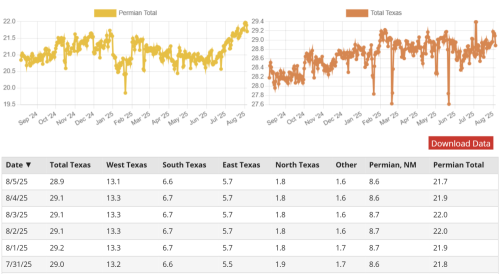
The NATGAS Production Tracker - Texas provides a DAILY update of natural gas production in Texas the New Mexico side of the Permian Basin. Quickly and easily view today’s supplies in the Lone Star state and download the full historical table when you need it.
But are things really as bad as all that? No, they probably aren’t, especially if you take a longer-term view. As we said, there are signs that the international LNG market’s mid-decade funk may be over, or that it’s at least in the process of ending. One indicator is that, as of this week, spot prices in eastern Asia—the epicenter of LNG demand—have risen to about $9/MMBtu, a gain of ~80% from the ~$5 spot prices of a few months ago. LNG demand is also up in 2016 compared to 2015—not necessarily at the two biggest LNG importing countries (#1 Japan and #2 South Korea), but declines there were more than offset by rising LNG demand from up-and-comers like #3 China and #4 India and from the six countries (Pakistan, Jamaica, Lithuania, Poland, Egypt and Jordan) that started importing LNG in 2015-16 (see Figure 1).

About the song
"Coming Up" is a song written, recorded and produced by Paul McCartney for his 1980 solo studio album, McCartney II. The single was released in April 1980; it quickly rose to #2 on the UK singles chart; a live version of the song with Wings went to #1 on the U.S. Billboard Hot 100 at the same time. In the music video of "Coming Up," Paul and his wife Linda play various roles as members of a band identified on the kick drum as "The Plastic Macs," an homage to John Lennon's Plastic Ono Band. On the album, Paul plays bass, guitar, keyboards, drums and sings all the lead vocals. Linda McCartney assists with the backing harmonies.
Sir James Paul McCartney is an English singer-songwriter, multi-instrumentalist, and composer. He gained worldwide fame as the bassist and singer for the Beatles. His songwriting partnership with John Lennon was the most successful of the post-World War II era. McCartney is a two-time inductee into the Rock and Roll Hall of Fame — in 1988 with the Beatles and in 1999 as a solo artist. He also is the recipient of an Academy Award (in 1971, for the score of the movie version of “Let It Be”) and 18 Grammy Awards. He has written or co-written 32 songs that topped the Billboard Hot 100, and is rock and roll’s only billionaire. Paul was knighted by Queen Elizabeth II in 1997.