


The U.S. nuclear power sector is facing its biggest crisis in years, with an increasing number of nuclear units being retired for economic reasons and the four new units now under construction in the Southeast facing possible cancellation. Bad news for the nuclear sector is good news for owners and developers of natural gas-fired power plants — and, of course, for natural gas producers — because gas plants are a primary alternative to nuclear in providing reliable, around-the-clock power. Gas plants also are a go-to choice for supporting intermittently available renewable sources like wind and solar. Today we review the woes facing the nuclear sector, efforts by some states to prop it up with subsidies, and the strong economic/environmental case for ramping up gas-fired generation.
Natural gas consumption for U.S. power generation has increased by nearly 150% over the past 20 years — from 11.1 Bcf/d, on average, in 1997 to 27.3 Bcf/d in 2016, according to the Energy Information Administration (EIA) — and despite President Trump’s June 1 (2017) announcement that the U.S. will be exiting the Paris climate accord, many U.S. utilities and independent power producers (IPPs) have indicated they won’t waver from their plans to shut down more coal units, build new gas-fired plants and ramp up their use of wind and solar power. The power sector’s strategy is based primarily on economics and regulatory expectations. The sheer abundance of U.S. natural gas supply suggests that gas prices will remain relatively low and competitive with coal, even as exports of liquefied natural gas (LNG) pick up. And while the Trump administration has promised to dismantle the Clean Power Plan (the Obama administration effort to reduce the power sector’s carbon dioxide (CO2) emissions 32% from 2005 levels by 2030, mostly by switching to gas and renewables) — see More, More, More (U.S. Gas Demand) — many states, utilities and IPPs are (as we said) pushing ahead with their plans to shift away from coal, which produces roughly twice the CO2 per megawatt-hour (MWh) that gas does.
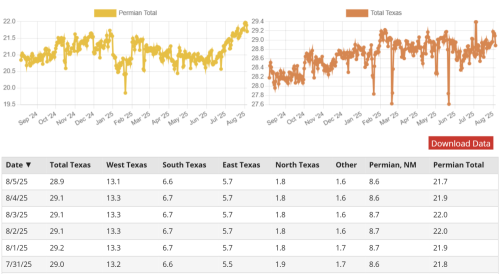
The NATGAS Production Tracker - Texas provides a DAILY update of natural gas production in Texas the New Mexico side of the Permian Basin. Quickly and easily view today’s supplies in the Lone Star state and download the full historical table when you need it.
Nuclear power plays an important role too, of course. The 99 operating nuclear units in the U.S. produced just under 20% of the electricity generated in the U.S. last year; gas-fired plants produced 34%, coal plants produced 30% and renewables (including hydroelectric plants) produced 15%. Nuclear also has figured prominently in utility strategies for reducing CO2 emissions (nuclear units don’t produce any) — enough so to spur talk just a few years ago of a nuclear renaissance during which a significant number of new, safer, more reliable nuclear units would be built to help the U.S. reduce its greenhouse gas production and its reliance on fossil fuels for power generation.

About the song
“Atomic” was a 1979 hit single for Blondie, the American new wave band. Written by lead singer Debbie Harry and keyboardist Jimmy Destri, the song rose to #1 in the UK but only #39 in the U.S.







Comments
Rusty:
You've clearly made the case that the natural gas industry will benefit as it picks up additional sales when nuclear plants close.
It isn't much of a step to wonder if some of the players in the gas industry have played a role in both encouraging ever more stringent (and costly) rules for nuclear plants and in driving excess production to lower market prices to the breaking point for nuclear competitors.
There is some indication of oil and gas industry opposition to zero emission credit programs that extend some of the preferential treatment that has been provided to wind and solar to nuclear plants in recognition of their equally CO2-free power.
I wonder if what is now happening in the open hasn't been happening for many years. After all, there is no good reason why a gas-fired heat engine would be several times cheaper than a heat engine driven by atomic fission. There's also no good reason why there is so much fear of nuclear accidents when experience has proven that they are far less common and far less deadly if they do occur than accidents in fossil fuel plants.
Has the oil and gas industry worked behind the political scenes to discourage nuclear energy and with its checkbook to encourage antinuclear movement activity?
You've made a good case for the fact that such activity would pay off in increased demand and bullish price behavior over the long term.
Rod Adams
Publisher, Atomic Insights
Hi,
I was wondering what your conversion is from Megawatts to number of homes powered in paragraph 5. "Taken together, the six retired units had the capacity to generate more than 4,600 megawatts (MW), or enough to power more than four million homes."
I only ask because I am trying to get an idea of how many additional cubic feet of gas consumption 4,600 MW would equal (assuming all 4,600 mw are replaced by gas generation). Thank you
-Chris