For a few years now, U.S. natural gas producers have benefited from the electric-power sector’s shift from coal-fired plants toward gas-fired ones. The ongoing transition makes sense. Not only is gas-fired generation cleaner, it’s mostly been cheaper than the coal alternative. Better still, gas turbines and combined-cycle plants are very flexible companions to all those new wind farms and utility-scale solar facilities, whose variable output requires at-the-ready replacement power when the wind’s not blowing and the sun’s not shining. But with the continued push by many state regulators — and many utilities — for lower-carbon generation fleets, gas-fired plants are facing a growing challenge from energy storage, mostly in the form of very big lithium-ion batteries. Today, we look into the increasing use of large-scale batteries in utility settings and whether they might pose a serious threat to gas-fired power in the 2020s and beyond.

The NATGAS Appalachia weekly report provides the data and insights to monitor the northeast natural gas market’s twists and turns and identify the risks and opportunities along the way, including tracking supply-demand trends, outbound capacity and their impact on takeaway pipeline utilization, and regional prices.
We’ve blogged every so often about the competition between coal- and gas-fired power generation, a steel cage match that’s been intensifying since the start of the Shale Era, with coal the consistent winner early on but gas victorious every year since 2015. As we said a couple of years ago in Slow Burn, coal plants (blue line in left graph in Figure 1) provided an impressive 45% of the electricity generated in the U.S. in 2010, when gas plants (orange line) accounted for only 24%. As shown in the left graph in Figure 1, by 2016, coal’s share had plummeted to 30% and gas’s had increased to 34%, according to the Energy Information Administration (EIA). The shift from coal to gas has continued apace since then; in the first four months of 2020, gas plants provided 40% of the U.S.’s electricity, while coal plants provided only 17% –– less than nuclear plants (with just over 21%; gray line) and renewables (hydroelectric, wind, solar, etc., with just under 21%; yellow line) for the first time ever.
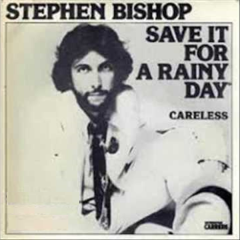
About the song
"Save It for a Rainy Day" was written by Stephen Bishop, and appears as the 10th song on Bishop's debut studio album, Careless. The song was released in December 1976 and went to #6 on the Billboard Adult Contemporary chart and #22 on the Billboard Hot 100 Singles chart. Personnel on the recording were: Stephen Bishop (lead vocals, acoustic guitar), Eric Clapton (lead electric guitar), Jeff Staton Jones (bass, rhythm electric guitar), Russ Kunkel (drums), Barlow Jarvis (acoustic piano, electric piano), Chaka Khan (backing vocals, lead vocal at end of song), and Ian Freebairn-Smith (horn arrangements). Country artist Kenny Chesney had a #1 hit on the country charts with a different song of the same title. Americana band, The Jayhawks, had a different song with the same title on their album, Rainy Day Music.
Bishop’s Careless LP was recorded at ABC Studios and A&M studios in Hollywood, CA, with Henry Lewy and Stephen Bishop producing. Released in December 1976, the album went to #32 on the Billboard Top 200 Albums chart. Two singles were released from the album, the other being “On and On,” which peaked at #11 on the Billboard Hot 100.
Stephen Bishop is an American singer-songwriter, musician, and actor. He is also known as playing the folk singer on the stairway in the movie National Lampoon's Animal House, where John Belushi grabs his guitar and smashes it to pieces. Bishop has contributed many songs to motion pictures, and a long list of recording artists have covered his songs over the years. Bishop has released 19 albums and 16 singles. He continues to record and tour to this date, with all touring plans on hold until 2021 due to COVID.