The “first wave” of liquefaction/LNG export projects in the U.S. is cresting. Two new liquefaction trains in Louisiana are already producing liquefied natural gas, and a dozen other trains are under construction and scheduled to begin commercial operation in the Lower 48 over the next three years. The problem is, these multibillion-dollar facilities––planned when LNG market dynamics were much more favorable––are “rolling in” as the global market faces a supply glut, weak LNG demand growth, and low prices. Today, we begin a series on the next round of U.S. LNG projects and how soon market conditions might improve enough to justify building them.
In the early 2000s––not that long ago, really––U.S. natural gas production was on the decline, and midstream companies were preparing for an onslaught of LNG imports from Qatar and other leading producers by building new LNG import terminals, many of them along the Gulf Coast. In 2005, the Energy Information Administration (EIA) estimated that by 2015 the U.S. would be importing the LNG equivalent of nearly 12 Bcf/d, and that by 2025 the nation would be importing LNG volumes equal to nearly 18 Bcf/d.

Join Backstage Pass, your gateway to exclusive industry insights, connections, and resources across energy markets. Gain direct access to RBN's extensive archive covering crude oil, NGLs, LNG, natural gas, refined products, renewables, and energy transition.
It had become clear by 2010-11, however, that the Shale Revolution had eliminated the need for LNG exports, and many of the companies that had developed U.S. LNG import terminals started exploring the possibility of building liquefaction plants at those sites and exporting LNG through them. These import terminals offered two important benefits for conversion to exports. First, they had port facilities in place, as well as deepwater access. And second, because the intent of the import terminals was to receive LNG, regasify it and feed it into U.S. gas pipeline networks, they had pipeline connections to gas mainlines. The existence of this useful infrastructure allowed developers like Cheniere Energy and Cameron LNG to develop liquefaction/LNG export facilities at a lower incremental cost than “greenfield” projects, thereby giving them an economic edge over many of their overseas competitors.
Perhaps the biggest thing working in U.S. developers’ favor, though, was their willingness to base the final cost of the LNG they loaded onto ships on the cost of natural gas, plus a small mark-up and a flat liquefaction fee (typically between $2.25/MMBtu and $3.50/MMBtu). That gave them another, even more significant economic edge, because most of the LNG produced elsewhere in the world was price-indexed to crude oil. In 2011 the average spot price for Brent crude was $111/bbl, and LNG sold under long-term agreements typically sold for about 15% of Brent, or more than $16/MMBtu. Now, Brent crude is selling for about $50/bbl, LNG sold under long-term contracts is selling for less than $8/MMBtu, and spot market LNG costs only $6/MMBtu, undercutting the price advantage that U.S. developers had expected from linking their LNG price to the cost of gas.
Fourteen liquefaction trains with a combined capacity of about 63 million tonnes per annum (MTPA) of LNG (enough to consume ~9 Bcf/d of gas if all the trains were running almost all the time) comprise the “first wave” of U.S. liquefaction/LNG export projects (see Figure 1).
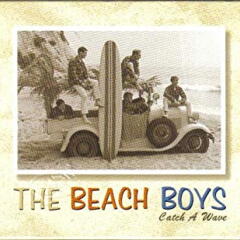
About the song
“Catch a Wave” was written by Brian Wilson and Mike Love, and appears as the second cut on the Beach Boys’ third album, Surfer Girl. The song was recorded at Western Studios in Los Angeles in July 1963, and released in September of the same year. Surfer Girl is the first album on which Beach Boy Brian Wilson was given full production credit — he maintained the producer's role for the band for a few more years, and many hit records.
An interesting side note about “Catch a Wave” is that Beach Boy friends Jan & Dean had Brian Wilson rework the song with new lyrics by Roger Christian. They released it as the Jan & Dean single “Sidewalk Surfin’,” which went to #25 on the Billboard Hot 100 chart in October 1964.
The Surfer Girl LP went to #7 on the Billboard Top 200 Albums chart. The album cover photo is an outtake from the Beach Boys’ first album, with the boys holding the same surfboard and wearing the same Pendleton shirts and wheat jeans, minus the tiki-trimmed Ford Model A pickup truck. Personnel on the record were: Brian Wilson (lead and harmony vocals, bass, piano, organ, and hand claps), Carl Wilson (lead guitar, harmony vocals, and hand claps), Dennis Wilson (drums, lead and harmony vocals, and hand claps), Mike Love (lead and harmony vocals, saxophone, and hand claps), Al Jardine (harmony vocals, bass, and hand claps), David Marks (rhythm guitar, and hand claps), and Maureen Love (harp).
The Beach Boys are an American rock band formed in Hawthorne, CA, in 1961. They have released 29 studio albums and nine archival albums. The band has sold over 100 million records worldwide to date, and has won two Grammy Awards; three of their songs are in the Grammy Hall of Fame. The Beach Boys were inducted into the Rock and Roll Hall of Fame in 1988. Brian Wilson still records and tours to this date. Mike Love fronts a touring version of the Beach Boys that is currently touring the U.S.