The small town of Cushing, OK, occupies a central place in the U.S. crude oil market thanks to its hundreds of storage tanks and numerous pipeline connections. And while it might seem far removed from the factors that influence the global crude market, what happens elsewhere directly impacts the storage volumes at Cushing. In today’s RBN blog, we review the critical role that Cushing plays in crude oil storage, show how the forward curve can influence inventories, and look at what might be behind the recent uptick in storage levels, which followed a four-month slide.
To truly understand Cushing — what it does and how it works — you need to know the hub’s assets and how they fit together. RBN’s Cushing Crude Oil Playbook provides the first one-stop, comprehensive guide to the hub’s assets.
Cushing — the “Pipeline Crossroads of the World” — is never far from our hearts and minds here at RBN. A popular topic in the RBN blogosphere, Cushing is connected to several inbound pipelines from Western Canada, the Bakken, the Niobrara, the Permian and SCOOP/STACK, and is also linked to outbound pipes that deliver to inland refineries and Gulf Coast refineries and export terminals. The Oklahoma hub is also the delivery point for the CME/NYMEX futures contract for West Texas Intermediate (WTI) — one of the most widely and actively traded physical commodity futures contracts in the world and the benchmark underpinning most physical U.S. crude oil purchase and sales contracts.
Cushing is home to the nation’s largest commercial crude tank farm, with more than 350 aboveground tanks all sited within 10 miles (shaded areas in Figure 1 inset below), according to the Energy Information Administration (EIA). Producers, midstreamers and refiners use Cushing for operational purposes — that is, as a sort of waystation where crude can be received, blended to meet refinery specifications, and sent out when needed to refineries and export terminals. Those companies and marketers also use storage at the hub for commercial operations to take advantage of market opportunities around the timing, volume or quality of crude supplied from producers to refiners.
(RBN’s Cushing Crude Oil Playbook provides the first one-stop, comprehensive guide to the hub’s assets and details the infrastructure each company controls with maps and comparable attribute tables. It also lists each company’s connectivity — upstream and downstream — and dives into each pipeline’s history and specifications. It has been recently updated with M&A activity, along with current storage capacities and pipeline connectivity at the individual terminals. For more information on what’s included in the Playbook package, click here.)
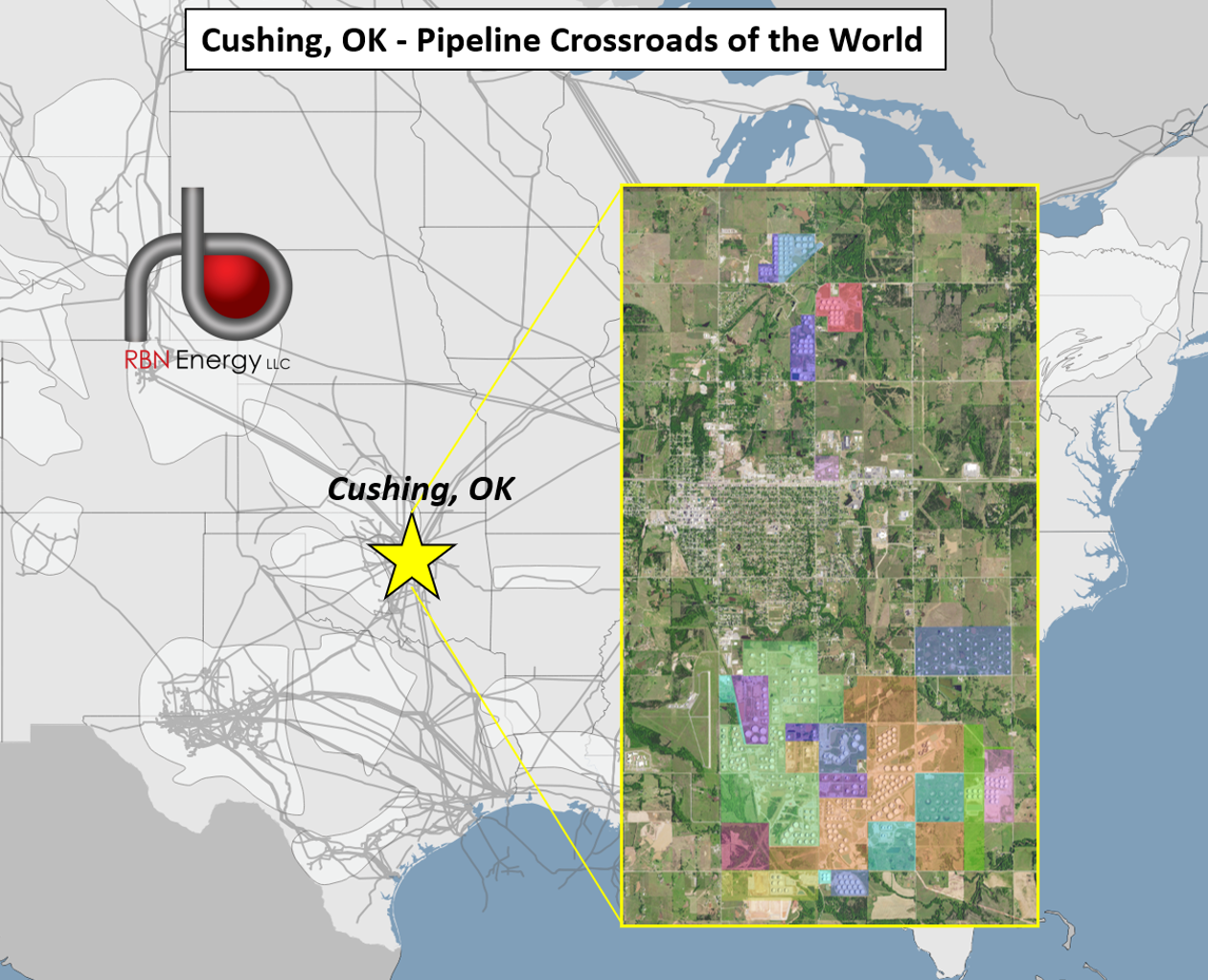
Figure 1. The Cushing, OK, Storage Hub. Source: RBN Note: Shaded areas represent sections with crude oil storage
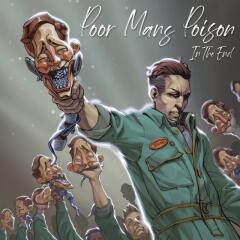
About the song
“Give and Take” was written by Ryan Hakker, Michael Jacobs, Dustin Medeiros and Tommy McCarthy. It appears as the third song on Poor Man’s Poison’s 2021 EP. There are many threads on social media as to whether the lyrics of revolution in the song lean to the right or left of the political spectrum. The band remains centrist and silent on the politics of the song. Personnel on the record were: Ryan Hakker (lead, backing vocals, guitar), Michael Jacobs (guitar, backing vocals), Dustin Medeiros (bass, backing vocals), and Tommy McCarthy (mandolin, backing vocals).
In the End is an EP recorded in Hanford, CA, and released in August 2021. It contains five songs: “In the End,” “Good People,” “Give and Take,” “Stronger Than the Whiskey,” and “The Struggle.”
Poor Man’s Poison was formed in 2009 in Hanford, CA, by longtime friends Ryan Hakker, Dustin Medeiros, Michael Jacobs and Tommy McCarthy. Hanford is a town of 60,000 people located in California’s San Joaquin Valley. The band’s sound is focused on organic acoustic music that could have been written and recorded on the front porch. Their songs fuse a blend of folk, country, Americana, pop, and gypsy jazz. The band members have known each other since middle school, with three of the members previously playing together in the rock band Done for Good. They released three studio albums and one live album in 2009-14 before taking a hiatus. They got back together again in 2019 with a focus on releasing individual songs on streaming platforms. Since that time they have released two EPs and five singles. All four members of Poor Man's Poison have day jobs outside of their music careers. Hakker is a plumber, Medeiros is a registered nurse, Jacobs is part-owner of a wedding venue, and McCarthy works with his brother’s earth-moving business. The band has a huge presence on social media and is focusing on writing and recording new material at this time.