Appetite for new North American LNG export capacity had been waning already when COVID-19 brought it to a screeching halt. The global gas market was expected to be well-oversupplied through the mid-2020s as U.S. liquefaction capacity additions, combined with supply growth from Australian LNG projects, were far outpacing any increase in demand. However, the past year or so has proven how quickly things can swing from oversupplied to undersupplied. The extended run of high global gas prices is bringing renewed interest in expanding North American LNG export capacity. Although COVID dashed the prospects of many LNG projects, a handful have emerged from the morass of the past year stronger and with a clearer path to FID than ever before. Those that remain will be better positioned if they can navigate four emerging trends that are key for offtaker agreements in the post-COVID era: shorter contract terms, increased pricing or deal-structure diversity, reduced environmental impact, and a prioritization of brownfield expansions or phased greenfield projects. Today, we conclude the series on the status of the second wave of LNG projects.
So far in this series, we have focused on the eight LNG projects under development that we believe have the most likely shot at reaching an eventual final investment decision (FID). In Part 1, we focused on the two projects that we categorize as “probable” (i.e., likely to reach FID this year): Woodfibre LNG and Cameron LNG Phase 2. Woodfibre has more than 70% of its capacity secured in firm long-term sales and purchase agreements (SPAs) with BP, while Cameron has credible, non-binding agreements equivalent to the full capacity of the expansion with the terminal’s existing offtakers: TotalEnergies, Mitsui, and Mitsubishi. Due to their strong commercial position, both of these projects could realistically take FID in the next six months. In Part 2, we rounded up the other six projects that have demonstrated momentum toward an FID — perhaps not in the next six months but in the mid-term. We categorize these facilities as “Tier 1” and “Tier 2” based on how far they are into their development, particularly on commercial agreements. These have the needed regulatory approvals in hand, along with reasonable access to feedgas supply, which are the two other metrics we use to grade prospective LNG projects in our LNG Voyager Quarterly supplement. Specifically, there are four projects we place as Tier 1: Cheniere Energy’s Corpus Christi Stage III expansion, Sempra Energy’s Port Arthur LNG, Freeport LNG’s Train 4 buildout, and Tellurian’s Driftwood LNG. And then, there are two projects we consider Tier 2: Venture Global’s Plaquemines LNG and NextDecade’s Rio Grande LNG.
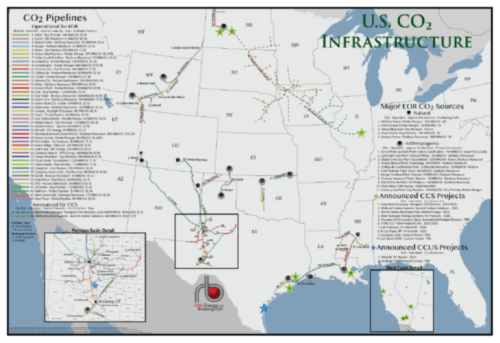
RBN Energy’s US CO₂ Infrastructure map brings together legacy Enhanced Oil Recovery (EOR) assets, as well as announced large-scale Carbon Capture and Sequestration (CCS) and Carbon Capture, Utilization and Sequestration (CCUS) projects, all in our signature concise, accurate, and intelligible style.
All eight projects, along with Sempra’s recently green-lighted Energía Costa Azul (ECA) LNG, have something in common: just about all of them have had to adapt their strategy to better compete for commercial commitments or SPAs with ever-pickier offtakers. Their forward momentum highlights the four main project features we named earlier that developers are offering as they strive toward FID: shorter contract terms, increased pricing or deal-structure diversity, reduced environmental impact, and a prioritization of brownfield expansions or phased greenfield projects that are scaling down the capacity for initial start-up. The projects we’re discussing today have homed in on at least one of these facets as part of their overall strategy to achieve FID, but most capitalize on multiple angles in order to make themselves look as attractive as possible to offtakers. The table in Figure 1 summarizes the ways in which they have incorporated the four metrics. A filled-in green circle indicates that the developers are very committed to that particular strategy, while an unfilled circle indicates that there has been at least some progress in that aspect. An empty cell means either that there has been no development or that no information has been provided publicly regarding that strategy. It is likely that most projects are exploring all four strategies but have not announced anything firm yet. While some developers share the structure of their offtake agreements others do not, so we simply don’t know what we don’t know here. Additionally, many of these projects had offtake agreements in place before the pandemic, and it’s likely that any new offtake agreements will look different than the original deals already made. That has certainly been the case for Driftwood LNG, which was selling equity stakes in the project before the pandemic and is now selling 10-year SPAs indexed to global gas prices. Below, we’ll dive into each of the strategies, specifically highlighting examples of how they’re being utilized by project developers.
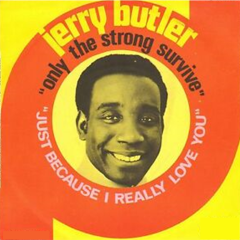
About the song
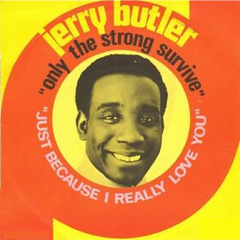
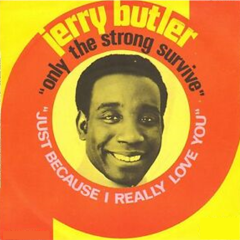
“Only the Strong Survive” was written by Jerry Butler, Kenny Gamble and Leon Huff. It was the third song on Butler’s 11th studio album, The Ice Man Cometh. It was released as a single in March 1969 and went to #1 on the Hot R&B Singles chart and #4 on the Billboard Hot 100 Singles chart. It was the most successful single of Butler’s career and it has been certified Gold by the Recording Industry Association of America. Artists such as Elvis Presley, Skeeter Davis, Billy Paul, and The Trammps have covered the song. Personnel on the record were: Jerry Butler (lead vocals), Curtis Mayfield (lead guitar), Norman Harris, Bobby Eli (guitar), Ronnie Baker (bass), Earl Young (drums), Leon Huff (piano) and Vince Montana (vibes).
The Ice Man Cometh was recorded between September 1967 and September 1968 at Bell Sound Studio in New York City and Cameo-Parkway Studios and Sigma Sound Studio in Philadelphia. Kenny Gamble and Leon Huff produced the record. Released in November 1968, it went to #2 on the R&B Album chart and #29 on the Billboard Top 200 Albums chart. Three singles were released from the album.
Jerry Butler is an American soul singer, songwriter, record producer, musician and retired politician. He was the original lead vocalist for The Impressions and was inducted with the R&B group into the Rock and Roll Hall of Fame in 1991. Since leaving the group in 1960 to pursue the career of a solo artist, Butler has had over 50 charting Billboard hits. He was inducted into the Rhythm and Blues Hall of Fame in 2015. From 1985 to 2018, he served as a commissioner for Cook County, Illinois. He has released 34 studio albums and 75 singles as a solo artist. Butler, 84, is now retired and lives in Chicago.